FOR PARENTS · EVERYDAY CONFIDENCE
Helping Your Child Adjust to Glasses & Contacts
Find calm words when a child refuses glasses. Check comfort, listen to worries, plan for teasing and agree on a school-day routine together.Check why the glasses feel difficult ↓
“What feels hardest about wearing them?” Find out whether it is comfort, appearance, or friends. Use the examples below to start talking.
On this page
01 / TRY THESE WORDS
What to say when your child resists glasses or contacts
Try these conversation starters and adapt them to your child’s age. Begin with the worry they bring up.
| If your child says | You could say | Next step |
|---|---|---|
| “I look different.” | “It can feel strange to see a new look. What would help you feel more like yourself?” | Let them choose among suitable frames and colors. |
| “They bother me.” | “Show me where or when it happens. We can ask for help with that.” | Arrange a fit check instead of guessing or bending the frames. [2] |
| “Someone will laugh.” | “What do you think they might say? Let’s decide who can help if that happens.” | Name a trusted adult and practice a brief response. [5] |
| “I want contacts.” | “We can ask about them. Let’s find out what the care routine would involve.” | Discuss suitability and training with the eye doctor. [3] |
Offer a real choice where one is available. A child can choose the case, help pick a reminder, or decide how to tell a friend. The prescribed wear schedule is a question for the eye-care team, rather than a bargaining tool. Confirm whether the glasses are needed throughout the day or for certain activities. [1]
You do not have to make your child love glasses immediately. Learning that the nose pads hurt or that Monday’s class photo worries them gives you something specific to address.
02 / UNDERSTAND THE CONCERN
Start with what feels difficult
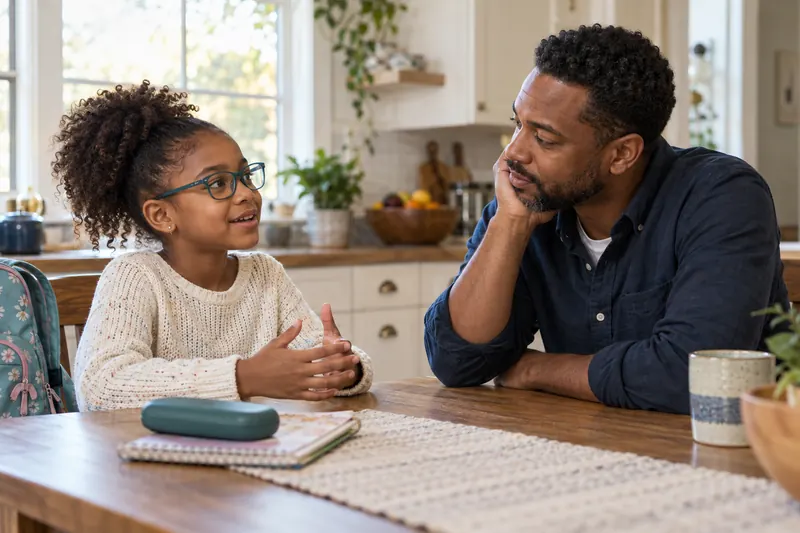
Your child may understand that glasses help them see and still feel unsure about wearing them. If they have little to say, leave some space. You can return to the conversation later while walking home or packing the school bag.
Try not to guess the reason for hesitation. “I don’t like them” could mean the frames slip, the school day feels awkward, or a friend made a comment. Ask, “Is it how they feel, how they look, or something else?” Let your child use their own words.
“These glasses are here to help you see. Tell me what feels new or difficult, and we will work out the next step together.”
Keep the explanation connected to your child’s day. You might talk about seeing the board, recognizing someone across the playground, or watching a game. Ask what they notice with their new correction. Keep the focus on what matters to them.
If your child has myopia, keep two ideas separate: correcting blur helps them see clearly; myopia control aims to slow progression. Ordinary glasses or contacts are not automatically myopia-control treatments. Ask the eye doctor what the prescribed option is meant to do. [6]
03 / CHECK COMFORT
If your child won’t wear glasses, check the fit
Discomfort deserves attention. Well-fitting glasses should sit securely and comfortably. If the frames slide, pinch, press against the cheeks, or touch the eyelashes, ask an optician to check them. Avoid adjusting bent frames yourself. [2]
Ask where
Let your child point to the place that bothers them.
Notice when
Is it while reading, looking across the room, or moving around?
Bring that detail
Tell the optician or eye doctor what your child noticed.
An older child may prefer to explain the problem to the optician directly. Bring their case and note when the discomfort happens, so the visit starts with useful details.
Some children need time to adapt. If resistance continues or your child has trouble seeing through the glasses, contact the eye-care practice rather than assuming it is a behavior problem. The doctor can decide whether the prescription or another issue needs attention. [1]
Keep encouragement specific and low-key: “Thanks for telling me the frame was slipping.” This makes it easier to discuss the next concern. Avoid comparing siblings or turning a missed reminder into a judgment about how responsible your child is.
04 / HELP THEM JOIN IN
Plan for school, friends, and teasing

Ask what your child wants the teacher to know. A brief, practical message might explain the prescribed wear plan, where the case will be kept, and whom to contact if the glasses are damaged. There is usually no need for a class announcement about your child’s eyes.
Give your child a simple way to ask for help: “My glasses keep slipping,” or “I can’t find my case.” Choose a named adult they can approach. Ask them which part of the day feels least straightforward, such as changing for PE or putting a bag away.
If teasing happens, listen before planning a response. Help your child identify a trusted adult, practice a short reply if it feels safe, and move away from the situation. Repeated or threatening behavior needs adult and school support; your child should not have to manage it alone. [5]
“They help me see.”
Your child can keep it brief, walk away, and ask for help. They do not owe classmates a medical explanation.
For a school conversation, keep a factual note of what your child reports, who was involved, and what help you are requesting. Ask when you and the teacher will check in again. Try not to make your child repeat the same upsetting account to every adult.
For PE and sports, ask the eye-care team about suitable eye protection. Everyday glasses and contact lenses do not replace protective sports eyewear. Ask separately about swimming; contact lenses should be removed before entering the water. [1][3][4]
05 / TALK ABOUT READINESS
When can kids wear contacts?
Some children can start wearing contacts as young as age 8, but age alone does not establish readiness. This is not a universal minimum age for every lens. The American Academy of Pediatrics describes readiness in terms of learning skills, following directions, and handling lens care. Your child also needs an eye-care assessment, a prescription, fitting, and training. [3][8]
Ask your child what they expect contacts to change. Is it a sport, how they look, or a problem with their glasses? Keep that answer in the discussion. Presenting contacts as a prize for putting up with glasses can distract from whether the routine is suitable.
Have the practice demonstrate the actual tasks: washing and drying hands, putting lenses in, taking them out, and following the lens-specific care and wear schedule. Ask what adult supervision is needed. A willingness to report a problem matters as much as willingness to try a lens. [4]
Keep lenses away from water, never share them, and never clean them with saliva. Use the prescribed care products. Do not sleep in them unless they are specifically prescribed for that use. Carry backup glasses. [3][4]
Overnight orthokeratology, or Ortho-K, is a separate prescribed routine. The American Academy of Orthokeratology and Myopia Control (AAOMC) offers patient resources explaining it. Ask the prescriber about care, risks, and follow-up rather than applying daytime-lens instructions to overnight treatment. [7]
A painful, red, irritated, or suddenly blurry eye is a reason to stop lens wear and contact the eye-care professional promptly. Do not encourage a child to push through a problem to finish the school day. [3]
06 / MAKE IT PRACTICAL
Agree on a school-day plan together
Start with the day your family actually has. Where will the case go? Who checks the school bag? What happens if a lens is lost or glasses are damaged? A plan that names the next action is easier to explain than “Be more careful.”
Choose one reminder with your child rather than adding several at once. It could be a note beside the school bag or a check when shoes go on. Ask whether the reminder feels helpful or like nagging, then adjust how you give it.
Open the school-day checklist- 1
Before leaving
Follow the prescribed wear plan. Check the case and any backup supplies.
- 2
During the day
Know where supplies belong and which adult can help.
- 3
Back at home
Ask what worked, note any problem, and prepare for tomorrow.
Before the first school morning, ask your child to show you where the case belongs and name the adult they would go to. Listen for a missing step. Fill in that gap together rather than testing how much of the conversation they can repeat.
Divide the jobs clearly. Your child might put the case in their bag while you keep track of replacement supplies. If a step keeps getting missed, change that part of the routine instead of restarting the whole plan.
07 / COMMON QUESTIONS
Questions parents often ask
Will wearing glasses make my child’s eyes weaker?
No. Prescribed glasses do not weaken the eyes or create dependence. Follow the eye doctor’s advice about when they should be worn. [1]
Should I promise they can switch to contacts later?
You can promise to discuss the options. Suitability depends on the eye-care assessment and the routine, so avoid promising a particular lens or starting date. [3]
What if my child keeps losing their glasses?
Ask them to walk you through the last time it happened. Choose one place for the case and one moment to check for it. Ask the optician about fit or storage if those are part of the problem.
The next step can be small: listen to one worry, solve one practical problem, and make sure your child knows who will help.
08 / CHECK THE EVIDENCE
Sources & references
Clinical guidance and parent resources. Checked October 21, 2026.
- 1Glasses for ChildrenAAPOS
- 2Glasses Fitting for ChildrenAAPOS
- 3What To Know If Your Child Wants Contact LensesU.S. Food and Drug Administration
- 4Preventing Eye Infections When Wearing ContactsCenters for Disease Control and Prevention
- 5How to Prevent BullyingStopBullying.gov
- 6Myopia Correction, Myopia Control and Myopia Management: Definitions and Recommended UsageInternational Myopia Institute · 2025
- 7Patient Resources: Myopia and OrthokeratologyAmerican Academy of Orthokeratology and Myopia Control (AAOMC)
- 8Contact Lenses for Kids: What to ConsiderAmerican Academy of Pediatrics · HealthyChildren.org
This guide offers general education and suggested conversation starters. It does not replace an eye examination, individual advice, or the prescribed care plan.