THE ACTIVE CHILD FIELD GUIDE
Myopia and Sports: See Clearly, Play Safely
Plan clear vision and eye protection for your child’s sport. Compare equipment, discuss contact lenses and prepare a coach and swimming plan.Match eye protection to the sport ↓
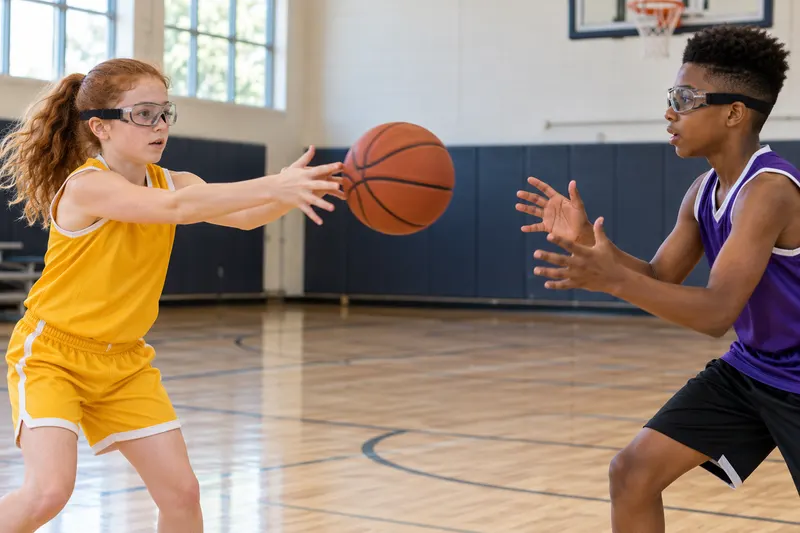
Children with myopia can often take part in sports with the right plan. Clear vision and impact protection are separate needs: ordinary glasses and contact lenses do not replace sport-appropriate protective eyewear. Remove contacts before swimming or showering.
On this page
See the game
Use the correction prescribed for your child.
Protect the eyes
Match protective equipment to the sport. [1]
Make two plans: seeing and protection
A child needs to see the ball, other players, and the space around them. They also need protection against the hazards of the sport. Those needs can overlap in one fitted product, but they are not automatically met by the same equipment.
Ordinary glasses and contact lenses do not provide adequate sports eye protection. Depending on the activity, a child may need sport-specific goggles, a certified face shield, or protection integrated with a helmet. Prescription options can sometimes combine clear vision and protection. [1]
Tell the eye-care team which sport your child plays, their position, and the equipment they use. “They do sport” is less helpful than “They play goalkeeper and wear this helmet.” Bring the equipment or clear details so the fit can be checked together.
Ball or racket sport
Vision: Can the child see clearly while moving?
Protection: Is the eyewear designed for that sport's impact risks?
Helmet sport
Vision: Does correction fit without pressure or slipping?
Protection: Does the complete helmet and shield system meet the sport's requirements?
Swimming
Vision: What correction works without contact lenses?
Protection: Are suitable swim goggles fitted correctly?
Outdoor activity
Vision: Can the child see the route and hazards?
Protection: What eye and sun protection is appropriate?
Choose equipment for the actual sport
Sports protection should be chosen for the activity, not only for a sporty appearance. Ask the optician or eye-care professional about the relevant sport-specific standard, lens material, frame, and fit. Check the league's rules too, since required equipment differs between sports and organizations. [1]
A retention strap on everyday glasses does not convert them into certified protective goggles. Similarly, an ordinary pair of sunglasses should not be assumed to protect against a fast ball. Product descriptions such as “durable” or “active” are not a substitute for the relevant safety specification.
Let your child try the equipment with the gear they actually wear. A helmet can change where a frame sits, and a strap may rub when a child turns their head. Ask them to look up, down, and side to side. The goal is a secure fit without pressure that encourages them to remove it.
Check the equipment again as the child grows or changes teams. Follow the manufacturer's replacement instructions and ask for assessment if the frame or lenses are damaged. Avoid home repairs that change the fit or protective structure.
An older child can help explain what happens during a drill. Listen when they say goggles slip or fog, then ask the fitter about suitable solutions. A safety rule is easier to follow when the equipment is usable through the whole session.
Understand where contact lenses fit
Contact lenses can be a useful correction option for some children. They need a prescription, fitting, handling instruction, and appropriate supervision. A child's age, preferences, eye health, and ability to follow the care routine all belong in that decision. [3]
Contacts still need protective eyewear over them for sports with an eye-injury risk. They do not shield the eye from fingers, balls, rackets, or impact. Choose protection even when the child no longer needs a prescription in the protective lenses. [1]
Keep lens handling away from the sideline when clean, dry facilities are unavailable. Plan where a child can remove a problem lens safely and how they will see afterward. A backup pair of glasses should be accessible, with a suitable sports alternative if needed to continue playing.
Do not lend or share lenses, clean them with saliva, or let a child keep a painful lens in until the end of a match. Remove lenses and seek prompt advice for pain, redness, unexpected blur, or light sensitivity. The treating practice should provide the specific urgent contact route. [5]
Ortho-K is a separate overnight treatment routine. It may reduce the need for daytime correction, but it does not create an impact-resistant eye. Ask the prescriber what daytime vision and backup plan to expect, then choose the sport's protection independently. [3][1]
Make a water-safe swimming plan
Remove contact lenses before swimming, showering, or other water activities. Water can contain organisms that cause serious eye infections. Wearing ordinary goggles over contacts does not make the combination risk-free, because water can still enter. [2]
Ask about prescription swimming goggles if your child needs correction to see the instructor, pool edge, or other swimmers. Let them test the fit before a lesson. A child who cannot see well should not be expected to navigate a busy pool by memory.
Plan three practical details before the lesson:
- Glasses: choose a safe place to leave them and an easy way to find them afterward.
- Help: agree who supports a younger child between changing room and pool.
- Communication: ask the instructor for visible cues your child can follow.
If lenses are accidentally exposed to water, follow the lens-specific advice from the prescriber and CDC. Remove them as soon as possible. A single-use lens is discarded; reusable lenses require the appropriate cleaning and disinfection before any reuse. Seek prompt assessment for symptoms rather than assuming chlorine made the eye safe. [2]
Ask about water activities in advance of camps and trips. A plan made at home is easier to follow than a decision made beside the pool with no alternative correction available.
Rehearse before match day
Try new protective equipment during a practice session before relying on it in competition. Ask the coach for time to check that the child can see, turn their head, and communicate comfortably. This is a practical rehearsal, not a reason to relax protection during a match.
Pack the same small kit each time: the fitted protection, an appropriate case, backup vision correction, and the supplies the prescriber recommends. Keep it somewhere an adult can reach. A case left in a locked car is not much use when a lens problem happens mid-session.
Ask the child to name their first action if vision becomes blurry or equipment is damaged. A useful answer might be, “Stop, tell the coach, and get my backup plan.” Make clear that they should not keep playing when they cannot see safely.
Include the adult's responsibility too. A parent or coach may need to help contact the eye-care practice, arrange assessment, or retrieve the backup correction. A child should not have to negotiate medical care while everyone is focused on finishing a game.
Give the coach a short, practical handoff
Ask your child what they want the coach to know. Usually the essentials are the required protective equipment, how to recognize that help is needed, where the backup correction is, and whom to contact. A team announcement about the child's eyes is rarely necessary.
If a rule or fitting problem prevents participation, ask the eye-care professional and sports organization to clarify a suitable option. Do not remove protection to solve the problem informally. The correct choice may depend on the sport, the child's vision, and the equipment standard.
A child with very high myopia, previous eye surgery, or reduced vision in one eye needs an individualized discussion about risk and activities. General encouragement to be active does not replace that assessment. Some sports may require special restrictions or precautions. [1]
The American Academy of Orthokeratology and Myopia Control (AAOMC) has patient resources on myopia and Ortho-K. Use those for treatment questions; ask the eye-care team separately about sport-specific protection. Slowing myopia progression and preventing a sports injury are different tasks. [6]
Your sports-day checklist
Use these prompts with your child and eye-care team. Check marks stay only on this open page. Nothing is submitted or saved.
Know when a sports eye injury needs help
After an eye injury, arrange prompt professional assessment. Pain, reduced vision, light sensitivity, or a visibly injured eye should not be treated as something to play through. Some serious injuries are less obvious at first than a bruise around the eye. [4][1]
Do not rub or press on an injured eye. If an object appears embedded, do not try to pull it out. Seek emergency care and follow the emergency team's directions. Keep the child out of play until the injury has been assessed and return advice is clear. [4]
Before the season begins, save the practice's urgent number and identify an accessible emergency service. You are preparing a response, not expecting an injury. Knowing the route in advance helps adults act without asking the child to decide how serious the problem is.
Questions parents ask
Does myopia mean my child should avoid sports?
Many children can participate with suitable vision correction and protection. Ask for individual advice when there is high myopia, previous surgery, or another eye condition. The right plan depends on the child and the sport. [1]
Can a glasses strap replace sports goggles?
No. A strap may help keep frames in place, but it does not establish impact protection. Choose equipment designed and fitted for the sport. [1]
Does outdoor sport replace myopia-control treatment?
Keep the prescribed treatment and monitoring plan. Discuss activity and protection with the clinician rather than assuming that playing outside removes the need for care.
CHECK THE EVIDENCE
Sources & references
Primary research, guidance, and patient resources. Checked October 21, 2026.
- 1Does my child need eye protection for sports?American Academy of Pediatrics · HealthyChildren.org
- 2Keeping water away from contact lensesCenters for Disease Control and Prevention
- 3What to know if your child wants contact lensesU.S. Food and Drug Administration
- 4Eye injury and safetyAAPOS
- 5Preventing eye infections when wearing contactsCenters for Disease Control and Prevention
- 6Patient resourcesAmerican Academy of Orthokeratology and Myopia Control (AAOMC)
General education. This article does not replace an eye examination, individual advice, or the prescribed care plan.