A THREE-STUDY RESEARCH DIGEST
2024 Myopia Research: What the Findings Mean for Families
Read a clearly dated 2024 myopia research digest. Separate study findings, later developments and practical questions for your child’s care team.See the later developments separately ↓
The 2024 evidence strengthened several discussions rather than establishing one universal treatment. Long-term atropine follow-up, a trial in children with intermittent exotropia, and an outdoor-time review addressed different questions. Read each within its own population and study design.
On this page
Read this as a 2024 research digest
This page looks back at three research developments published in 2024. It is a historical guide, checked again in October 2026. It does not present the 2024 papers as the newest evidence on every treatment. Later context is separated below so that a family can tell what was known in the year being discussed and what happened afterward.
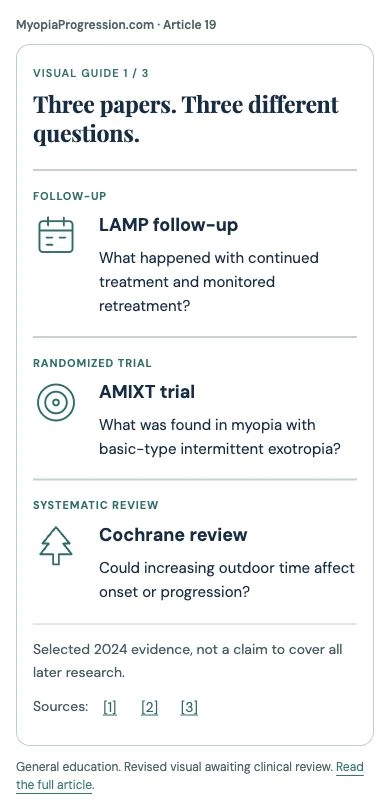
VISUAL GUIDE 1 / 3
Three papers. Three different questions.
The three questions are different: What happened during longer follow-up of low-concentration atropine? What did a trial find in children who had both myopia and a particular type of eye turn? What did a review of outdoor-time interventions conclude? None can be reduced to a single headline saying that myopia has been solved.
A study can change the questions a family brings to an appointment without changing every child's prescription. Before applying a result, ask who was studied, what was compared, how long follow-up lasted, and which outcome was measured. Those four details make a research headline much easier to assess.
Finding one: longer follow-up changes the atropine conversation
The five-year LAMP report, published in 2024, extended understanding beyond the first years of treatment. Earlier LAMP work had compared low atropine concentrations. The later follow-up examined continued treatment and a monitored retreatment approach under the study's particular protocol. [1]
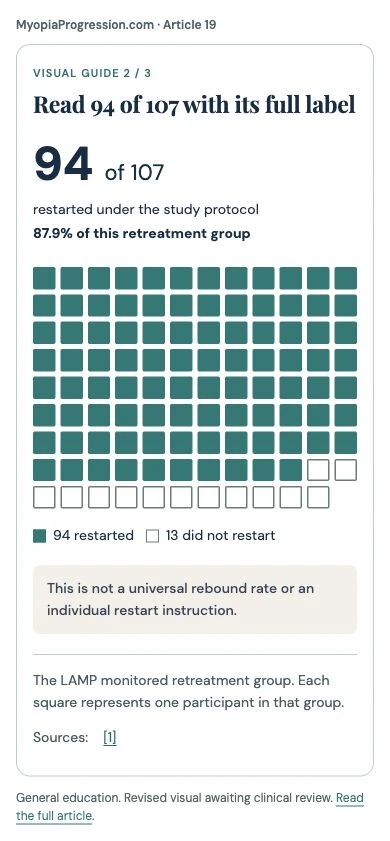
In the as-needed retreatment group, 94 of 107 children, or 87.9%, restarted atropine. That number is often striking to parents. It needs its full sentence: these were children in a particular study group, followed under specified rules. It is not the chance that every child using any atropine product will need to restart. [1]
VISUAL GUIDE 2 / 3
Read 94 of 107 with its full label
87.9% of this retreatment group
This is not a universal rebound rate or an individual restart instruction.
The paper's retreatment threshold was part of its research design. It should not become a home instruction for changing a child's drops. The study also involved a specific population and concentrations. Other formulations, ages, or stopping approaches may have different evidence.
What a parent can take to the appointment
Ask the prescriber what follow-up would be arranged if treatment were changed or stopped. Which measurements would be compared? When would the next examination happen? What would prompt a review of the plan? These are practical questions that the longer follow-up supports asking. It does not supply an individual taper schedule.
Do not confuse returning blur with measured progression. Drops do not replace glasses for clear distance vision, and a stopping discussion still needs a vision-correction plan. If someone quotes the LAMP percentage, ask them to name the group and the retreatment rule rather than applying it as a universal warning.
Finding two: a trial addressed a specific eye-alignment concern
The 2024 AMIXT randomized trial studied children with myopia and basic-type intermittent exotropia. Intermittent exotropia is a type of outward eye deviation that occurs some of the time. The trial enrolled children aged six to twelve and compared 0.01% atropine with placebo over one year. [2]
The researchers assessed myopia progression as well as findings related to eye alignment and binocular vision. The report supported slowing of myopia progression in that studied group. It also considered the effects of atropine on accommodation, the eye's ability to adjust focus for near work. [2]
The important boundary is the population. A result in children with one defined form of intermittent exotropia is not a blanket safety statement about every eye turn, every concentration, or every child with a binocular-vision concern. A child with double vision, an eye turn, or a known alignment diagnosis needs the relevant examination and advice.
What makes this more useful than a broad headline
A parent can ask, “Does my child's alignment condition resemble the condition studied, and which findings would you monitor?” That is more precise than asking whether atropine is safe for all children whose eyes sometimes turn. Bring the existing diagnosis if one has been made. Do not try to identify the type of eye turn from an online photograph.
The trial also shows why clear vision is not the only outcome to ask about. For some children, focusing comfort, alignment, and binocular vision need particular attention. A treatment conversation should account for the whole examination rather than reducing care to a myopia percentage.
Finding three: outdoor-time evidence is stronger for onset than progression
A Cochrane review published in June 2024 assessed interventions intended to increase time outdoors. It included five studies with 10,733 participants. The review found that increasing outdoor time may reduce the development of myopia. Evidence about slowing progression in children already myopic was less certain. [3]
That distinction changes the message. Preventing or delaying onset and slowing established myopia are different goals. An outdoor activity plan should not be promoted as a proven replacement for prescribed myopia-control care in a child who already has myopia.
The review combined research with particular settings and methods. It does not establish a magic outdoor schedule that guarantees prevention for every child. Families should also consider ordinary safety, weather, access, and the child's abilities rather than turning outdoor time into a competition.
A practical interpretation
Build enjoyable outdoor opportunities into a day where possible, and keep the child's examination and treatment plan in place. Ask the clinician how prevention advice relates to the child's actual status. A sibling who is not myopic and a child already receiving treatment may have different clinical questions, even if the family enjoys the same garden or walk.
The outdoor-time field guide separates those goals and explains one trial's absolute numbers. That is a more useful next step than repeating a claim that daylight alone cures myopia.
The headline test: four questions before sharing a result
Research summaries can travel much farther than the details behind them. Before sharing a screenshot, look for the original paper or a reliable review. If the summary does not identify the population, comparison, duration, and outcome, pause before treating it as a care instruction.
Who took part? A result from young children in one country may be relevant without being identical to the experience of an older teenager elsewhere. Specific conditions, such as intermittent exotropia in AMIXT, narrow the question further.
Compared with what? Placebo drops, single-vision glasses, another active treatment, and usual school routines are different comparators. A treatment can look different depending on the comparison. A percentage without that detail is incomplete.
For how long? One year of follow-up does not establish lifelong benefit or safety. Longer follow-up can answer new questions, while also losing participants over time. Ask how many of the original participants contributed to the later result.
Which outcome? A prescription change, eye-length change, and new myopia diagnoses measure different things. A study about preventing onset should not be retold as though it proved slower progression after diagnosis.
These questions are useful even when the result sounds encouraging. They help a parent recognize where a finding fits, rather than asking a single paper to answer every concern about treatment.
What changed after 2024
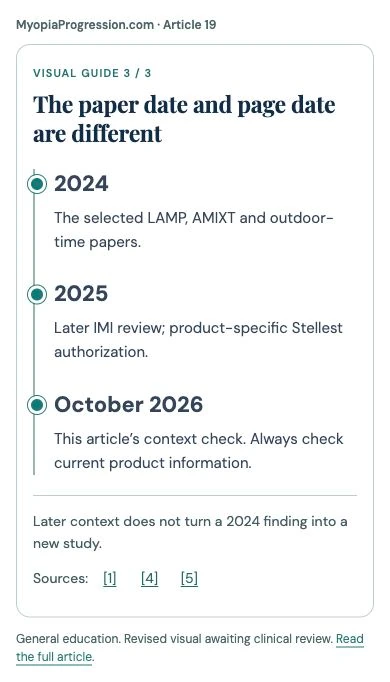
VISUAL GUIDE 3 / 3
The paper date and page date are different
- 2024The selected LAMP, AMIXT and outdoor-time papers.
- 2025Later IMI review; product-specific Stellest authorization.
- October 2026This article’s context check. Always check current product information.
The International Myopia Institute published a broader intervention review in 2025. It provides later context across methods and helps show why a 2024 digest should not be treated as a complete current comparison. Research decisions should be checked against the evolving evidence, not frozen at the year in a page title. [4]
U.S. regulatory developments also continued. In September 2025, the FDA authorized Stellest spectacle lenses for a defined pediatric indication. That event belongs to 2025, not the 2024 findings above. It is product-specific and does not authorize every spectacle design marketed for myopia control. [5]
As checked on October 21, 2026, an FDA advisory committee meeting was scheduled for October 30 concerning an application for atropine sulfate 0.01% ophthalmic solution. A scheduled advisory discussion is not an approval. The regulatory position needs checking again when a treatment is prescribed or this page is published. [6]
Later work can strengthen, qualify, or challenge earlier findings. This digest is a guide to reading selected 2024 papers, not a promise that those papers settle all questions about atropine, outdoor time, or future products.

Turn a paper into a useful care question
Bring one or two focused questions to the appointment rather than a stack of competing headlines. “Does this population resemble my child?” or “Would this change how we monitor stopping?” gives the clinician a clear issue to address. Ask them to explain when a study does not apply, as well as when it might.
Your research reading card
Discussion prompts only. Check marks stay on this open page; nothing is submitted or stored. This tool does not diagnose, choose a treatment, or set a dose.
Keep the article date and the paper date separate in your notes. A page updated in 2026 may discuss a trial from 2024. An older study may still matter, but the update date alone does not make its evidence new. If a recommendation depends on current product labeling, check that information separately.
The American Academy of Orthokeratology and Myopia Control (AAOMC) provides patient resources that can support these conversations. [7] They sit alongside primary papers and clinical guidance, rather than replacing the examination or implying endorsement of a particular claim.
The aim of following research is a clearer discussion about your child's care. A useful paper helps explain an option, an uncertainty, or a follow-up question. It does not require a family to change treatment on the strength of a headline.
CHECK THE EVIDENCE
Sources & references
Primary research, guidance, and patient resources. Checked October 21, 2026.
- 1Five-year LAMP trial: phase 4 reportZhang et al. · Ophthalmology · 2024
- 2AMIXT: atropine in children with myopia and intermittent exotropiaWang et al. · JAMA Ophthalmology · 2024
- 3Increasing outdoor time: prevention and progression reviewKido et al. · Cochrane · 2024
- 4Interventions for controlling myopia onset and progressionInternational Myopia Institute · 2025
- 5Stellest: De Novo authorization and exact starting indicationU.S. Food and Drug Administration · September 2025
- 6October 30 advisory committee: atropine 0.01% applicationU.S. Food and Drug Administration · October 2026
- 7Patient resourcesAmerican Academy of Orthokeratology and Myopia Control (AAOMC)
General education. This article does not replace an eye examination, individual advice, or the prescribed care plan.