AN OUTDOOR RESEARCH FIELD GUIDE
Outdoor Time and Myopia: What the Research Supports
Explore outdoor-time research with onset and progression kept separate. Read the school-trial results in context, then plan realistic outdoor habits.Read the school-trial chart in context ↓Make an outdoor-time plan →
More outdoor time can help reduce the chance that children develop myopia. Evidence for slowing progression after myopia has started is less certain. Build safe, enjoyable outdoor opportunities alongside regular eye care and any prescribed treatment; do not replace treatment with a time target.
On this page
Two questions that sound similar but are different
“Can outdoor time help prevent myopia?” and “Can outdoor time slow my child's existing myopia?” are different research questions. Keeping them separate is the most useful first step. Advice that makes sense for prevention should not be presented as a proven replacement for treatment after a child has become myopic.
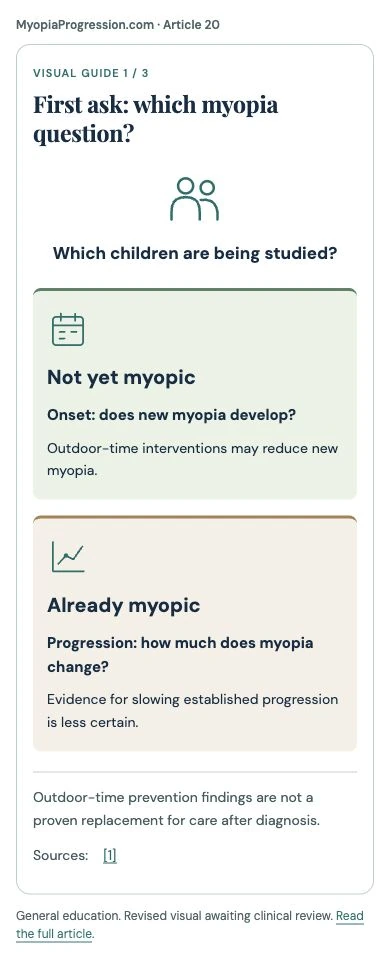
A 2024 Cochrane review examined interventions that increased time outdoors. Across five studies involving 10,733 participants, it found that outdoor-time interventions may reduce new myopia. The evidence for slowing progression in children already myopic was less certain. [1]
VISUAL GUIDE 1 / 3
First ask: which myopia question?
That is a reason to make outdoor opportunities part of family life, while keeping expectations honest. It is not a promise that a child who spends enough time outside will never need glasses. Nor does a diagnosis mean a parent failed to organize the right number of outdoor minutes.
If your child already has myopia, ask the eye-care team how outdoor habits fit alongside the prescribed plan. Continue the agreed examinations, vision correction, and treatment instructions. For a child who is not myopic, ask about risk and appropriate follow-up rather than assuming good outdoor habits remove the need for an eye examination. [4]
What one school trial actually found
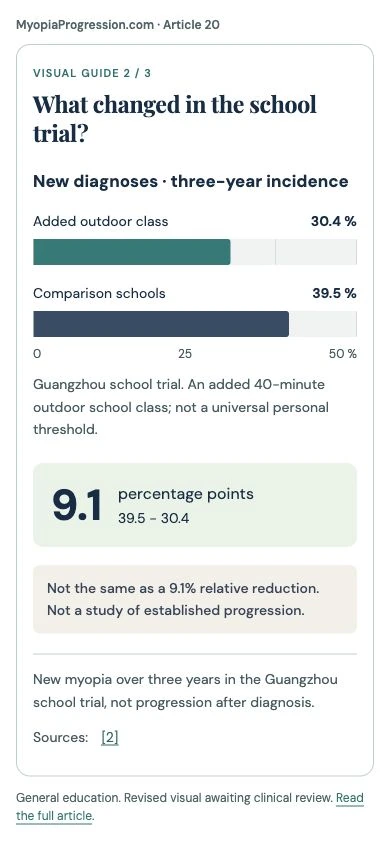
In a randomized school-based trial in Guangzhou, China, an additional forty-minute outdoor class was added to the school day. Over three years, new myopia developed in 30.4% of the intervention group and 39.5% of the comparison group among children in the study's onset analysis. The absolute difference was 9.1 percentage points. [2]
VISUAL GUIDE 2 / 3
What changed in the school trial?
New diagnoses · three-year incidence
Guangzhou school trial. An added 40-minute outdoor school class; not a universal personal threshold.
39.5 − 30.4
Not the same as a 9.1% relative reduction. Not a study of established progression.
A percentage-point difference is subtraction: 39.5 minus 30.4 equals 9.1. It is not the same as saying a 9.1% relative reduction. The numbers also describe new myopia in that trial, not the amount of eye growth prevented in every child who already wears glasses.
The setting matters. This was a structured school intervention with a particular population and follow-up period. The added class is not proof that precisely forty minutes is a universal threshold, or that another child can expect the same result from a different routine. It provides evidence that changing outdoor opportunities can matter.
When reading a social post about the study, look for those details. Does it say new myopia or existing progression? Does it mention three years? Does it identify the school intervention? A short claim that “outdoors cuts myopia” leaves too much room for misunderstanding.
Daylight is part of the question, not a reason to seek UV exposure
Researchers study how light and visual environments relate to eye growth. The International Myopia Institute's review discusses this complex evidence. It does not justify telling children to look at the sun or treating ultraviolet exposure as a medicine. [3]
Outdoor time can include shade and ordinary sun protection. Follow relevant health, weather, and safety advice for the child and location. A walk, a shaded playground, or a school garden can be part of an outdoor routine without seeking harsh midday exposure. Safety needs may change with heat, air quality, allergies, or a child's medical condition.
Do not buy an indoor lamp or shine a light toward the eyes on the assumption that it reproduces an outdoor intervention. A light-based medical treatment, an indoor desk lamp, and ordinary outdoor activity are different things. Evidence about one cannot be assigned automatically to another. [3]
Likewise, a bright window is not proof of an equivalent outdoor exposure. The practical message is to create suitable outdoor opportunities, not to invent a home light dose. Ask the clinician before using any device promoted as a myopia treatment.
Build the plan around an activity your child likes
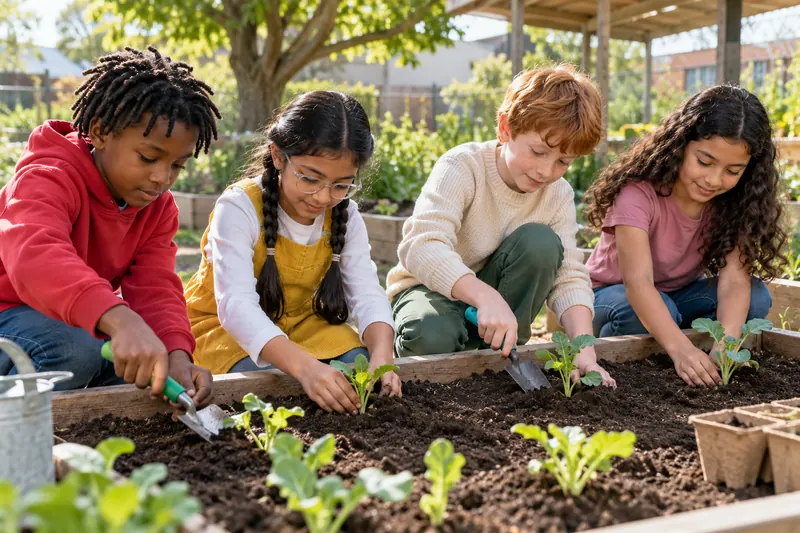
A plan that begins with enjoyment is easier to discuss than a daily argument over a timer. Ask what your child would choose: walking with a friend, a playground visit, gardening, an accessible nature path, or helping with an outdoor household task. The activity does not need to be competitive or expensive.
For a school-age child, identify a part of the day that already has a transition. There may be an outdoor pause after arriving home or a safe walk before an evening task. A short opportunity that happens regularly can be a starting point for a larger discussion with the family and care team. This article does not calculate an individualized treatment dose from minutes.
For a child with limited mobility or other access needs, begin with what is feasible and enjoyable. A suitable outdoor seating area, accessible school space, or supported activity may be more relevant than advice to join a sport. Avoid making the child responsible for barriers that adults or institutions need to address.
School and family plans can support one another. Ask what outdoor opportunities are available during recess or other parts of the school day. Do not assume a school will be able to deliver the exact intervention used in a research trial. A useful conversation asks what can realistically be improved within the school's circumstances.
Make a weather-flexible week, not a perfect streak
A routine needs alternatives. Rain, extreme heat, poor air quality, homework deadlines, and caregiver schedules can interrupt an outdoor plan. Missing a day does not mean the family has ruined the effort. Look at the next available opportunity rather than trying to make up time with an unsafe activity.
VISUAL GUIDE 3 / 3
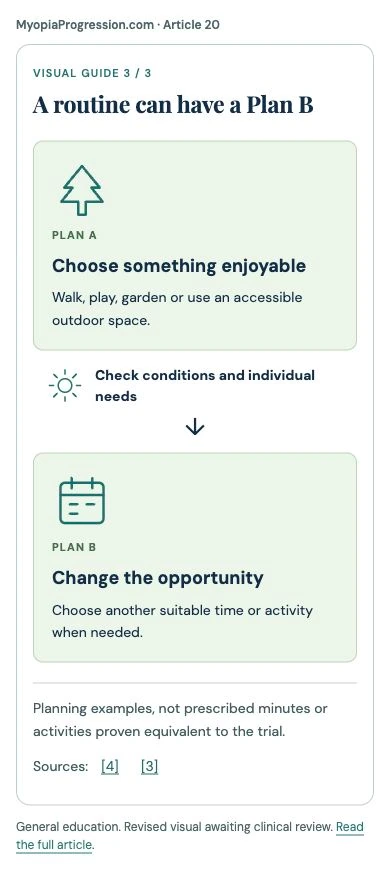
A routine can have a Plan B
Choose a primary opportunity, a feasible alternative, and a person responsible for checking conditions. For example, a family might plan an after-school walk and use a shaded weekend garden visit when the weekday is not workable. These are planning examples, not research-equivalent prescriptions.
Keep the child's own preferences visible. If the planned activity is always disliked, ask what could change. A child might prefer a friend, a different location, or a quieter setting. Building the habit together avoids framing outdoor time as punishment for wearing glasses or using a screen.
Three questions for the family calendar
Where can we go safely? Consider shade, supervision, accessibility, traffic, and local conditions. A nearby practical option may be more useful than a distant destination that rarely happens.
What activity will we actually do? Give the outing a purpose beyond “protect your eyes.” A game, conversation, garden task, or shared walk can make the plan part of ordinary life.
What changes the plan? Agree that heat, illness, air quality, or other safety concerns can alter the day. A flexible plan is not a failed plan.
Outdoor habits do not replace clear vision or follow-up
A child should use the vision correction and treatment plan prescribed by the eye-care team. Do not tell them to remove glasses outdoors to make the eyes work harder. Outdoor activity and adequate vision are compatible goals. Ask the practice about suitable protection and correction for the particular activity. [4]
For contact-lens wearers, activities involving water need a separate safety conversation. An outdoor outing does not override lens-care instructions. If swimming is planned, ask the eye-care team about appropriate vision options rather than assuming contact lenses should remain in the eyes.
Keep follow-up appointments even when the outdoor routine is going well. Progression and eye health cannot be judged solely from a family activity calendar. Conversely, a prescription change does not prove that outdoor opportunities were worthless. Prevention evidence, individual growth, and a treatment response are different questions.
Breaks from close work can be a useful practical habit, but do not treat a named break rule as a proven standalone progression-control treatment. Ask which parts of the plan are intended for comfort, which support general habits, and which have evidence for the child's myopia-management goal. [4][3]
Your outdoor opportunity plan
Discussion prompts only. Check marks stay on this open page; nothing is submitted or stored. This tool does not diagnose, choose a treatment, or set a dose.
Ask for advice that fits the child's actual situation
At the next appointment, say whether your question concerns a child who is not yet myopic, one newly diagnosed, or one already receiving treatment. Then describe the routine and barriers honestly. A useful recommendation should be understandable within that context.
The American Academy of Orthokeratology and Myopia Control (AAOMC) provides patient resources on myopia management. [5] Use those resources with the research and your child's examination findings, rather than turning general advice into a guarantee.
The strongest family message is practical: create safe, enjoyable outdoor opportunities and keep the care plan in place. The research supports taking outdoor environments seriously. It does not support blaming a child, promising a cure, or abandoning prescribed care because a new weekly routine looks good on paper.
CHECK THE EVIDENCE
Sources & references
Primary research, guidance, and patient resources. Checked October 21, 2026.
- 1Increasing outdoor time: prevention and progression reviewKido et al. · Cochrane · 2024
- 2School outdoor-time randomized clinical trialHe et al. · JAMA · 2015
- 3The role of light in refractive error development and myopiaInternational Myopia Institute · 2025
- 4Myopia and treatment of myopia in childrenAAPOS
- 5Patient resourcesAmerican Academy of Orthokeratology and Myopia Control (AAOMC)
General education. This article does not replace an eye examination, individual advice, or the prescribed care plan.