A CONCENTRATION EVIDENCE NOTEBOOK
Atropine Research: Concentration, Follow-Up, and Stopping
Read the LAMP atropine comparisons with concentration, population and outcomes in view. Understand mixed trial findings and questions about stopping.Read the LAMP comparison chart ↓
Atropine concentration is only one part of the evidence. Trials differ in formulation, age, setting, outcomes, and follow-up, and 0.01% results have not been uniform. Discuss the exact prescription, response, side effects, and any stopping plan with the prescriber. Never dilute drops or change strength yourself.
On this page
A concentration is one part of a prescription
Atropine research does not reduce to finding the largest number on a bottle. Concentration, formulation, the child's circumstances, side effects, and follow-up all matter. This guide explains selected trials and the questions they raise. It does not choose a concentration, provide a taper, or tell a parent how to dilute drops.
VISUAL GUIDE 1 / 3
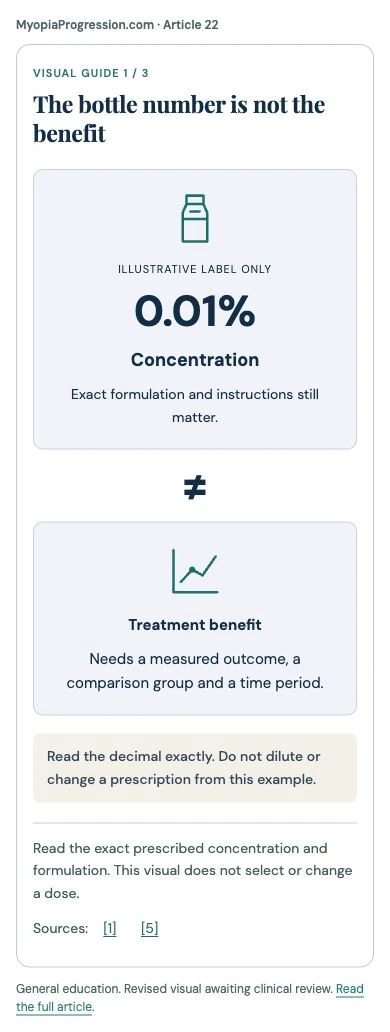
The bottle number is not the benefit
Read the decimal exactly. Do not dilute or change a prescription from this example.
A concentration such as 0.01% or 0.05% describes the amount of atropine in the solution. It is not a promise about the percentage of myopia prevented. A 0.05% label does not mean a five-percent treatment benefit. The outcome has to come from evidence about that intervention and its use.
Ask who will answer a prescription question between appointments. If care is shared between homes, each responsible adult needs the same written instructions and contact details. A clear handoff reduces uncertainty about which bottle and schedule the prescriber intended.
Keep the exact pharmacy label with the prescribing instructions. If the written concentration and the bottle appear inconsistent, ask the pharmacy and prescriber before using it. Do not try to settle a decimal-point concern by comparing the bottle with a photograph online.
Three useful questions organize the discussion: What evidence supports this exact approach? How will effects and tolerability be reviewed? What is the plan if the clinician later recommends a change or stopping? The answers need more than one trial headline.
LAMP compared concentrations within one trial
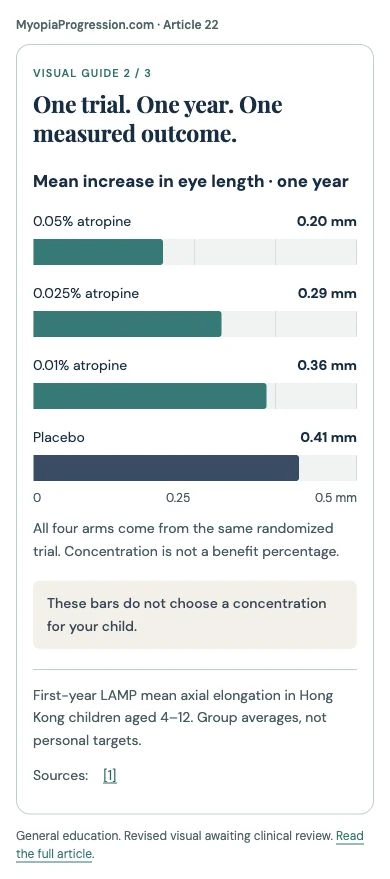
The first-year LAMP randomized trial in Hong Kong studied children aged four to twelve. It compared 0.05%, 0.025%, and 0.01% atropine with placebo. Because these groups were part of the same trial, their outcomes can be considered together within that study's conditions. [1]
Average axial elongation over one year was 0.20 mm in the 0.05% group, 0.29 mm in the 0.025% group, 0.36 mm in the 0.01% group, and 0.41 mm with placebo. Axial elongation means an increase in eye length. These are group means, not promised results or growth targets for an individual child. [1]
VISUAL GUIDE 2 / 3
One trial. One year. One measured outcome.
Mean increase in eye length · one year
All four arms come from the same randomized trial. Concentration is not a benefit percentage.
These bars do not choose a concentration for your child.
The trial also assessed refractive change and effects on pupil size and accommodation, the focusing adjustment used for near work. Greater control of progression must be considered alongside tolerability and the other findings. The study does not justify a parent increasing a prescribed concentration at home. [1]
The chart is limited to one-year eye-length results from that trial. It does not rank every atropine product or compare drops with glasses and contact lenses. It also does not show that the same concentration will perform identically in every country, age group, or formulation.
A useful question about a chart
Ask, “Is this a comparison within one randomized trial, or a lineup of results from unrelated studies?” The first can answer a defined research question. The second may hide differences in participants, placebo progression, follow-up, and products. A neat set of bars does not make those differences disappear.
Why 0.01% does not have one universal result
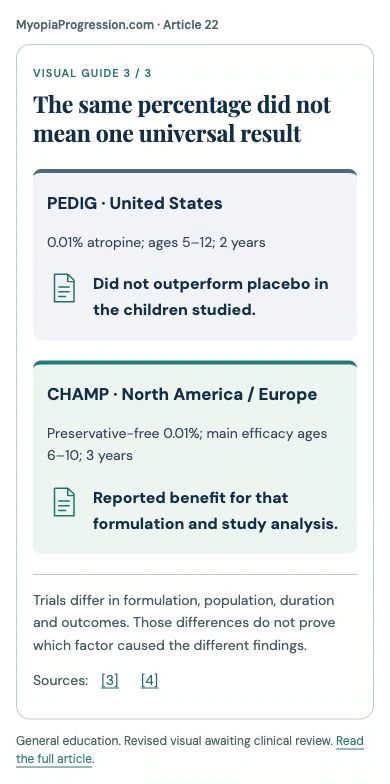
A U.S. trial supported by the National Eye Institute and conducted by the Pediatric Eye Disease Investigator Group found that 0.01% atropine did not outperform placebo in slowing myopia progression over two years in the children studied. The trial involved 187 children aged five to twelve. [3]
The CHAMP trial reported a different result for its preservative-free 0.01% formulation over three years in a North American and European study. Its main efficacy analysis focused on children aged six to ten. The study also tested 0.02%, and a simple claim that the higher concentration must win did not describe all its outcomes. [4]
VISUAL GUIDE 3 / 3
The same percentage did not mean one universal result
PEDIG · United States
0.01% atropine; ages 5–12; 2 years
CHAMP · North America / Europe
Preservative-free 0.01%; main efficacy ages 6–10; 3 years
These findings should not be edited into a false certainty that 0.01% either always works or never works. Trials differ in formulation, population, design, duration, and endpoints. Those differences need examination; listing them does not prove which one caused the results to differ.
Ask the clinician which evidence is most relevant to the proposed product and to your child. If a treatment is described only as “low-dose atropine,” ask for the exact concentration and formulation. An online percentage cannot establish that two preparations are interchangeable.
This page discusses selected studies, not every later atropine publication. New follow-up and additional trials continue to appear. A prescribing decision should use the current evidence available to the clinician, rather than assuming that the trials summarized here settle every question.
Review comfort as well as progression
Atropine can change pupil size and near focusing. Those effects were assessed in the LAMP trial, alongside the progression outcomes. A child who is struggling with reading or light sensitivity needs a discussion about the actual symptoms and prescribed product. [1]
Ask what the team wants the family to report and how soon a concern should be reviewed. Describe the activity affected: reading a book, looking at the board, or being outdoors. A child's practical description can be more helpful than an adult labeling every complaint as an expected side effect.
Do not add drops, change concentration, or adjust frequency to solve a symptom without instructions. Likewise, do not assume that a new painful or red eye is simply an atropine focusing effect. Contact the eye-care team for advice about unexpected symptoms and urgent assessment when appropriate.
Keep vision correction in the conversation. Atropine intended for progression control does not itself provide the optical correction of glasses. Ask which glasses or other correction should be used and how the prescription will be reviewed. A complete plan covers seeing clearly as well as tracking progression.

Stopping needs a monitoring plan
The five-year LAMP report examined longer-term treatment and an as-needed retreatment strategy. Within its monitored retreatment group, 94 of 107 children restarted atropine under the study protocol. This was 87.9% of that group. [2]
That result is not a universal rebound rate for every atropine formulation, concentration, age, or stopping method. It also does not mean that a parent should use the trial's restart rule at home. The report describes what happened under its own design and follow-up.
If stopping is being considered, ask which measurements will be compared afterward and when. Ask whether the child's age, earlier progression, concentration, and response affect that plan. A clear review arrangement is more useful than a general claim that treatment can never stop or that no follow-up is needed.
The phrase rebound also needs care. A return of progression, an unusually rapid change after stopping, and a clinician's decision to restart under a protocol are related but not identical descriptions. Ask which meaning is intended when someone uses the term. Do not assume every later prescription change proves the same biological process.
The treatment-duration guide explains why a universal stopping birthday is not a sound substitute for an individual review. This article supplies no tapering schedule and no recommendation to stop a current prescription.
Formulation and regulatory status deserve their own questions
In the United States, compounded drugs are not FDA-approved products. The FDA explains that it does not verify their safety, effectiveness, or quality before marketing in the same way it does for approved drugs. Compounding may serve particular needs, but a family should understand what product is being supplied and by whom. [5]
Ask the pharmacy how to store the exact preparation, when to discard it, and whom to contact about a concern. Do not transfer a shelf-life instruction from another bottle or assume every formulation has identical storage requirements. Avoid touching the bottle tip and follow the supplied handling instructions.
As checked October 21, 2026, an FDA advisory committee meeting was scheduled for October 30 to discuss an application for atropine sulfate 0.01% ophthalmic solution. A scheduled meeting is not a marketing approval. The application, any eventual decision, and any resulting label are specific matters that require current verification. [6]
Do not infer that an application makes all compounded atropine products authorized, or that evidence from a trial automatically supplies an FDA label. The prescribing team should explain the current status of the exact product being proposed. Recheck this dated information at publication and at the time of care.
Your atropine prescription questions
Discussion prompts only. Check marks stay on this open page; nothing is submitted or stored. This tool does not diagnose, choose a treatment, or set a dose.
The American Academy of Orthokeratology and Myopia Control (AAOMC) provides patient resources on myopia management. [7] Use them alongside primary research, pharmacy instructions, and the child's examination. Their inclusion does not select a concentration for an individual child.
Leave the appointment with the exact prescription, a practical routine, safety contact details, and the next review date. Research can explain why a concentration is being considered. The care plan must explain how that choice will be used and reviewed for this child.
CHECK THE EVIDENCE
Sources & references
Primary research, guidance, and patient resources. Checked October 21, 2026.
- 1LAMP: randomized trial of three low atropine concentrationsYam et al. · Ophthalmology · 2019
- 2Five-year LAMP trial: phase 4 reportZhang et al. · Ophthalmology · 2024
- 3U.S. trial: 0.01% atropine no better than placeboNational Eye Institute · 2023
- 4CHAMP: three-year randomized atropine trialZadnik et al. · JAMA Ophthalmology · 2023
- 5Understanding the risks of compounded drugsU.S. Food and Drug Administration
- 6October 30 advisory committee: atropine 0.01% applicationU.S. Food and Drug Administration · October 2026
- 7Patient resourcesAmerican Academy of Orthokeratology and Myopia Control (AAOMC)
General education. This article does not replace an eye examination, individual advice, or the prescribed care plan.