A HOME THAT WORKS FOR YOUR CHILD
Create a Myopia-Friendly Home
Plan a comfortable reading space, useful lighting and a realistic home routine. Try a seven-day reset alongside your child’s prescribed care.Try the seven-day home reset ↓
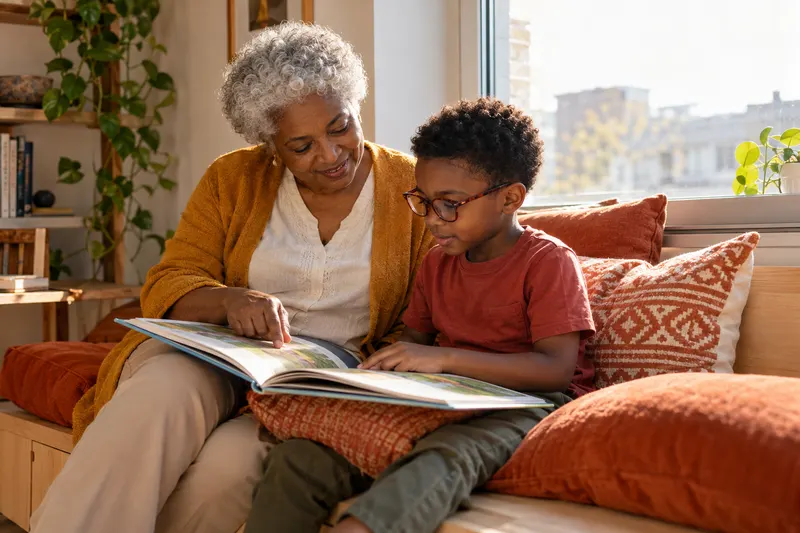
A home plan can support healthy habits. It cannot reverse myopia or replace prescribed treatment. Start with a comfortable reading setup, regular breaks, and realistic opportunities to be outdoors.
On this page
Start with the room your child uses most
You do not need a special lamp, an expensive desk, or a bigger home to begin. Choose the place where your child usually reads or does homework. Sit beside them for a few minutes and ask what feels awkward. Can they see the print? Does a reflection cover part of the screen? Do they end up curled over a phone because the table is crowded?
A useful home change solves a specific problem. Moving a book, clearing a little space, or finding a better place for a case may matter more to daily life than buying another product. Make the change with your child, then see whether it helps them use the space comfortably.
Myopia means distant things look blurry because light focuses in front of the retina. A home routine supports eye care, but it does not remove a prescription or reverse an elongated eye. If your child already has myopia, keep their prescribed correction and treatment plan in place. [4]
Homework spot
Clear space for the book or device
Can your child work without crowding it close? →Lighting
Move the lamp or screen to reduce reflections
Is the page easy to see without glare? →Daily schedule
Find one regular outdoor opportunity
Who can help make it happen? →Care supplies
Give glasses and supplies a reliable place
Can your child find what they need? →Give reading a comfortable setup
Reading is part of childhood. The goal is to make close work easier to manage, not to make books feel dangerous. A child who loves stories should still have stories. Help them vary their position and take pauses rather than hovering over every page.
Check how close your child holds the book or device. If print seems small, try larger text before telling them to sit back. A simple stand can free space for a tablet or book. Support their feet if the chair leaves them dangling, and make sure the screen does not force a twisted posture.
Guidance recommends avoiding very close reading and long stretches of uninterrupted near work. AAPOS suggests keeping reading and screens at least 12 inches away. That is a helpful cue, not a test a parent needs to measure all evening. Persistent difficulty seeing at a comfortable distance deserves an eye-care check. [3][4]
Try a neutral observation: “Your book keeps ending up close to your face. Would bigger print help, or does it still look blurry?” This gives your child a way to explain what is happening. Repeated reminders to sit up may miss a vision problem or an awkward setup.
For shared spaces, keep a small tray with the stand, pencil case, and glasses case. It can move off the kitchen table at dinner. You do not need to turn a family room into a clinic. Make the useful setup easy to bring back the next day.
Use lighting for visibility, without buying a cure
A reading light should make the task easier to see. Try changing its position before changing the bulb. Look at the page from your child's seat, because glare that is invisible to an adult standing nearby may be directly in the child's view. Angle a tablet away from a bright reflection and adjust its brightness to suit the room.
Let your child compare two positions and tell you which feels clearer. If one hand casts a shadow over the page, try the lamp on the other side. A book stand can also change the angle without needing a brighter light. Avoid shining light directly into the eyes.
Evidence does not establish an ordinary indoor lamp, a certain bulb color, or sitting beside a window as a substitute for outdoor time or prescribed myopia control. The International Myopia Institute notes that the best light characteristics for preventing myopia are still uncertain. Do not turn a comfortable room into a do-it-yourself light treatment. [1]
A bright window can be pleasant, but looking through glass is not the same activity as spending time outdoors. Choose an indoor position for comfort. Choose outdoor opportunities as a separate part of the day.
Make outdoor time possible in your actual week
The strongest outdoor-time evidence concerns reducing or delaying the onset of myopia. It is less certain that extra outdoor time alone slows progression once a child is already myopic. That distinction matters: a walk is worthwhile, but it is not a replacement for a prescribed treatment. [1]
A school trial in Guangzhou added a 40-minute outdoor class each school day. Over three years, new myopia developed in 30.4% of children in the intervention group and 39.5% in the comparison group. These were group results in a particular setting, not a promise for an individual child. [2]
Rather than trying to copy a research schedule exactly, look for opportunities you can repeat. Could part of the journey to school be outside? Can a snack move to a safe outdoor area? Is there a supervised school club, park visit, or weekend walk your child enjoys? Outdoor time need not be competitive sport.
Professional recommendations vary, and some public-health programs encourage around two hours outdoors daily. Ask your child's eye-care team how to work toward a suitable goal. Consider weather, air quality, disability, supervision, and the safety of your neighborhood. Use sun protection and never encourage looking at the sun. [1][4]
If a day goes wrong, restart at the next opportunity. Avoid making a child responsible for bad weather, a parent's work shift, or a lack of safe local space. A useful plan names who can help and where it can happen.
Build breaks into tasks, not arguments
A break works best when everyone knows when it will happen. Choose a cue before homework starts: after a section, between assignments, or at a mutually agreed timer. AAPOS describes the 20-20-20 reminder: every 20 minutes, look about 20 feet away for 20 seconds. It is a practical prompt, not a proven stand-alone treatment for myopia. [4]
Help a younger child find something across the room to look at. An older child may prefer a quiet reminder on the device. Keep the pause simple. It should not require another video, a new app, or a complicated exercise routine.
Switching from a tablet to a tiny-print book is still close work. A pause can mean looking farther away, standing to stretch, or moving to another task. At the same time, avoid turning every pause into a lengthy interruption that makes homework drag into the evening.
Ask the child and teacher about unusually long assignments. You may be able to split a task or use accessible text settings without changing what the child is learning. The screen-time family plan offers a more detailed way to separate required learning from optional screen use.
Give the prescribed routine a home
Choose one place for glasses when they are off the face. It could be a case beside the school bag rather than a special storage unit. Ask your child to show you where the case belongs. If it is hard to reach or gets buried, choose somewhere else.
For prescribed drops or contact-lens supplies, follow the pharmacy's and eye-care team's storage instructions. Keep medicines safely away from younger children. Do not move them into an unmarked container to make the room look tidy. The instructions should stay with the product.
Divide the jobs in plain words. Your child might return the case after school while an adult tracks refills and appointments. Write down who handles each step when care is shared between homes. A second caregiver needs the actual instructions, not a child's best memory of them.
The American Academy of Orthokeratology and Myopia Control (AAOMC) provides patient resources on myopia and treatment options. Use them to prepare questions for the prescriber. Home habits and lens-care routines serve different purposes, so ask which parts of the plan are essential for your child's treatment. [5]
Try a seven-day home reset
Choose two changes. Pick one reading-space change and one outdoor opportunity. Write down who helps. “Walk together after pickup” is clearer than “Spend more time outside.”
Midweek: find the obstacle. Set up the space together. Midweek, ask, “What keeps getting in the way?” Fix the practical obstacle, whether it is a missing charger, crowded table, rain, or tiredness.
At the end of the week: keep what works. At the end of the week, keep what was useful and drop unnecessary complexity. You are checking whether the routine is workable, not measuring whether myopia has improved. Prescription and eye-growth changes need professional assessment over time.
Your seven-day home reset
Use these prompts with your child and eye-care team. Check marks stay only on this open page. Nothing is submitted or saved.
If you are preparing for a follow-up, bring a short description of your child's routine and any ongoing symptoms. You do not need to track every minute. A clear account of what happens on an ordinary school day helps the eye-care team understand the family context.
Questions parents ask
Can these changes mean my child no longer needs glasses?
No. Keep using the prescribed correction. Comfortable reading and outdoor habits do not remove an established prescription. Ask the eye doctor before changing when glasses are worn. [4]
Should I stop my child reading for fun?
Make room for reading, breaks, and other activities. Try larger print or a more comfortable setup if needed. Discuss persistent symptoms rather than assuming the hobby itself must be stopped. [3]
What should we buy first?
Start by moving what you already have. Identify the problem before spending money. If your child still crowds the page, reports blur, or avoids tasks because seeing is difficult, arrange an eye-care assessment rather than buying a product that promises to fix myopia at home.
CHECK THE EVIDENCE
Sources & references
Primary research, guidance, and patient resources. Checked October 21, 2026.
- 1The role of light in refractive error development and myopiaInternational Myopia Institute · 2025
- 2School outdoor-time randomized clinical trialHe et al. · JAMA · 2015
- 3Clinical management myopia guidelinesInternational Myopia Institute
- 4Myopia and treatment of myopia in childrenAAPOS
- 5Patient resourcesAmerican Academy of Orthokeratology and Myopia Control (AAOMC)
General education. This article does not replace an eye examination, individual advice, or the prescribed care plan.