A READING-SPACE WORKSHOP
Reading Habits for Comfortable Eyes: Distance, Light and Breaks
Improve a child’s reading setup without treating distance or breaks as a cure. Explore readable materials, useful adjustments and when to book an exam.Tour a comfortable reading space ↓
Keep reading material at a comfortable distance, make text easy to see, use suitable light and take regular distance-viewing breaks. These habits can support comfort. They do not reverse myopia or replace prescribed correction and monitoring. A child who must move very close to see needs an eye assessment.
On this page
Fix the task before correcting the child
When a child bends close to a book, adults often begin with “sit up” or “move it away.” Sometimes a small change to the reading space helps more: larger print, a stable book, less glare or a seat that supports the child comfortably.
Start by asking what is hard. Is the text too small? Is a reflection covering the page? Is the child trying to see through glasses that slip? Is the material interesting enough that they keep reading without noticing discomfort?
Reading habits can make close work more manageable. They do not explain every symptom or determine whether myopia is progressing. A child who repeatedly struggles to see deserves an appropriate eye assessment, even when the desk looks well arranged.
Tour the space from the page outward
Look at the book or device first. The child should be able to view the material without repeatedly bringing it unusually close. Enlarging digital text or using a larger-print version can be more useful than asking the child to work harder at the same small letters.
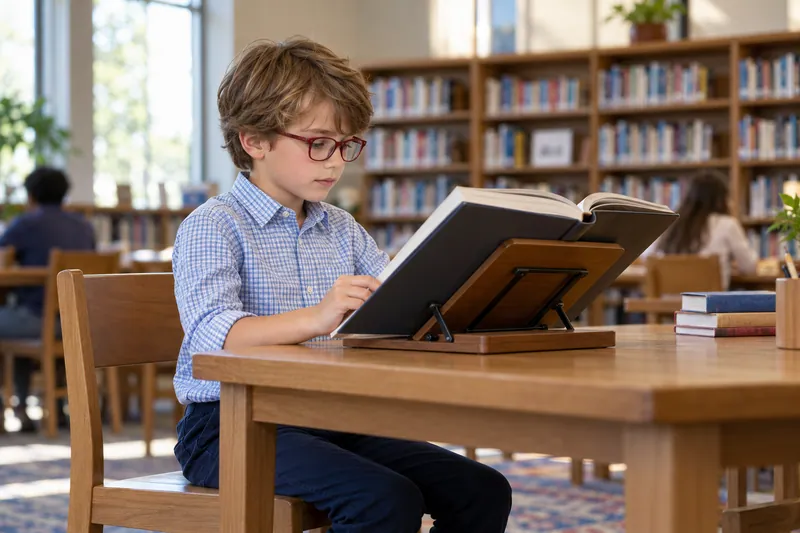
A book stand or supported device can help keep the material in a comfortable position. It should be stable and suited to the child’s needs. An expensive “ergonomic” accessory is not required if an ordinary setup works safely.
VISUAL GUIDE 1 / 3
A reading setup you can actually see
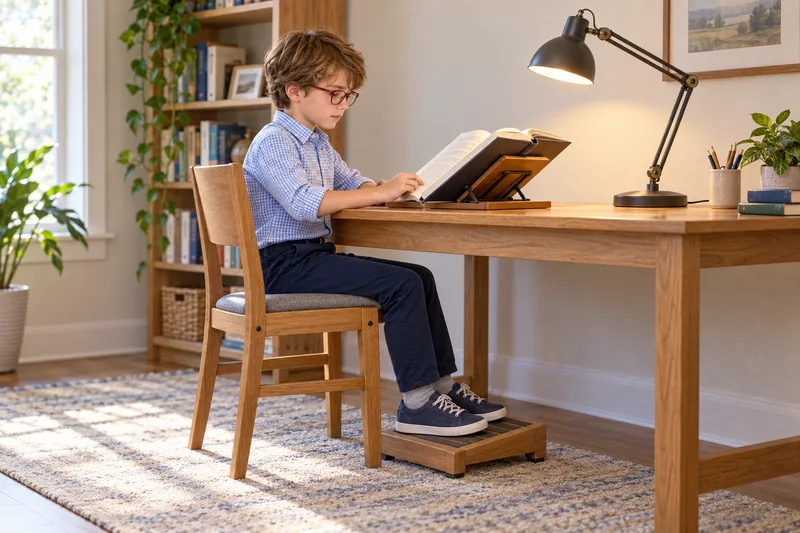
Next, check the light from the child’s position. A bright reflection on a screen or glossy page can make a task harder. Try repositioning the material or light source before increasing brightness indiscriminately. The aim is clear, comfortable viewing, not the brightest possible room.
Finally, consider support. A chair, foot support or different reading location may help a child stay comfortable. There is no single posture every child must hold perfectly, and disability-related needs may require advice from the child’s usual support team.
Distance is a useful clue, not a home diagnosis
The American Association for Pediatric Ophthalmology and Strabismus advises avoiding very close viewing, with practical guidance such as keeping reading material at least about 12 inches away and screens around an arm’s length away. Use such guidance to notice the setup, not to force a rigid measurement through every task. [1]
Text size, device size, the child’s reach and accessibility needs all affect what is workable. If moving the material farther away makes it unreadable, do not turn reading into a test of endurance. Adjust the task and discuss the difficulty with the eye-care team.
A child may choose a close position for several reasons. An observation alone cannot tell you whether the cause is myopia, another visual problem or a habit. Record what you notice and whether the current correction is being used, rather than announcing a diagnosis at the kitchen table.
One useful description is, “He moves close even with his glasses on, especially for small print.” That gives the clinician more information than “He has bad posture.” The examination can then address the appropriate question.
Use breaks as a cue for comfort
The 20–20–20 rule is a familiar reminder: about every 20 minutes, look at something around 20 feet away for about 20 seconds. The American Optometric Association describes it as a way to interrupt prolonged close viewing and support comfort. [2]
It is a cue, not a treatment dose. Reaching an exact second does not prove a child’s myopia is controlled, and missing one pause does not mean harm has occurred. Do not use a break timer as a replacement for prescribed correction or a clinical review.
VISUAL GUIDE 2 / 3
A comfort cue, not a treatment dose
Use a natural pause when a precise timer is impractical. Looking from a laptop straight to a near phone is still close viewing. The reminder does not measure myopia progression or replace correction and care.
A school task may not pause on a perfect schedule. Look for natural transitions between questions, pages or activities. A brief look across the room is different from switching straight from a laptop to a phone held at the same near distance.
Choose a reminder that does not interrupt learning more than it helps. A quiet adult prompt, a classroom routine or an agreed pause between tasks may work better than repeated alarms. Children who need support with transitions may benefit from planning the pause in advance.
What reading habits can and cannot change
Research on myopia considers near work, outdoor time, inherited risk and other factors. The International Myopia Institute’s risk-factor review places these exposures in a wider picture. It does not turn one preferred chair, lamp or break schedule into a proven solution for every child. [3]
Good habits can support an easier reading experience. They cannot tell you the eye’s axial length, replace an examination or guarantee that a prescription remains stable. Keep those boundaries clear when evaluating a product promoted as a “myopia desk” or “eye-saving lamp.”
Do not discourage reading because of a myopia concern. Books and learning are valuable. The aim is to make tasks suitable, include opportunities to look farther away and arrange care when there are signs of difficulty.
It is also unhelpful to tell a child that ordinary reading has “ruined” their eyes. Such language can create anxiety around schoolwork while offering no useful next step. A calm description of the task and the care plan is more constructive.
Run a simple reading-space experiment
Choose one short, ordinary task and change one feature that seems relevant. Enlarge the font, reduce a reflection or support the book. Ask the child whether that specific change makes the task easier.
VISUAL GUIDE 3 / 3
Change one feature, then listen
Small text, glare, a slipping frame or an unsupported book? Ask rather than guess.
Enlarge the text, move a reflection or support the material without removing needed accommodations.
Keep a helpful change. Report persistent blur or difficulty to the eye-care team.
Do not score the experiment as a vision test. Its purpose is to improve the environment, not prove that the eyes are healthy. A comfortable task can still coexist with myopia, and ongoing difficulty needs assessment even after several sensible adjustments.
Keep a useful change if it helps without creating another problem. If a stand blocks the child’s hand movement or a larger font makes school material difficult to navigate, look for an alternative. Accessibility and learning should remain central.
Share the result with the school if the same issue occurs there. A concrete request, such as a larger digital version or a different seat to avoid glare, is easier to act on than a general concern about eye strain. Teachers should not be expected to diagnose the child’s eyes.
Make room for different kinds of readers
Some children read while using magnification, communication devices, specialized seating or other supports. Generic posture advice may not fit their needs. Ask the relevant team before removing an accommodation because it looks different from a stock image of a desk.
A child with limited attention or movement may also need shorter tasks or a different way to take a break. Looking toward a distant point, changing activity or using an accessible outdoor space can be considered in a way that suits the individual.
For siblings sharing a space, agree on the basics that can be adjusted without a daily conflict. A movable light or simple book support may be easier to share than a complete furniture change. Let each child explain which part of the setup is difficult.
The National Eye Institute’s advice for children includes healthy habits, breaks and protecting vision. Treat this as support for everyday routines, while keeping individual visual needs with the professionals who examine the child. [4]
Know when an appointment matters more than another adjustment
Arrange an eye check when a child repeatedly reports blur, cannot see school material, holds things unusually close or has persistent difficulty using the current correction. Tell the clinician when the problem occurs and whether it happens with glasses or contact lenses in place.
Do not wait for a home setup experiment to settle a persistent concern. Sudden loss of vision, severe pain or an eye injury needs urgent assessment rather than a reading-space review. [6] A comfortable desk cannot rule out a medical problem.
Bring the current glasses and any relevant previous prescription information. Ask what the examination found, whether the correction needs attention and what follow-up is appropriate. If myopia management is being discussed, ask how it will be monitored rather than judging it by reading posture alone.
The American Academy of Orthokeratology and Myopia Control (AAOMC) provides patient resources for understanding myopia and care discussions. Use them to prepare questions about the bigger plan, not to turn everyday reading habits into a substitute for that plan. [5]
End with a change the child can understand: “We are making this easier to read, and we will ask about the blur at your appointment.” That gives the routine a purpose without making the child responsible for diagnosing or treating their own eyes.
The vision warning-sign guide helps organize observations for an appointment. The family screen-use guide addresses the broader routine around the reading task.
Your reading-space review
Discussion prompts only. Checks stay on this open page; nothing is submitted or saved. This sheet does not diagnose, choose treatment or determine urgency. Do not delay urgent care to complete it.
CHECK THE EVIDENCE
Sources & references
Research, professional guidance and patient resources. Checked October 21, 2026.
- 1Screen Time and Online LearningAmerican Association for Pediatric Ophthalmology and Strabismus
- 2Computer vision syndrome and the 20-20-20 ruleAmerican Optometric Association
- 3IMI Risk Factors for MyopiaInternational Myopia Institute · 2021
- 4Healthy Vision Tips for KidsNational Eye Institute
- 5Patient Resources: Myopia and OrthokeratologyAmerican Academy of Orthokeratology and Myopia Control (AAOMC)
- 6Warning Signs of Vision Problems in Infants and ChildrenAmerican Academy of Pediatrics
General education. This article does not replace an eye examination, individual advice, or the prescribed care plan.