AN OUTDOOR ACTIVITY FIELD GUIDE
Family Outdoor Activities for Myopia-Friendly Routines
Choose outdoor activities for kids by interest, access and setting. Use a family selector and easier alternatives while keeping eye care in the plan.Find an activity that fits your child ↓Fit outdoor opportunities into a day →
Choose outdoor activities your family can repeat and enjoy, with safe access, supervision, shade and appropriate eye protection. Daylight opportunities can support myopia prevention, but activity is not a replacement for glasses or prescribed care. The best plan fits the people and place available to you.
On this page
Choose a reason your family wants to go outside
An outdoor routine is easier to repeat when it starts with something enjoyable. One child wants to notice birds, another wants a ball game and another wants a quiet place to talk. The best activity is not necessarily the longest, most athletic or most expensive option.
Start with what is nearby and accessible. A shared courtyard, shaded path, neighborhood garden or familiar park may fit more easily than a special outing. Consider transport, supervision, mobility, sensory needs and the time available to the adults involved.
Outdoor time has evidence for helping reduce the chance that myopia starts. It should not be presented as a guaranteed treatment for a child who already has myopia. Keep prescribed correction and clinical follow-up in place, even when your family spends a great deal of time outdoors. [1]
VISUAL GUIDE 1 / 3
Choose the outing by interest and access
A familiar accessible path, a bench or a courtyard. Look without approaching wildlife.
A shaded place with usable paper or support. Near-task comfort still matters.
Choose a manageable walk or accessible wheeling route with places to rest.
Suitable space, supervision and activity-specific eye protection.
Showing all 4 ideas.
The selector helps match an idea to the people and place available. It does not rank activities by a measured myopia benefit. No study result is being claimed for the individual games or outings listed here.
Try a noticing activity before planning a large trip
A noticing activity gives the outing a purpose without requiring a competition. Look for different leaf shapes, listen for birds or find familiar landmarks along an accessible route. Let the child choose what to notice. Keep the activity safe and avoid asking them to approach unfamiliar animals or plants.
A simple prompt can work across ages: “What is different from last time?” An older child may enjoy taking an occasional photograph, while a younger child may prefer collecting words or pointing things out. A phone can be useful for a specific purpose without becoming the focus of the whole outing.
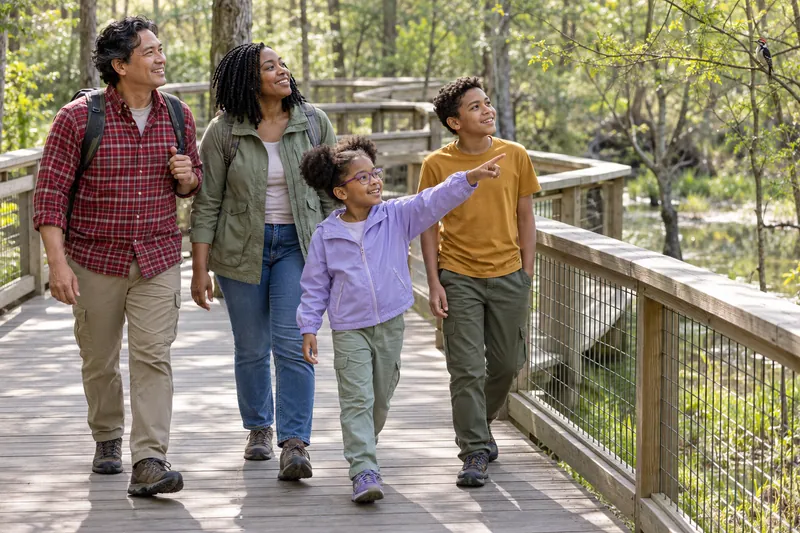
The illustrated family is looking at a bird from a boardwalk. The image shows one way to share an activity, not a field test of vision. A child who cannot identify a distant bird should not be compared with siblings or asked to remove correction to improve their eyes.
If you want a lower-energy version, sit in a suitable outdoor place and observe what changes. Movement and intensity are separate from the fact that the activity takes place outdoors.
Add movement that fits the child
Walking, accessible wheeling, gentle games and organized sport can all belong in an outdoor routine. Choose an activity the child can join with suitable support. A family does not need to turn every outing into exercise training to make it worthwhile.
Offer a choice between two realistic ideas. “A short park route or a game in the courtyard?” is easier to answer than “What should we do outdoors all day?” Let children help shape the activity while adults retain responsibility for safety and access.
For ball or racket activities, ask about appropriate protective eyewear. The National Eye Institute explains that ordinary glasses and sunglasses do not provide the protection needed for many sports. Correction and protection should be considered together. [2]
Do not assume a child's reluctance is laziness. They may be worried about a slipping frame, glare, not seeing the ball or keeping up with the group. A practical adjustment can matter more than another reminder about the health benefits of being outside.
Match the safety plan to the setting
Look at the route or play space before treating it as a regular option. Is there shade? Can everyone access a toilet or a resting place? Does the activity place the child near traffic, water or equipment that needs extra supervision?
Check local weather and air-quality information. The American Academy of Pediatrics advises adapting outdoor play around sun, heat and air quality. Myopia prevention is not a reason to ignore those conditions or remove ordinary sun protection. [3]
VISUAL GUIDE 2 / 3
Read the setting before choosing the activity
| Setting | Check before you begin | Adaptation to discuss |
|---|---|---|
| Park or path | Access, shade, traffic and resting places | A shorter or more accessible route |
| Ball or racket area | Activity-specific protection and clear vision | Suitable equipment and supervision |
| Strong sun, heat or poor air | Local advice and individual health needs | Another time or a safer alternative |
| Quiet outdoor task | Readable material and comfortable support | Larger print or a different work surface |
The setting map links recognizable situations with practical questions. It is a planning aid rather than a complete safety assessment. Individual medical restrictions and local advice still apply.
For sunlight, use appropriate protection and avoid looking directly at the sun. The National Eye Institute recommends suitable UV-blocking sunglasses and warns against sun-gazing. A shaded activity with protection can still be part of an outdoor routine. [4]
If the child needs extra support because of a disability or medical condition, involve the people who normally advise on access and safety. Adapt the setting rather than assuming one model fits every family.
Make room for different ages and interests
Siblings may not want the same activity. Give them a shared setting with different ways to participate. One child can look for birds while another sketches a tree. A teen might choose the route or take responsibility for a small part of planning.
Keep expectations clear. Everyone can help choose, but not every outing needs to satisfy every interest equally. Rotate choices so the same child is not always expected to follow someone else's favorite activity.
A family conversation can also happen outdoors. A short accessible walk or a comfortable place to sit may create time together without requiring a game. Do not treat quiet participation as less valuable because it produces fewer steps.
If the child wants to read or draw outdoors, that may be enjoyable. It remains a near task, so make material readable and allow comfortable pauses. The setting does not make all viewing demands disappear. The purpose is a varied day, not a claim that every activity under an open sky has the same effect.
Plan an easier version for busy days
An outing that depends on perfect weather, a car and several free hours can disappear when the week gets difficult. Choose a smaller version that uses the same interest. A long nature visit might become a short look at trees near home. A sports session might become a gentle outdoor game with suitable space and protection.
VISUAL GUIDE 3 / 3
Keep the interest when the day gets busy
| Original idea | Smaller version | What stays appealing |
|---|---|---|
| A long nature visit | Notice birds or leaves near home | Curiosity and shared attention |
| A large group game | A suitable gentle game with one companion | Play and connection |
| An outdoor art afternoon | A short shaded sketch session | Making and noticing |
| A route across town | A nearby accessible place to sit or move | Time together outdoors |
The comparison board shows how to adapt the activity, not how to replace a prescribed treatment. A smaller plan is valuable because it can be repeated, not because the chart assigns it an equivalent medical effect.
Agree who helps make the opportunity happen. If a child needs adult supervision or assistance, “just go outside” is not a complete instruction. Check whether the adult is available and whether the location can be reached safely.
For seasonal scheduling, the summer guide addresses camps, changing routines and weather. This field guide focuses on selecting an activity your family can enjoy throughout the year when conditions allow.
Keep correction and care part of the outing
A child should be able to see and participate comfortably. Follow the prescribed instructions for glasses or contact lenses. Do not remove correction to make the eyes work harder or decide that outdoor play means myopia management can stop.
Ask the care team about the specific activity when needed. A sports setting may require different protection, while water activities need a plan that avoids contact-lens exposure. These are practical care questions, not reasons to exclude the child from everything they enjoy.
Bring a suitable case and a simple plan for a broken or lost frame. If another adult supervises the activity, explain the relevant instructions and how to contact you. Give only the information needed to support the child.
The American Academy of Orthokeratology and Myopia Control (AAOMC) offers patient resources about myopia and care options. Use them to prepare questions for the child's clinician rather than choose a correction or treatment based on the outing alone. [5]
Notice whether the plan fits, not whether it proves a result
After trying an activity, ask what made it easy or difficult. Was the route too noisy? Did the child enjoy having a purpose? Was there enough shade? Did everyone have the correction or support they needed? These questions help improve the next outing.
Avoid evaluating eye health through the activity. A child who can spot a bird or catch a ball has not completed an eye examination. A child who prefers a quiet game has not failed at prevention. Clinical monitoring and family enjoyment answer different questions.
Keep a small menu of workable choices rather than a long list nobody uses. Include a low-energy option, an accessible option and something the child actively looks forward to. Change the menu as interests, seasons and support needs change.
The aim is an outdoor routine that has a place in real family life. It can support shared time and a broader prevention approach while leaving diagnosis and treatment with the professionals who examine the child. Choose the next opportunity, keep it safe and make it worth returning to.
Your outdoor activity plan
Discussion prompts only. Checks stay on this open page; nothing is submitted or saved. This sheet does not diagnose, choose treatment or determine urgency. Do not delay urgent care to complete it.
CHECK THE EVIDENCE
Sources & references
Research, professional guidance and patient resources. Checked October 22, 2026.
- 1IMI Risk Factors for MyopiaInternational Myopia Institute · 2021
- 2Sports and Your EyesNational Eye Institute
- 3Summer Sun, Heat & Air Quality: Tips to Keep Kids SafeAmerican Academy of Pediatrics
- 4Healthy Vision Tips for KidsNational Eye Institute
- 5Patient Resources: Myopia and OrthokeratologyAmerican Academy of Orthokeratology and Myopia Control (AAOMC)
General education. This article does not replace an eye examination, individual advice, or the prescribed care plan.