Eye-care professionals
A HANDS-ON READINESS WORKSHOP
Pediatric Contact Lenses: Readiness, Fitting and Safety Follow-Up
For clinicians: assess pediatric contact-lens readiness, teach practical skills, discuss risk with context and plan follow-up, support and stop rules.Walk through the practical teaching stations ↓
Assess the child, caregiver support, ocular findings and the exact lens indication together. Teach the prescribed handling and wear routine, check the skills in practice, and arrange follow-up and urgent contact routes. Age alone does not establish readiness, and trial safety results do not remove infection risk.
On this page
Assess the child and the support system together
Pediatric lens fitting is a clinical assessment and a teaching process. Interest in contacts is useful, but it does not establish suitability. A quiet child may learn the routine well; an enthusiastic child may still need substantial help.
Ask why lenses are being considered and what the child expects. Separate correction for an activity, a specific myopia-control indication and any other ocular need. Confirm the exact product, intended use and relevant labeling.
The FDA's family guidance emphasizes maturity, motivation and the ability to follow safe instructions. There is no universal age that substitutes for examining the eyes and assessing the routine. [3]
Include the caregiver who will actually help. Ask about home arrangements, travel, school, accessibility and who can obtain supplies or arrange urgent assessment. A workable support plan matters even when the child appears independent during the appointment.
VISUAL GUIDE 1 / 3
Readiness is a fit between eyes, skills and support
Examination and product-specific indication.
Observe the actual task and response to a problem.
Agree who helps and how follow-up happens.
All three feed the clinical decision. A birthday alone does not establish readiness.
Match the lens and the evidence to the clinical question
Do not treat every soft contact lens as a progression-management product. Identify whether the lens is intended only to correct refractive error or also has evidence and authorization for the proposed myopia-control use.
The FDA's MiSight 1 Day indication is product-specific: treatment initiation in children aged 8–12, within specified refractive and astigmatic limits, with non-diseased eyes. Those conditions are not an age rule for every pediatric lens or every clinical situation. Check the current labeling and jurisdiction. [2]
Assess ocular findings, vision, fit and practical suitability according to the exact lens and professional requirements. Where use is outside a labeled indication, the clinician needs to address the applicable evidence, consent and local requirements.
Explain alternatives in a way that does not make the child feel unsuccessful if contacts are unsuitable or unwanted. Glasses and other appropriate options remain part of the discussion. A trial of handling skills should not become pressure to accept a particular product.
Teach a sequence the child can demonstrate
Use the actual prescribed lens system and instructions. Explain the purpose of each step, demonstrate it, then allow supported practice. Build in time for questions and a repeat session if needed.
Observe more than insertion and removal. The child and caregiver should understand the wearing and replacement schedule, the supplies required, the storage or disposal routine and the safe response when something is missing or uncomfortable.
For reusable lenses, cleaning and disinfection are different functions that must be addressed by the prescribed system. For daily disposables, the routine still needs clear handling, disposal and resupply instructions. Do not assume “disposable” means no teaching is required.
Ask for a show-me demonstration and an explanation in the family's own words. AHRQ's teach-back method checks the teaching, not whether a patient can repeat a memorized phrase. If a misunderstanding appears, change the explanation and check again. [5]
VISUAL GUIDE 2 / 3
Teach the whole journey, including the point to stop
Identify the prescribed lens, schedule and instructions.
Clinician teaches; child and caregiver show the task back.
Missing supplies, an unsuitable place or an uncomfortable eye has a safe help route.
Backup correction, resupply, review and urgent contacts are accessible.
Make the fallback visible during training
Ask what happens when the child cannot complete the task. A safe response may involve using prescribed backup correction and contacting the clinic, rather than continuing to struggle or borrowing another person's lenses.
Rehearse a realistic school or sports day. Who can help if a lens is uncomfortable? Where are backup glasses? Is there a suitable place for a task, and what is the plan if that place is unavailable?
Water should not be used as a lens-care substitute. The CDC recommends keeping lenses and cases away from water, washing and fully drying hands before handling, and using recommended care products. Daily-wear lenses should not be slept in; prescribed overnight Ortho-K is a separate modality with specific instructions. [4]
Keep the safety response distinct from the routine appointment. The family should know how to contact the practice promptly about symptoms and where to seek urgent assessment if it is closed.
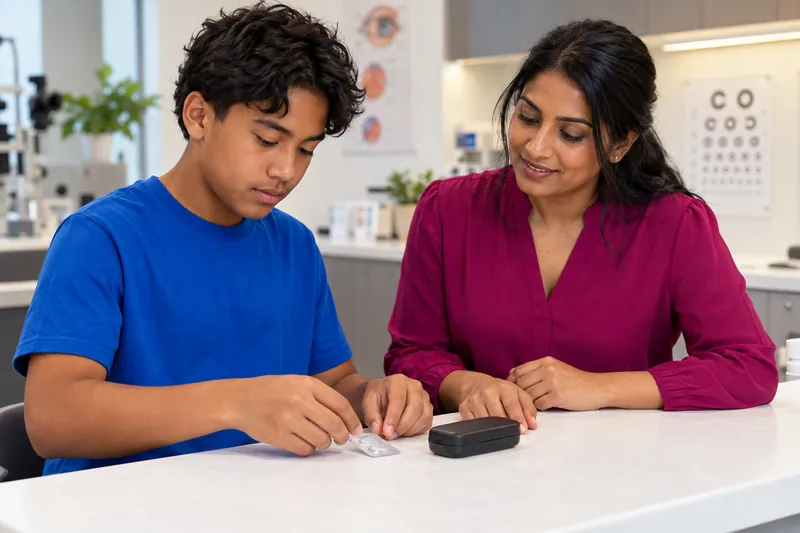
The fictional supplies scene is not a handling demonstration. Use the clinician's teaching and the actual product instructions for insertion, removal and care.
Discuss risk using the right denominator
Contact lenses are medical devices and are not risk-free. Describe relevant adverse events, symptoms and the response plan, alongside benefits and practical demands. Do not imply that a successful teaching session removes infection risk.
A 2023 review combined seven prospective studies with 1,756 children and 3,752 patient-years of soft-lens wear. It estimated microbial keratitis at 2.7 cases per 10,000 patient-years, with a wide 95% confidence interval of 0.5–15. The estimate concerns those study settings and lens modalities; it is not an individual forecast or an Ortho-K rate. [1]
A patient-year is a unit of observation time, not necessarily a different child. Keep that distinction visible when presenting a rare-event rate. Do not silently translate a pooled annualized rate into a lifetime probability.
The uncertainty matters. Selected trial participants, clinical support, products and wear schedules can differ from a family's routine. Use the estimate to inform a balanced discussion while maintaining the actual prevention and response plan.
VISUAL GUIDE 3 / 3
A rare-event estimate still has meaningful uncertainty
Microbial keratitis in pooled prospective pediatric soft-lens studies
95% CI: 0.5–15
Dot: estimate. Line: 95% confidence interval. Units: cases per 10,000 patient-years.
Observation time is not a count of different children. This is not an Ortho-K rate or an individual prediction.
Check the clinical response after dispensing
Arrange follow-up appropriate to the lens, indication and findings. The first review is an opportunity to assess both the eye and how care is happening outside the practice.
Ask about vision in class, sport and near work, comfort during wear and any symptoms between visits. Examine and assess according to the clinical situation rather than assuming reported comfort proves that every aspect is satisfactory.
Review the routine using neutral questions. “Which step is hardest?” may reveal more than “Are you following instructions?” Observe again when needed. A product change, another caregiver or a new school schedule can make previously learned skills less reliable.
For a lens used in myopia management, keep fit and safety review connected to appropriate progression monitoring. Clear vision and good handling are important outcomes, but neither is a stand-alone measurement of the progression effect.
Give symptoms a clear action route
The family should not have to decide whether an infection is present before asking for help. Explain the symptoms that should lead them to remove lenses when appropriate and contact an eye-care professional promptly.
Pain, redness, light sensitivity, discomfort or changed vision should not be managed by wearing through the problem. Severe pain, sudden vision loss or an injury requires urgent assessment. The clinic's advice should identify the available route when the usual team is unavailable. [4]
Avoid a handout that lists symptoms without a contact method. Ask the child or caregiver to find the number and explain what they would say. Check whether language, hearing or phone-access needs require another arrangement.
Record the advice and confirm understanding. A routine follow-up date should not be mistaken for the only time the family is allowed to contact the practice.
Build resupply and replacement into the care plan
Confirm how the prescribed lenses and any care products will be obtained. Record lead times, replacement requirements and the process for a lost or damaged lens. A safe plan should not depend on stretching use until a delivery arrives.
Discuss cost with the actual household. A clinically attractive product may be difficult to sustain if its supply process is unreliable or its cost has not been understood. Route those concerns to the clinician and billing team before interruptions become routine.
Review who owns ordering and reminders. An older child may participate, but adults should remain responsible for access and support. Use the teen independence workbook when transferring tasks.
When a family changes provider, preserve a clear record of the product, prescription, fitting status, prior findings and follow-up needs through the appropriate authorized process. Continuity matters as much as the initial dispensing.
Know when to pause, change or reconsider the option
If the child cannot manage the routine safely despite support, discuss another teaching session, more adult involvement or a different suitable option. The goal is usable care, not completion of a fitting at any cost.
A new symptom or ocular finding may require a different response from a practical handling difficulty. The clinician should assess and document the reason for any pause, change or referral, with clear interim instructions.
The American Academy of Orthokeratology and Myopia Control (AAOMC) provides professional education and resources relevant to pediatric myopia care. Listing the Academy here does not imply endorsement of a lens, practice or this article. [6]
Use the worksheet to review clinical assessment, demonstrated skills, support, safety advice and follow-up together. It is a training prompt, not an automated readiness score or a substitute for professional judgment.
Your fitting and teaching review
Discussion prompts only. Checks stay on this open page; nothing is submitted or saved. This sheet does not diagnose, choose treatment or determine urgency. Do not delay urgent care to complete it.
CHECK THE EVIDENCE
Sources & references
Research, professional guidance and patient resources. Checked October 22, 2026.
- 1Incidence of Corneal Adverse Events in Children Wearing Soft Contact LensesBullimore and Richdale · Eye & Contact Lens · 2023
- 2MiSight 1 Day: Approved Indications and LabelingU.S. Food and Drug Administration · PMA P180035
- 3What To Know If Your Child Wants Contact LensesU.S. Food and Drug Administration
- 4Preventing Eye Infections When Wearing ContactsCenters for Disease Control and Prevention · 2025
- 5Use the Teach-Back Method: Tool 5Agency for Healthcare Research and Quality
- 6Practitioner Education and ResourcesAmerican Academy of Orthokeratology and Myopia Control (AAOMC)
General education. This article does not replace an eye examination, individual advice, or the prescribed care plan.