A DEPARTURE-AND-ARRIVAL GUIDE
Travel with Myopia: Glasses, Contact Lenses and Care Away from Home
Prepare a child’s contact-lens travel kit and a plan for delays, water activities and disrupted care. Keep daytime lenses and prescribed Ortho-K distinct.Check the recognizable travel essentials ↓
Plan the exact prescribed routine before travel. Carry backup glasses, the correct supplies and written care contacts, and keep contact lenses away from water. Daily-wear contacts should be removed for sleep. For prescribed overnight Ortho-K, follow its specific schedule and ask the fitter about travel changes.
On this page
Plan for the delay, not just the destination
A good travel plan should still work when a bag arrives late, a flight changes or a child cannot use the usual bathroom setup. Start with the correction and prescribed routine the child already uses. Then identify what would make that routine difficult away from home.
Ask the prescriber about the actual trip. Include the length of travel, time-zone changes, swimming plans, available help and any uncertainty about storing a product. The answer depends on the exact lens, drop or device. General travel advice cannot replace those instructions.
The CDC's contact-lens travel guidance emphasizes backup supplies and appropriate wear and care. Pack with the assumption that an item may be lost, damaged or unavailable at the destination. [1]
Keep the essentials accessible during the journey. A backup pair in a checked bag is less useful when that bag is delayed. Check the applicable transport rules for liquids and medical supplies before departure, and confirm requirements with the relevant carrier or authority when needed.
Put recognizable essentials in the travel kit
Lay out the actual supplies before packing. For a contact-lens wearer, the kit may include the prescribed lenses, the correct care system, a suitable case, backup glasses and a way to contact the care team. A child using drops may have different requirements, including the product's specific storage instructions.
VISUAL GUIDE 1 / 3
Know what each item in the travel kit is for
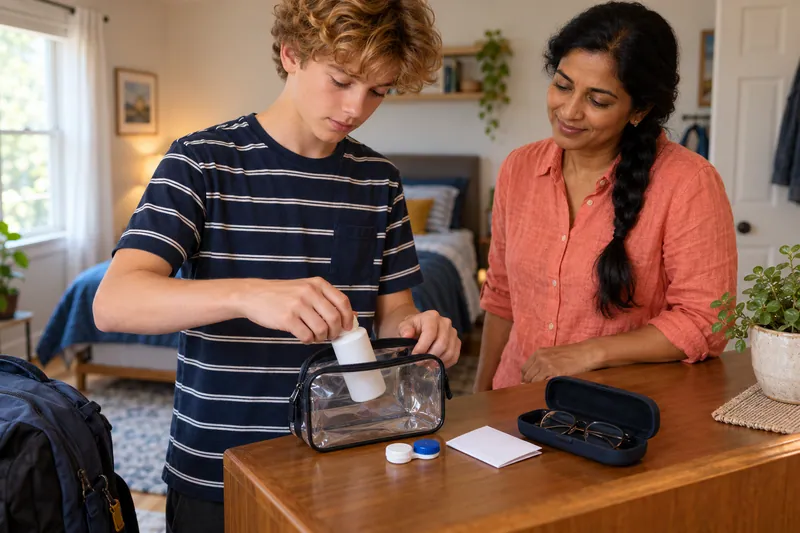
- 1Correct care product
Use the prescribed lens-care system, with original instructions and required labeling.
- 2Suitable case
Have the right case and agreed backup supplies.
- 3Backup glasses
Keep usable correction accessible if lenses cannot be worn.
- 4Contact information
Know the usual and out-of-hours care route before leaving.
The annotated photograph identifies visible supplies. It is an example of organization, not a complete kit for every prescription. Match it to the child and the actual instructions. Do not choose a solution because its bottle looks similar to the one in an illustration.
Use original, clearly identified containers where required. Do not decant a care product into a small unlabelled bottle or transfer prescription drops into another container to save space. The FDA advises using the appropriate contact-lens care products and following instructions. [3]
Check quantities and dates before the last evening. If something will run out, contact the usual supplier or prescriber. An unfamiliar replacement bought in a hurry may not be compatible with the child's lens or care system.
Distinguish daytime contacts from prescribed overnight Ortho-K
Daily-wear contact lenses and overnight orthokeratology have different intended schedules. A child wearing daily-wear lenses should remove them for sleep, including an unplanned nap during travel. Do not extend wear simply because a flight is long. [3]
Ortho-K is specifically fitted for overnight use according to an individual prescription. Follow that schedule and the associated care instructions. Ask the fitter in advance how to manage a disrupted sleep period, missed wear or a time-zone change. Do not improvise a new schedule from a general rule about sleeping in contacts.
VISUAL GUIDE 2 / 3
Daily-wear contacts and overnight Ortho-K have different instructions
| Situation | Sleep-related instruction | What still applies |
|---|---|---|
| Daily-wear contact lenses | Remove for sleep, including naps | Correct care, water avoidance and prompt attention to symptoms |
| Prescribed overnight Ortho-K | Follow the exact fitter’s overnight schedule | Correct care, water avoidance and infection-risk precautions |
| A disrupted journey or missed routine | Ask the prescriber about the actual product | Do not improvise a new wear schedule |
The comparison separates two situations that otherwise sound contradictory. It does not make overnight wear risk-free or suggest daily-wear lenses can be used as Ortho-K. Contact-lens infection risk remains part of the professional discussion.
The American Academy of Orthokeratology and Myopia Control (AAOMC) provides resources explaining Ortho-K and other myopia options. Use those resources to prepare questions, while relying on the professional who fitted the child's lenses for individual travel instructions. [5]
Make a water plan before the first swim
Contact lenses should stay away from water. The CDC advises removing them before swimming or showering. Water can carry organisms that cause serious infection, even when it looks clean or has been treated for ordinary use. [2]
Discuss vision for water activities before leaving. The child may need prescription swim goggles or another suitable plan. Do not assume standard goggles make contact-lens use in water safe, and do not leave a child without useful vision in an unfamiliar pool or beach setting.
Avoid using tap water, bottled water or saliva to rinse or store lenses. Use the correct care system. If you cannot provide the required conditions, contact the prescriber about a safe alternative rather than creating a substitute routine.
If water reaches a lens, follow the lens-specific instructions and seek professional advice when needed. The CDC describes removing the lens and appropriate disposal or disinfection. Symptoms such as pain, redness, light sensitivity or changed vision need prompt assessment. Do not continue lens wear through symptoms to keep a holiday on schedule. [2]
Decide what to do when the routine breaks
A care routine can fail for ordinary reasons. The case cracks, the correct solution is missing or the child is too unwell to manage lenses. The useful question is what safe alternative was agreed before the trip.
VISUAL GUIDE 3 / 3
When travel disrupts care, use a safe route
Do not create a water rinse or substitute care system. Use the agreed backup and contact the prescriber.
Use the planned alternative and seek appropriate help. Do not borrow another person’s prescription.
Remove contact lenses when appropriate and seek prompt professional assessment. Do not keep wearing them through symptoms.
The response pathway starts with stopping an unsafe workaround. It does not tell you to make an independent treatment change. Use backup glasses if they are the agreed alternative, and contact the care team for advice about the specific problem.
Keep contact details somewhere available without relying on one phone. A printed card or a secure accessible note can include the clinic's usual and out-of-hours route. For an international trip, ask how the family should seek local care if the original practice cannot provide immediate help.
Know the difference between a practical query and an urgent symptom. A missing case can be discussed with the care team. Sudden vision loss, severe eye pain, an eye injury or a symptomatic contact-lens eye needs prompt medical attention. Do not wait until returning home simply because the next booked appointment is there.
Prepare the child and the supervising adult
A child may be confident at home but uncomfortable handling supplies in an unfamiliar place. Ask which parts of the routine they can manage and where they need help. Pack in a way they understand rather than handing them a pouch of unfamiliar items at departure.
If a relative, camp worker or other adult is responsible, explain the actual instructions and limits. They should know what must not be substituted, where backup correction is stored and who to call. Check any documentation or consent process required by the organization.
Older children should have a role without carrying every responsibility. They might help check the kit or explain a difficulty. Adults still need to make sure the care conditions, supplies and access to help are in place.
Practice the organization at home if it is new. A short trial of where items go can reveal a missing step before the family reaches a crowded terminal. Do not use the practice to change a prescribed cleaning or wear routine.
Keep the wider routine flexible
Travel often changes close work, outdoor opportunities and sleep. Aim for a manageable day rather than a perfect reconstruction of home. A child can read, watch something during a journey and enjoy the destination without every activity becoming a verdict about their myopia.
Comfortable viewing and appropriate outdoor opportunities have a place in the wider routine. They do not compensate for unsafe contact-lens care or replace prescribed treatment. Research about myopia risk should not be turned into a reason to skip necessary correction. [4]
For a long journey, make the material readable and use sensible opportunities to pause. If the child reports persistent blur or discomfort, address the symptom rather than tightening a screen timer and assuming the problem is resolved.
For more detail, the Ortho-K safety guide covers infection risk and care questions. The sleep guide explains why general sleep advice and myopia treatment are separate discussions.
Return with the plan still connected to the clinic
After travel, check supplies and the next appointment. Replace missing or damaged equipment through the appropriate route. If the routine changed, tell the clinician what actually happened, including missed wear, product problems or symptoms.
Do not restart a painful or problematic lens simply because the trip is over. Follow professional advice. The value of a travel record is a clear description of the problem, not proof that the family followed every step perfectly.
If one part of the plan was difficult, improve that part before the next trip. Perhaps the backup glasses were inaccessible, the written instructions were unclear or only one adult knew the emergency contact. Fixing the practical gap can make future travel easier.
A good plan leaves the child able to see, the responsible adult able to help and the family able to find care. It should preserve the prescribed routine while giving you a safe route when circumstances change. Prepare the fallback before departure, and use it rather than inventing a workaround under pressure.
Your travel care plan
Discussion prompts only. Checks stay on this open page; nothing is submitted or saved. This sheet does not diagnose, choose treatment or determine urgency. Do not delay urgent care to complete it.
CHECK THE EVIDENCE
Sources & references
Research, professional guidance and patient resources. Checked October 22, 2026.
- 1Travel Tips for People Who Wear Contact Lenses (archived)Centers for Disease Control and Prevention
- 2Healthy Habits: Keeping Water Away from Contact LensesCenters for Disease Control and Prevention · 2025
- 3Contact Lens CareU.S. Food and Drug Administration
- 4IMI Risk Factors for MyopiaInternational Myopia Institute · 2021
- 5Patient Resources: Myopia and OrthokeratologyAmerican Academy of Orthokeratology and Myopia Control (AAOMC)
General education. This article does not replace an eye examination, individual advice, or the prescribed care plan.