THE DAILY-LENS HANDBOOK
MiSight 1 Day: A Parent’s Guide
Explore MiSight 1 day for children: current labeling, trial evidence, handling readiness, daily-wear responsibilities and the complete follow-up plan.Explore the handling-readiness questions ↓Contact-lens treatment overview →

MiSight 1 Day is a prescription daily disposable lens that corrects blur and is FDA-approved to slow myopia progression within its U.S. indication. Starting age, prescription, eye health, and safe lens handling all matter. A fitting and follow-up are essential.
On this page
U.S. LABEL: STARTING TREATMENT
Age when treatment starts.
Spherical equivalent.
Healthy eyes and professional assessment are also required. [2]
Check the U.S. indication before discussing a fitting
MiSight 1 Day is a prescription daily disposable soft contact lens. It provides distance correction and is FDA-approved to slow myopia progression within a defined indication. It should not be treated as an ordinary contact lens that a parent can select without a fitting. [1]
The current U.S. label specifies that a child starting treatment is eight through twelve years old, has healthy eyes, and has a spherical-equivalent prescription from -0.75 to -4.00 diopters with no more than 0.75 diopters of astigmatism. An eye-care professional determines whether those criteria and the rest of the assessment fit the child. [2]
Those starting criteria are not instructions to stop on the thirteenth birthday. Continued wear, response, and monitoring are clinical decisions. Also distinguish the range of lens powers a manufacturer may supply from the prescription range covered by the starting indication. [2]
Understand what the lens is intended to do
The lens has zones that provide vision correction and other zones designed to provide a myopia-control optical signal. The aim is to slow the eye's progression while helping the child see clearly during wear. It does not permanently remove myopia or make future monitoring unnecessary. [2]
A child may still need backup glasses when lenses are off or cannot be worn. Ask which prescription those glasses should have and how they fit into the plan. Good vision in lenses does not mean a child can safely manage every activity without correction afterward.
Do not assume every daily disposable lens has the same myopia-control design or approved indication. If the practice offers an alternative soft lens, ask its name, purpose, evidence, and regulatory status. A comparison should concern the actual product rather than the broad word “contacts.”
Keep treatment separate from appearance preferences. Some children like contact lenses for sport or social reasons, but the decision still needs eye health, fitting, training, and follow-up. A child who prefers glasses should be able to discuss suitable alternatives without feeling that they have rejected care. [6]
Read the three-year trial accurately
The original randomized trial enrolled 144 children aged eight to twelve. They were assigned to MiSight or a single-vision daily disposable control lens. A total of 109 children completed three years. The study measured both prescription change and axial elongation. [3]
Mean prescription change was -0.51 diopters with MiSight and -1.24 diopters with the control lens. Mean axial elongation was 0.30 mm and 0.62 mm, respectively. The reported relative differences were 59% for prescription progression and 52% for axial elongation. Those percentages refer to different outcomes. [3]
MiSight: eye growth over three years
These are averages from one trial, not a personal forecast or a promise that progression stops. The study reported no serious ocular adverse events, but four asymptomatic corneal infiltrative events occurred. A trial without a serious event does not establish zero risk in everyday lens wear. [3]
Ask the clinician how the trial relates to your child's age, prescription, and routine. Be wary of comparing its three-year percentage with a different treatment's one-year percentage as if they were a direct head-to-head result. Suitability and monitoring matter alongside average efficacy.
Let the child try the skills before committing
Starting eligibility
Age, prescription, and eye health
Prescribing eye-care professionalLens fit and vision
Comfort, fit, and clear usable vision
Fitter and child togetherSafe routine
Handling skills and adult support
Practice, caregiver, and childOngoing plan
Measurements, supply, and reviews
Treating practice
A contact-lens assessment includes more than whether a child can tolerate something near the eye. The practice should check fit and vision, teach insertion and removal, and assess the child's ability to follow instructions with the appropriate adult support. [6]
Let your child ask for a pause during training. The first session should not become a contest to get the lens in quickly. Ask what happens if more practice or another teaching visit is needed, and whether that support is included in the quoted care plan.
A caregiver should understand the routine too. Can the child explain when lenses come out, where clean supplies are kept, and what to do if an eye hurts? If the child stays in another home, that adult needs the same instructions and contact details.
Discuss school and after-school activities before fitting. A long day may include PE, a shower, a nap, or swimming. Each needs a plan that matches daily-disposable wear, rather than a general instruction to keep the lenses in until bedtime.
Ask the practice how it decides that a child is ready to start at home. A child who needs more time is not failing. Another correction option or another training session may be the appropriate next step.
Keep single use, sleep, and water rules clear
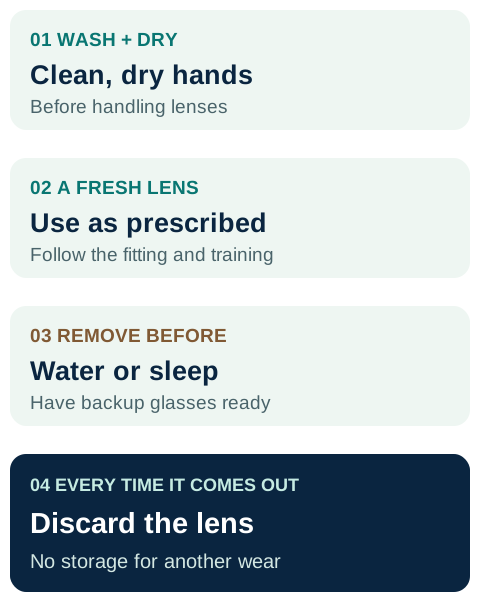
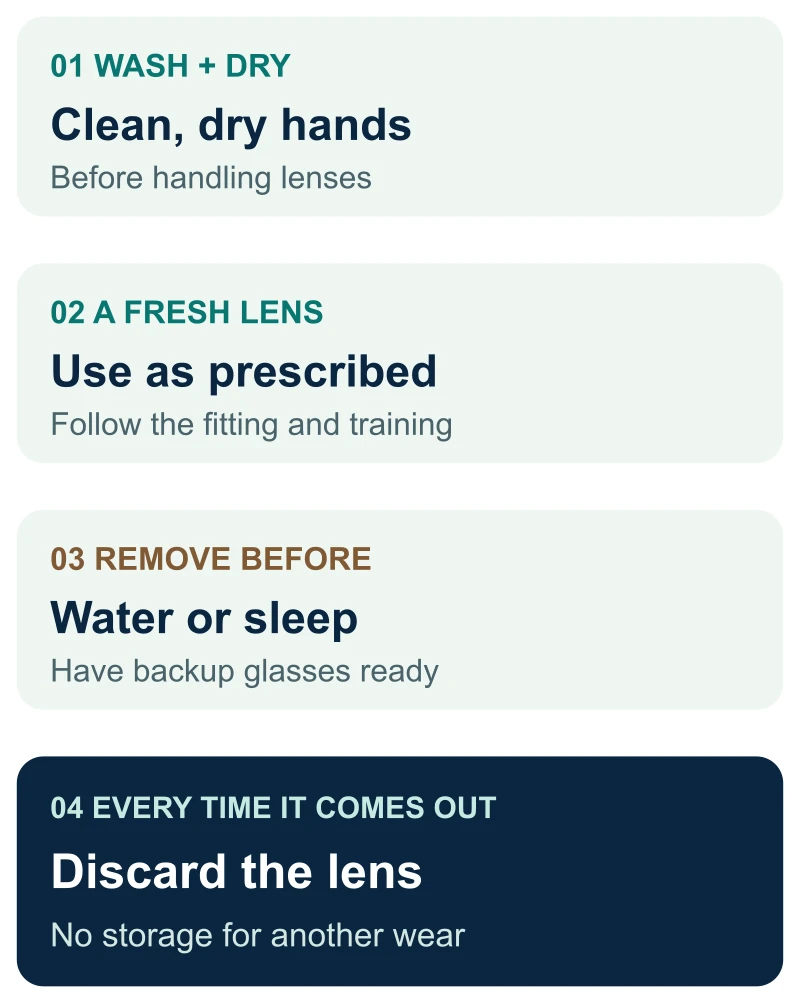
MiSight 1 Day is for daytime single use. Discard a lens whenever it is removed. Do not store it for later that day or the following morning. Follow the prescribed wearing plan and the product labeling; do not stretch a supply by reusing lenses. [2]
One lens, one use
Open the labeled diagram ↗
Do not sleep in these lenses. If the child is likely to nap, plan removal and an appropriate backup with the practice. Overnight Ortho-K is a different prescribed lens routine and does not change MiSight's daytime-only instructions. [2]
Remove lenses before swimming or showering. Water can expose the eye to organisms that cause serious infections. Swim goggles do not make contact-lens wear in water safe. Ask about prescription swim goggles or another suitable water-activity plan. [4]
Wash and dry hands before handling lenses, never share them, and do not use saliva or water on them. Check the sealed package as instructed and do not use a lens from a damaged or already opened package. Ask the practice what to do if a lens is dropped or damaged while learning. [5][2]
Build the safe choice into the day. Keep backup glasses easy to reach and make sure the child knows whom to tell at school. A lens problem should not force them to choose between seeing clearly and continuing wear that feels wrong.
Know which symptoms need prompt help
Contact-lens problems can develop quickly and sometimes threaten vision. Pain, redness, light sensitivity, discharge, or unexpected blur are reasons to remove the lenses and contact the eye-care professional promptly. Do not encourage a child to finish the day in an uncomfortable lens. [6][5]
Do not reinsert a problem lens to test whether it feels better. Use the practice's urgent instructions, including where to obtain assessment after hours. If the child's vision is reduced or symptoms are severe, seek urgent care rather than waiting for a routine review.
Ask your child how they would describe a problem to a teacher or coach. “My eye hurts and I need my backup glasses and an adult” may be enough to start getting help. They should not need to know the medical name for a possible complication.
Keep the product information and practice contact details with the family care plan. If care is shared, make sure both caregivers know the same response. This is part of learning contact-lens care, not a reason to frighten a child away from asking about it.
Compare the supply and follow-up together
Ask whether a quoted annual program includes the initial assessment, fitting, training, lens supply, progression measurements, and additional visits if there is a problem. Confirm the number of lenses supplied and what happens if some are lost or damaged during training.
Check whether the price assumes a rebate, an insurance allowance, or a purchase deadline. Verify eligibility before subtracting a benefit from the family budget. The whole-plan cost guide includes a blank planner for actual written quotes rather than an assumed national price.
Book the recommended reviews even when vision feels clear. The clinician needs to assess eye health, lens use, fit, and progression. Ask which results will be compared and when the plan would be reconsidered. Clear vision alone is not evidence that eye growth has stopped.
The American Academy of Orthokeratology and Myopia Control (AAOMC) offers patient resources on soft contact lenses and other myopia-management approaches. Use those to prepare questions and compare the responsibilities of suitable options, without assuming that one approach is best for every family. [7]
Your MiSight start-up checklist
Use these prompts with your child and eye-care team. Check marks stay only on this open page. Nothing is submitted or saved.
Questions parents ask
Does treatment have to end at age twelve?
The U.S. indication describes age at initiation. Turning thirteen is not, by itself, an instruction to stop. Ask the treating professional about continued suitability, response, and follow-up. [2]
Can a lens be reused if it was only worn briefly?
No. The labeling requires disposal after removal. Use a fresh lens according to the prescribed plan and keep backup glasses available. [2]
Does 59% mean my child will become 59% less myopic?
No. It is a relative difference in average prescription progression between groups in the three-year trial. The axial-length result was a separate 52% relative difference. Neither predicts an individual child's exact prescription. [3]
CHECK THE EVIDENCE
Sources & references
Primary research, guidance, and patient resources. Checked October 21, 2026.
- 1MiSight 1 Day: FDA premarket approval P180035U.S. Food and Drug Administration
- 2MiSight indications and safety informationCooperVision · U.S. labeling
- 3Three-year randomized MiSight clinical trialChamberlain et al. · Optometry and Vision Science · 2019
- 4Keeping water away from contact lensesCenters for Disease Control and Prevention
- 5Preventing eye infections when wearing contactsCenters for Disease Control and Prevention
- 6What to know if your child wants contact lensesU.S. Food and Drug Administration
- 7Patient resourcesAmerican Academy of Orthokeratology and Myopia Control (AAOMC)
General education. This article does not replace an eye examination, individual advice, or the prescribed care plan.