A SAFETY AUDIT AND RESPONSE PLAN
Is Ortho-K Safe? Infection Risk and Long-Term Care
Know which Ortho-K symptoms need action. Read infection estimates with their denominators, review water precautions and build a clear contact plan.Start with symptoms that need action ↓
Ortho-K can be an option for a suitably assessed child, but overnight contact-lens wear carries an infection risk. Safe care needs the exact prescribed routine, water avoidance, follow-up and a clear symptom plan. Pain, redness, light sensitivity or sudden blur needs prompt professional advice, not a wait for the next review.
On this page
First, know which symptoms need action
If a child wearing Ortho-K develops eye pain, redness, light sensitivity or sudden blur, remove the lenses and contact the eye-care team immediately. Do not put them back in until the clinician advises. Sudden vision loss or severe symptoms needs emergency eye care. A safety article should make that action clear before discussing long-term averages. [3]
A symptom cannot be declared harmless because the child has worn lenses successfully for years. Nor can an online checklist distinguish irritation from a corneal infection. Explain the exact lens type, which eye is affected, when the symptom began and whether vision has changed. Ask where the child should be assessed and what instructions apply while you arrange care.
This page examines Ortho-K safety in the context of a prescribed routine. It does not teach fitting, choose a cleaning system or tell families to manage symptoms at home. Keep the practice's daytime and out-of-hours contact details with the care supplies. A clear response plan is useful even when you hope never to need it.
VISUAL GUIDE 1 / 3
Warning symptoms: act before the routine review
- Remove the lenses
Contact the eye-care professional immediately for advice and assessment.
- Escalate severe symptoms
Sudden vision loss or severe symptoms need urgent emergency assessment. Do not wait for a booked routine appointment.
- Keep lenses out
Do not reinsert them until the clinician advises. Do not delay a call to collect a perfect history.
Separate the vision effect from the safety question
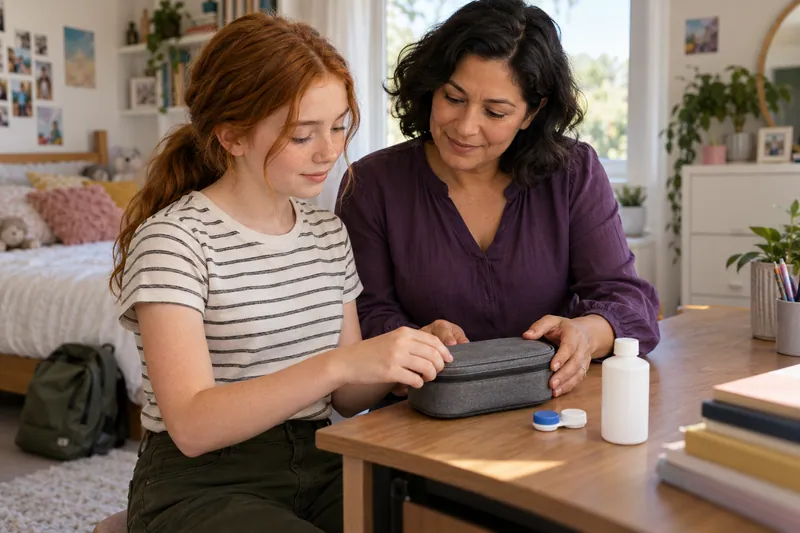
Ortho-K uses specially fitted rigid contact lenses to change the cornea's shape temporarily. Overnight lenses are removed after the prescribed wear period. The FDA explains that the vision-correction effect wears off when treatment is discontinued. Clear daytime vision is therefore not proof that the eye is healthy, or that myopia progression has stopped. [4]
The safety discussion concerns the cornea, the lens fit, handling, wear, cleaning and clinical review. The progression discussion asks how myopia is changing over time. Both belong in care. A child who sees well still needs scheduled checks, and a good progression result does not remove the need for safe lens use.
Ask the prescriber to explain the exact lens and its intended use. Do not assume that instructions for a friend's Ortho-K lenses, a daytime soft lens or an online cleaning video apply to your child's system. The complete prescription includes more than the lens power. The care products, replacement arrangements and follow-up instructions also need to be understood by the adults supporting the child.
What one infection study can tell us
A multicenter retrospective study at four hospitals in Japan reviewed 1,438 Ortho-K wearers. It recorded four cases of microbial keratitis over 7,415 patient-years of wear. The estimated incidence was 5.4 cases per 10,000 patient-years, with a 95% confidence interval from 1.0 to 9.8. The paper appeared online in 2024 and in the January 2025 journal issue. [1]
Keep the denominator beside the number. Patient-years combine the time people were observed; they are not a count of 10,000 individual children. The sample's mean age was 12.7 years, with a standard deviation of 5.4 years. This is not a universal pediatric rate or a guarantee about another practice, lens system or child. The retrospective design and small number of infection cases also matter.
The estimate helps describe an uncommon but potentially serious event. It should neither be converted into “no risk” nor presented as a prediction that a particular child will develop an infection. Comparing this number directly with a rate from a differently designed study can also mislead. Ask how the prescriber explains the available evidence and the practical safeguards in your child's care.
VISUAL GUIDE 2 / 3
Keep “patient-years” beside the number
95% confidence interval: 1.0–9.8. A patient-year is a unit of observation time, not an individual child.
Long-term experience does not cancel daily responsibilities
A family may become more confident as lens handling becomes familiar. That is useful, but routines can also drift. Supplies change, travel interrupts the usual setting, a child becomes more independent and another caregiver takes over. A plan that worked at fitting needs to remain workable later.
At review, describe the actual routine rather than the one you think the practice expects. Mention missed wear, discomfort, damaged lenses, water exposure or difficulty obtaining the prescribed products. These details help the clinician address the problem. They are not an admission that the child should be blamed or that every deviation has caused harm.
Also ask what changes need a call before the scheduled appointment. A lost lens, repeated difficulty removing it or new discomfort can require advice even when it is not an emergency. Keep backup vision correction available as directed, so that the child is not tempted to continue an unsuitable routine simply because they need to see at school. Never change the prescribed wear schedule to compensate for a missed night without guidance.
Water avoidance is part of contact-lens care
CDC guidance advises keeping contact lenses away from water and removing them before showering or swimming. Do not rinse or store lenses in tap, bottled or homemade water-based solutions. Water can contain organisms that cause serious corneal infection. The specific cleaning and disinfection instructions still come from the prescribed lens-care system and professional team. [2]
For Ortho-K, ask the practice to walk through the morning and evening sequence, including when lenses are handled in relation to washing or bathing. Washing and drying hands is different from letting water touch a lens. If the written instructions seem unclear about a step, ask for a demonstration or clarification rather than improvising.
Plan for unusual days. A sleepover, school trip or overnight visit may put the supplies in a different room with a different adult. Decide in advance who is responsible and what to do if the required products are missing. A small travel checklist is more useful than assuming a child can remember every detail under unfamiliar conditions. If water exposure occurs, contact the practice for lens-specific advice and seek prompt assessment for symptoms.
VISUAL GUIDE 3 / 3
A safe routine needs every link
Do not rinse or store them in tap water. Remove contact lenses before swimming or showering.
Use the prescribed products and the taught cleaning, wear and replacement routine. Do not substitute products casually.
Know the urgent contact number, the backup correction and the plan for travel or lost supplies.
Handwashing and thoroughly drying hands are different from exposing lenses or a case to water. This diagram does not replace hands-on teaching.
Make the written plan specific enough to use
Before leaving a fitting or review visit, check that the family can identify the lens, care products, wear instructions and next appointment. Ask what the practice expects you to do with a damaged lens, an empty bottle, an unavailable product or a symptom. Record the after-hours route, not only the reception number.
Check the practical route to care when the family is away from home. Ask whether the practice can provide a short treatment summary and whom to contact if the usual team is unavailable. Save the details somewhere accessible without relying on the child’s phone. Planning access is different from trying to diagnose a symptom while traveling.
Each caregiver should understand the same plan. A teenager may handle much of the routine but still need help with ordering supplies and arranging care. A younger child may need direct adult supervision. The division of responsibility should reflect the individual child's skills and the clinician's advice, not an assumption that a birthday makes overnight lens care independent.
Use a teach-back conversation: explain the routine in your own words and ask the professional to correct anything missing. If instructions depend on a particular solution or device, keep that name in the record. Do not decant products into unmarked containers or treat products with different instructions as interchangeable. Ask the practice before substituting a care product, even when the packaging looks similar.
Review the whole arrangement, not only the prescription
A safety review should leave room for the child's experience. Ask about comfort, handling, vision during the day and whether the routine fits school and family life. Let the child explain a difficult step without being interrupted. A routine that looks simple to an adult may become hard when the child is tired or moving between households.
The prescriber should also explain how eye health and progression will be monitored. The IMI intervention review discusses treatment evidence, but a published benefit does not remove the need for individual assessment and follow-up. [5] If the practical arrangement is repeatedly failing, ask whether it needs additional teaching, support or a different approach. Do not turn persistence with an unworkable routine into a test of the child's effort.
The main Ortho-K guide explains the treatment's role. The side-effect guide compares symptom conversations across treatments. This safety page focuses on the ongoing responsibilities of overnight lens wear and on interpreting research without losing sight of the individual plan.
Decide with an honest view of both benefit and burden
The right question is not simply whether Ortho-K is “safe” in the abstract. Ask whether the proposed treatment is appropriate for this child, whether the family can carry it out safely and how problems will be recognized and managed. A discussion should include the possible benefit, infection and other risks, alternatives, monitoring and the work involved.
The American Academy of Orthokeratology and Myopia Control (AAOMC) provides patient information that can help prepare those questions. [6] Its resources sit alongside clinical research and public-health guidance; listing the Academy does not imply that it has endorsed this site or assessed your child.
Leave with a plan that another caregiver could follow. Keep the exact instructions accessible, keep supplies current and call when something is unclear. Good information should support an informed decision and prompt care when needed. It should not promise that careful behavior eliminates every risk, or make a family feel they must continue a treatment that they cannot manage safely.
Your Ortho-K safety check
Discussion prompts only. Checks stay on this open page; nothing is submitted or saved. This sheet does not diagnose, choose treatment or determine urgency. Do not delay urgent care to complete it.
CHECK THE EVIDENCE
Sources & references
Research, professional guidance and patient resources. Checked October 21, 2026.
- 1Microbial keratitis with overnight orthokeratology: multicenter studyHiraoka et al. · Japanese Journal of Ophthalmology · 2025 (online 2024)
- 2Keeping Water Away from Contact LensesCenters for Disease Control and Prevention · 2025
- 3What Causes Contact Lens-related Eye InfectionsCenters for Disease Control and Prevention
- 4Types of Contact Lenses: OrthokeratologyU.S. Food and Drug Administration
- 5Interventions for Controlling Myopia Onset and ProgressionInternational Myopia Institute · 2025
- 6Patient Resources: Myopia and OrthokeratologyAmerican Academy of Orthokeratology and Myopia Control (AAOMC)
General education. This article does not replace an eye examination, individual advice, or the prescribed care plan.