A PRACTICAL FOOD NOTEBOOK
Food and Children’s Eye Health: What Nutrition Can and Cannot Do
Plan varied, affordable foods for children’s eye health. Check supplement claims and understand why vitamin A and AREDS2 are different questions.Explore the everyday food notebook ↓Understand a myopia diagnosis →
A varied diet supports normal health, including the eyes, but foods and “eye vitamins” are not established substitutes for myopia control. Treat a suspected deficiency with professional advice. Check supplement claims, age suitability and ingredients, and keep glasses, examinations and prescribed treatment in place.
On this page
Feed the child, not a promise about their prescription
Food supports a child’s health, growth and normal visual function. It should also be enjoyable, affordable and workable for the family. A conversation about eye health should not turn ordinary meals into a search for an expensive ingredient that promises to stop myopia.
If a child’s prescription has changed, buying a supplement is not a substitute for an eye examination or a review of treatment. Myopia involves how the eye focuses light, and established care decisions require information about the individual child. Nutrition has an important place without being asked to do a different job.
The National Eye Institute encourages a varied diet as part of healthy vision. That is useful general guidance. It is not evidence that a particular food reverses myopia or means a child no longer needs glasses. [1]
Separate three different questions
“Is this food part of a balanced diet?”, “Does this child have a deficiency?” and “Will this change myopia progression?” are different questions. They need different evidence and sometimes different professional advice.
VISUAL GUIDE 1 / 3
Do not let one food claim answer three questions
| Question | What is needed? |
|---|---|
| Balanced diet? | A varied, suitable eating pattern that supports normal health. No single “superfood” is required. |
| Deficiency? | A clinical assessment when indicated and individualized treatment if a problem is identified. |
| Myopia control? | Evidence for the claimed effect on onset or progression in the relevant population, not a general nutrient fact. |
A balanced diet supports normal function over time. A suspected deficiency needs assessment and an appropriate treatment plan. A claim about controlling myopia needs evidence about that outcome in a relevant population, using the product or intervention being proposed.
Do not let a general statement about a nutrient’s role in vision silently become a claim about prescription change. A label saying “supports eye health” may not be making, or proving, the stronger claim a worried parent hears.
If a child has a very limited diet, poor growth, a medical condition or difficulty accessing food, raise that concern with their pediatric or nutrition team. The priority is to understand the child’s needs, not to assemble several overlapping “eye” products without guidance.
Build variety with foods the family already uses
Start with ordinary meals. Different fruits and vegetables, protein foods and other suitable staples can contribute to a varied pattern. The National Eye Institute highlights foods such as leafy vegetables and fish in its general healthy-vision advice. It does not require every family to eat the same menu. [1]
Think in flexible groups rather than a list of perfect ingredients. A child who does not like one vegetable may accept another preparation or a different food. Frozen and canned options can make variety more practical, depending on the family’s budget and needs.
VISUAL GUIDE 2 / 3
Ordinary foods. Flexible choices.
| Start with | Make it work |
|---|---|
| Variety | Choose suitable fruits and vegetables in familiar forms. Fresh, frozen or canned options may fit. |
| Suitable protein foods | Use foods the family accepts, considering allergies, restrictions, cost and preparation. |
| Repeatable meals | Build ordinary combinations that fit the budget and cooking facilities. |
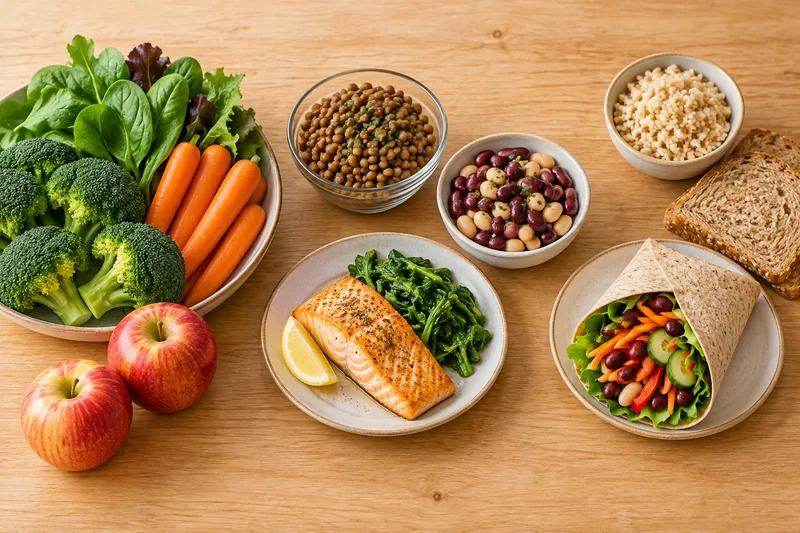
Illustrative food image. Flexible examples, not a prescribed menu, nutrient-dose chart or myopia treatment.
Use familiar cultural foods. Beans, lentils, vegetables, eggs, fish or other foods may already appear in meals the family enjoys. A useful plan builds on that pattern instead of replacing it with a fashionable “eye-health bowl.”
Be careful about allergies, choking risks, dietary restrictions and food preparation needs. A picture of a meal is not an individual nutrition prescription. A child’s care team can help when choices are restricted or a condition makes general advice unsuitable.

What vitamin A does not tell you about myopia
Vitamin A is needed for normal vision and other body functions. Deficiency can cause serious health problems. The National Institutes of Health Office of Dietary Supplements explains both its role and the risks of excessive intake, particularly preformed vitamin A. [2]
Those facts do not mean that extra vitamin A will improve every child’s eyesight. A nutrient can be essential without extra amounts treating a condition that has a different mechanism. Do not use a child’s myopia prescription as evidence that they have a vitamin deficiency.
Before giving a supplement, check what the child already receives from other products and whether a professional has identified a reason for it. Multivitamins, separate nutrients and combination “eye” supplements can overlap. More products can make the total harder to understand.
Ask a pharmacist or clinician about safety, interactions and suitability when considering a product. This page does not set a dose. If a deficiency is diagnosed, follow the individualized treatment and monitoring instructions rather than borrowing a dose from an online discussion.
Why AREDS2 is a different conversation
Parents sometimes encounter eye supplements marketed with references to AREDS or AREDS2. The National Eye Institute describes these formulations for particular stages of age-related macular degeneration. That is a condition and patient group different from childhood myopia. [3]
Evidence for a formulation in an adult retinal condition cannot simply be transferred to a child whose glasses prescription is changing. The name of a well-known study does not make a product appropriate for every eye problem.
Do not give a child an adult eye formula because its label looks more specialized than an ordinary multivitamin. Such products may contain substantial amounts of nutrients and can carry risks. Ask about the actual indication and the evidence for the child’s situation before purchase.
A useful question is, “What condition was this formula studied for, and does my child have that condition?” If the answer concerns an older adult disease, the claim needs a much better explanation before it belongs in a child’s myopia plan.
Check a supplement claim before paying for it
A persuasive advertisement may combine an accurate fact, an appealing photograph and a claim the evidence does not establish. Slow down long enough to identify the exact promised result.
VISUAL GUIDE 3 / 3
Follow the claim before following the purchase link
- Name the promised outcome
General nutrition, relief of discomfort, lower prescription or slower progression? These claims need different evidence.
- Find the actual study
Same product, relevant age group, suitable comparison and the outcome being promised? A testimonial is not enough.
- Check the population
AREDS2 concerns certain stages of age-related macular degeneration, not routine childhood myopia.
- Review safety before use
Ask about ingredients, overlapping products, interactions and individual need. Do not delay eye care to try a supplement.
Does the advertisement promise general support, relief of discomfort, a lower prescription or slower eye growth? Those are not interchangeable outcomes. Look for a study of the actual product in the relevant age group, with a meaningful comparison and an outcome that matches the promise.
A testimonial cannot answer that question. A child’s prescription may change for several reasons, and a story rarely tells you what else happened at the same time. Before-and-after images of a chart can also hide differences in testing conditions or correction.
The International Myopia Institute’s review of interventions is a useful place to understand the broader evidence for managing onset and progression. Use a treatment discussion with an eye-care professional to put claims in context. A supplement purchase should not delay that conversation. [4]
Make the plan affordable and calm
Families should not need a premium shopping list to care about a child’s eyes. Identify what is already working, what is hard to obtain and where a small change might help. A consistent breakfast or an accepted source of protein may matter more to the family’s daily nutrition than a specialty product.
If food cost is the main barrier, say so directly to the child’s health team. Ask about suitable community resources or dietetic support where available. Advice is more useful when it respects the actual budget and cooking facilities.
Avoid making the child responsible for protecting their prescription through every bite. Pressure and fear can make meals more difficult, especially for a selective eater. Offer variety in a supportive way and seek help if eating difficulties are persistent or concerning.
Invite the child to participate where safe. Choosing between two suitable foods, assembling a wrap or helping with a shopping list can make the plan feel ordinary. Participation should fit the child’s age, abilities and food-safety needs.
Keep nutrition beside the eye-care plan
At the next eye appointment, explain what correction or myopia treatment is being used and ask how progress will be monitored. If the family is considering supplements, bring the product name and ingredient list so a professional can review the actual proposal.
The American Academy of Orthokeratology and Myopia Control (AAOMC) provides patient information about myopia and care options. It can help prepare questions about treatment and follow-up, while a pediatric or nutrition team addresses dietary concerns. These roles can support one another. [5]
A practical plan might have two separate actions: arrange the recommended eye follow-up and make a feasible improvement to meals. Keeping them separate prevents a general health habit from becoming an unproven treatment promise.
If the prescription changes despite a balanced diet, that does not mean the child ate the wrong food. Return to the clinical plan and ask what the measurements show. Good nutrition remains worthwhile, even when it is not the answer to the myopia question.
If the immediate concern is a changing prescription, the younger-child care guide explains how assessment and suitability shape a plan. The vision warning-sign guide helps you describe what you have noticed.
Your food and supplement questions
Discussion prompts only. Checks stay on this open page; nothing is submitted or saved. This sheet does not diagnose, choose treatment or determine urgency. Do not delay urgent care to complete it.
CHECK THE EVIDENCE
Sources & references
Research, professional guidance and patient resources. Checked October 21, 2026.
- 1Healthy Vision Tips for KidsNational Eye Institute
- 2Vitamin A and Carotenoids: Consumer Fact SheetNIH Office of Dietary Supplements
- 3AREDS 2 Supplements for Age-Related Macular DegenerationNational Eye Institute
- 4Interventions for Controlling Myopia Onset and ProgressionInternational Myopia Institute · 2025
- 5Patient Resources: Myopia and OrthokeratologyAmerican Academy of Orthokeratology and Myopia Control (AAOMC)
General education. This article does not replace an eye examination, individual advice, or the prescribed care plan.