YOUR APPOINTMENT, STEP BY STEP
Your Child’s Myopia Appointment: What to Expect
Prepare for your child’s myopia appointment: check the visit type, gather useful records, understand the tests and leave with clear next steps.See which records to bring ↓

A myopia-control visit looks beyond the glasses prescription. The team reviews eye health, previous results, daily routines, and treatment options. Ask which measurements will be repeated and when your child should return.
On this page
Before you book, ask what kind of visit it is
A routine eye examination, a myopia consultation, and a contact-lens fitting may be separate appointments. When you call, say whether your child has just been diagnosed, has a changing prescription, or is already using treatment. Ask what the scheduled visit includes so you know what to bring and what decisions may be possible that day.
You can also ask about visit length, dilation, and whether a second fitting or training visit is likely. If your child needs an interpreter, accessible equipment, extra time, or support with unfamiliar procedures, mention that while booking. These are practical needs to plan for, not reasons to delay asking for care.
A myopia-control assessment looks at more than how clearly a child can read a chart. It considers the prescription, eye health, progression, and the suitability of different care options. The tests depend on the child and the treatment being considered. [1]
Bring a small set of useful records
Bring current glasses, previous prescriptions if available, and details of any myopia treatment already tried. Include the treatment name, start date, and why it was changed or stopped. If records are held elsewhere, ask the practices how to transfer them securely before the visit.
List medicines, allergies, eye symptoms, and relevant health history. Tell the team if your child was born very prematurely or has had eye surgery. Share a family history of high myopia or retinal problems when you know it. You do not need to guess missing information. [1][2]
For contact-lens wearers, ask the practice what lenses, case, solutions, or packaging to bring and whether wear needs to change before testing. This is especially important with Ortho-K, which alters corneal shape. Follow the practice's instructions rather than stopping or continuing lenses based on a general article.
Choose two or three priorities with your child before leaving home. A parent may want to know about eye growth while the child wants to know whether they can play a sport or manage a school trip. Put both on the list. It helps the discussion address the family's actual concerns.
Explain the visit in words your child can use
A simple explanation might be, “The team will find out how you see and check that your eyes are healthy. Some tests use pictures, lights, or drops. You can tell them when you need a pause.” Avoid promising that nothing will feel strange or that the visit will take a specific short time.
Ask the practice how it prepares children for drops or unfamiliar equipment. Some children do better when the next step is explained immediately before it happens. Others prefer a fuller explanation beforehand. Let the team know what has helped at previous visits.
Bring sunglasses if dilation is planned. Drops can leave vision blurry and eyes light-sensitive for a period afterward. Ask the practice how the expected effects fit with schoolwork, travel, or activities later that day. The exact duration depends on the drops and the child. [3]
Give an older child time to answer questions directly. If they say a routine is difficult, let them finish before filling in the details. Their account can help the clinician understand a problem that is not obvious from the prescription alone.
Understand what the main measurements mean
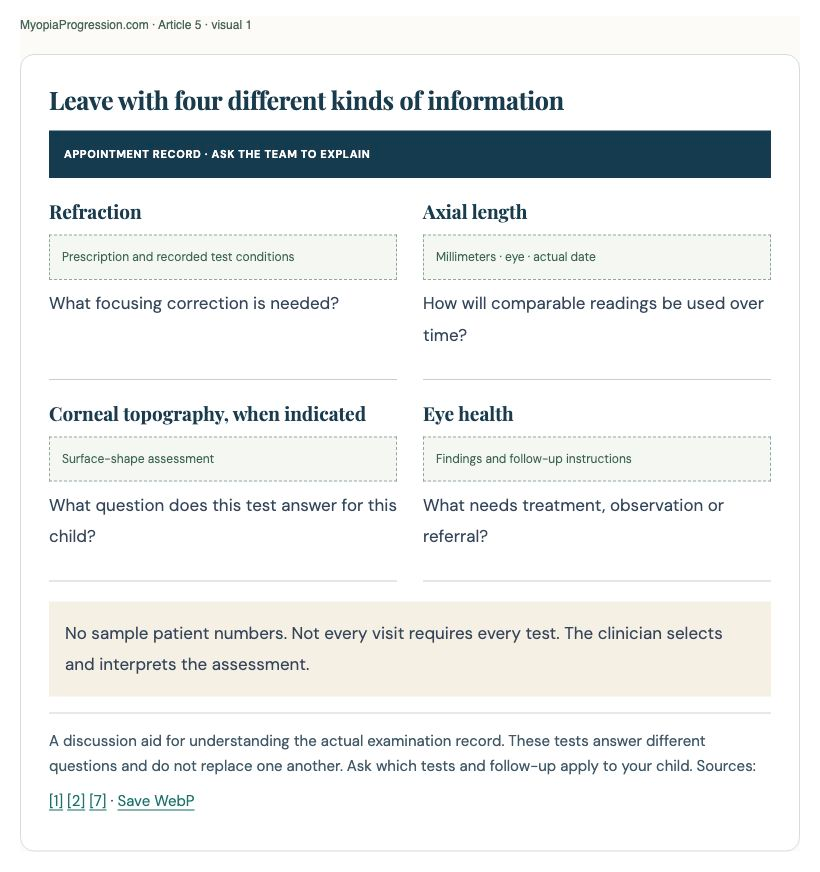
Leave with four different kinds of information
Refraction
Prescription and recorded test conditionsWhat focusing correction is needed?
Axial length
Millimeters · eye · actual dateHow will comparable readings be used over time?
Corneal topography, when indicated
Surface-shape assessmentWhat question does this test answer for this child?
Eye health
Findings and follow-up instructionsWhat needs treatment, observation or referral?
No sample patient numbers. Not every visit requires every test. The clinician selects and interprets the assessment.
Visual acuity describes how clearly a child sees a test target. Refraction measures the lens power needed to focus vision. Neither result is a complete eye-health examination on its own. Cycloplegic refraction uses drops to temporarily relax the eye's focusing effort, which can improve the accuracy of a child's prescription assessment. [2]
Axial length is the distance from the front to the back of the eye. When available, repeat measurements can help the clinician assess growth alongside refraction. A single number should be interpreted in context, including age and earlier results; it is not a parent-operated pass-or-fail test. [1]
Corneal topography maps the shape of the clear front surface of the eye. It is especially relevant when fitting Ortho-K. Retinal examination checks the back of the eye. These tests answer different questions, so ask which finding supports the recommendation being made. [1]
Do not worry about memorizing every term during the visit. Ask for the main results in writing and a plain-language explanation. A useful question is, “What changed since the last reliable measurement, and what does that change mean for our next step?”
Talk through options before choosing
Ask the clinician to separate the goal of correcting blur from the goal of slowing progression. Some prescribed options address both. Atropine drops, for example, do not replace distance correction. Ordinary single-vision glasses should not be assumed to provide the same myopia-control effect as a treatment designed for that purpose. [5]
The recommendation should make sense for your child's prescription, eye health, age, daily routine, and ability to use the treatment safely. Ask why a particular option fits and what alternatives are reasonable. A list of products is less useful than understanding how the team reached its recommendation. [5]
For contact lenses, ask about fitting, training, adult supervision, water exposure, sleep, and what to do if a lens is uncomfortable. Readiness is more than enthusiasm for a new look. The child and caregiver need to understand and carry out the prescribed routine. [4]
The American Academy of Orthokeratology and Myopia Control (AAOMC) offers patient resources on Ortho-K and other approaches. Use them to prepare questions, then check the specific product, instructions, risks, and follow-up with the prescriber. [6]
A good discussion leaves room for uncertainty. No option guarantees that a child's prescription will stop changing. Ask how the team will judge benefit, what would prompt a change, and what happens if the first choice does not suit your child.
Leave with a plan you can explain at home
Before the visit ends, repeat the main plan back in your own words. Include what your child uses, when they use it, who helps, and when the team checks it again. If a step is unclear, ask for a demonstration or written instructions before you leave.
Separate early fitting or safety checks from longer-term progression reviews. A lens may need checking soon after it is fitted even though a meaningful eye-growth comparison takes longer. The schedule should come from the treating practice rather than a generic calendar. [1]
Ask for the practice's routine and urgent contact routes. Know whom to call after hours, especially if contact lenses are involved. Ask which symptoms mean stopping lens wear and seeking prompt assessment. Do not let a family planning worksheet replace the practice's emergency instructions. [4]
Discuss fees while the plan is still being formed. Which visits, measurements, supplies, or replacements are included? Is a later year priced differently? The cost comparison guide provides a way to compare written quotes without assuming every package contains the same care.
Your appointment preparation sheet
Use these prompts with your child and eye-care team. Check marks stay only on this open page. Nothing is submitted or saved.
Keep the visit summary with the actual prescription and product instructions. If care is shared between households, give each caregiver the same plan. Your child should not have to carry a complicated medical message between adults.
When the recommendation is hard to follow
Say so before agreeing to a routine your family cannot maintain. The obstacle may be handling lenses, getting to appointments, paying for supplies, or managing care during a school trip. Ask which parts are essential and whether another suitable approach would fit better.
If you want time to decide, ask what should happen in the meantime. Confirm the correction your child should wear and the timing of the next assessment. Do not let uncertainty about a treatment package leave a child without clear vision or follow-up.
A second opinion can be useful when you do not understand the recommendation or when options differ. Bring the existing records and explain the question you want answered. That makes the second discussion more useful than starting again from a remembered prescription.
Questions parents ask
Will every appointment include all of these tests?
No. The examination is tailored to the child, earlier findings, available equipment, and the treatment under consideration. Ask why a test is recommended and what decision it informs. [1][2]
Does a stronger prescription mean treatment has failed?
A changing prescription needs interpretation, not an automatic verdict. Ask about the measurement conditions, eye growth, wear routine, and the expected course for your child. The team may recommend continuing, adjusting, or changing care. [5]
What is the most useful question to ask before leaving?
Try: “What do we do next, when do we return, and whom do we call if there is a problem?” Write the answer down. A clear next step is more useful at home than trying to remember every detail of the consultation.
CHECK THE EVIDENCE
Sources & references
Primary research, guidance, and patient resources. Checked October 21, 2026.
- 1Clinical management myopia guidelinesInternational Myopia Institute
- 2Pediatric eye evaluations preferred practice patternAmerican Academy of Ophthalmology · 2022
- 3Get a dilated eye examNational Eye Institute
- 4What to know if your child wants contact lensesU.S. Food and Drug Administration
- 5Interventions for controlling myopia onset and progressionInternational Myopia Institute · 2025
- 6Patient resourcesAmerican Academy of Orthokeratology and Myopia Control (AAOMC)
- 7How the eyes workNational Eye Institute
General education. This article does not replace an eye examination, individual advice, or the prescribed care plan.