A MEASUREMENT EXPLAINER
Axial Length: Understanding Your Child’s Eye Measurements
See what axial eye length measures, how it differs from a glasses test and which questions help you understand a child’s result over time.See what the measurement reaches ↓
Axial length is the distance from the front surface of the cornea to the retina at the back of the eye. Repeated measurements help track eye growth. A result needs context: age, previous measurements, prescription, device, and eye health. There is no single normal number for every child.
On this page
What the measurement reaches
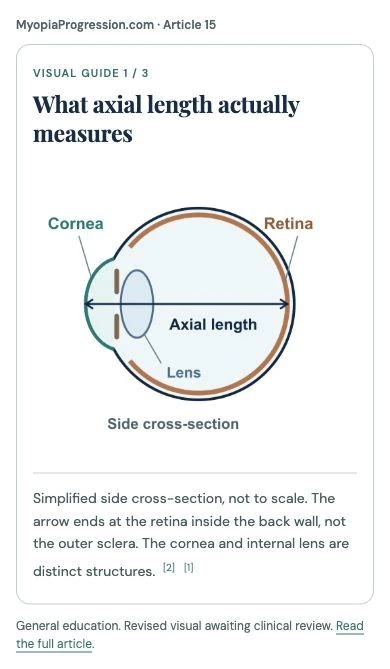
An axial-length result is a distance, usually written in millimeters. It describes how far it is from the front surface of the cornea to the retina at the back of the eye. The cornea is the clear front window. The retina is the light-sensitive lining inside the back. The natural lens sits farther inside, behind the iris. The measurement does not start at that lens. [1][2]
VISUAL GUIDE 1 / 3
What axial length actually measures
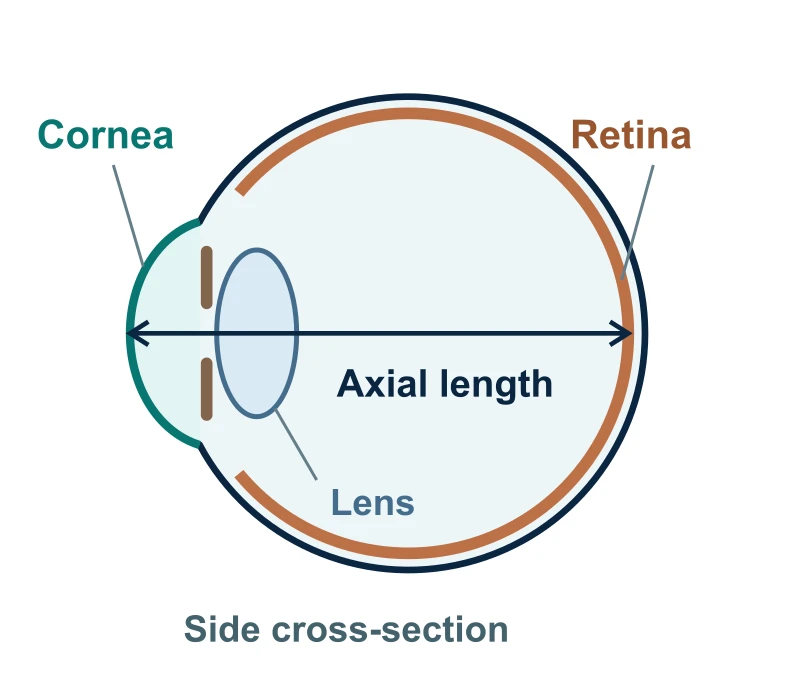
A side cross-section helps explain the distance. Looking at an eye from the front shows the colored iris and pupil, but it cannot show the front-to-back measurement correctly. In the illustration, the arrow reaches the posterior retina, inside the back wall. It does not measure across the eyelids or stop at the outside of the white coat. The drawing is simplified and is not to scale.
Myopia often involves an eye that has grown too long for its focusing power. That is why repeated eye-length measurements can be useful in myopia care. However, length is only one part of the picture. The cornea and lens also affect focus, and eye health needs its own examination. A long eye and a stronger glasses prescription are related concepts, not interchangeable measurements. [5][1]
The useful parent question is not simply, “Is this number big?” Ask, “How has this eye changed, over what interval, and what does that mean alongside the rest of the examination?” That turns a number on a printout into a discussion about care.
Read a result before judging it
Start with the identity of the measurement. Check the date, which eye it belongs to, and the unit. OD commonly means the right eye and OS the left; ask the practice to label them in plain language if the abbreviations are unfamiliar. Do not compare the right-eye result from one visit with the left-eye result from another and call the difference growth.
Next, ask whether earlier results are available from the same device. Modern optical biometers can measure eye length without touching the eye. Different instruments and measurement methods still need care when results are compared. The International Myopia Institute describes the importance of reliable instruments and consistent measurement in tracking myopia. [1]
A report may display several readings, an average, a quality indicator, or a graph. Ask which value the clinician is using and whether the measurement quality was acceptable. More decimal places do not make every tiny difference clinically meaningful. A precise-looking printout can still need a repeat measurement or a better explanation of the circumstances.
If you are transferring practices, bring the original reports when possible. A cropped screenshot may leave out the device, eye, or date. Keep the full page in a private family record rather than posting a child's medical details to a public group. The new clinician can decide which earlier results can fairly be compared with the new ones.
Four labels worth keeping together
- Eye: right or left, clearly identified.
- Date: the actual examination date, not the day a report was emailed.
- Method: the device or technique used, where available.
- Context: the prescription, current treatment, and the clinician's interpretation.
These labels prevent avoidable mix-ups. They also make it easier to ask a focused question when you return: “Are these two readings comparable?” is often a better starting point than asking an online group to interpret a single number.
A fictional example: subtraction is not a diagnosis
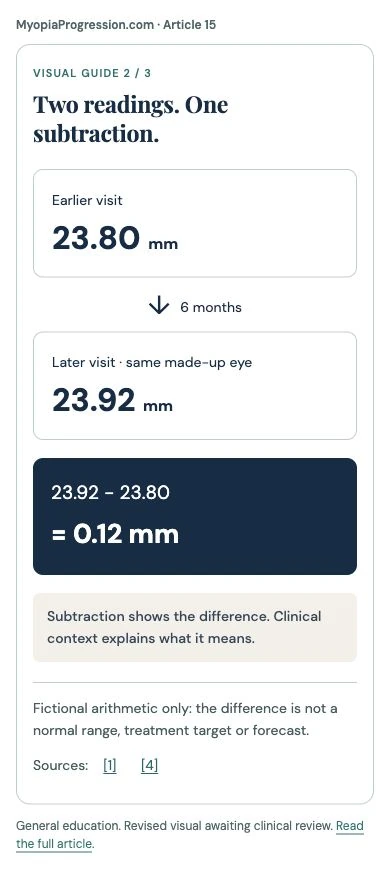
Imagine a made-up report for one eye. The first reading is 23.80 mm. Six months later, the reading is 23.92 mm. Subtracting the first from the second gives an increase of 0.12 mm. That calculation describes the difference between those two readings. It does not, by itself, tell you whether treatment should change.
VISUAL GUIDE 2 / 3
Two readings. One subtraction.
Subtraction shows the difference. Clinical context explains what it means.
These numbers are fictional arithmetic examples. They are not a target, a normal range, or a cutoff for a child. Multiplying a six-month difference by two would give an annualized rate, but that arithmetic is not a prediction of what the next six months will bring. Growth can vary over time, and measurement context matters.
Professional guidance advises interpreting progression over a suitable interval and with awareness of factors such as age and season. It also places eye-length measurements alongside refraction and the rest of the examination. [4][3] Ask the clinician why a particular interval is being used rather than deciding that every change should be doubled into a yearly forecast.
A second useful distinction is between the amount of change and the response to treatment. An eye can continue to grow while a treatment is providing benefit. To discuss response, the clinician needs the child's history and a reasonable clinical expectation, not only the hope that a number will remain exactly the same. No website can create a reliable untreated version of your own child for comparison.
Why there is no single normal number
Children differ in age, body and eye development, refractive status, and other characteristics. A single eye-length value cannot be read like a pass-or-fail score for every child. A chart may compare a result with a reference population, but the chart's population and method should be explained. [1]
Ask what a percentile or colored zone actually means. Does the chart describe children of the same age? Which population supplied the reference data? Is it showing a current position, a change over time, or a projected path? Those are different things. A reference curve can support a clinical conversation without becoming an exact forecast for one child's future.
Avoid fixed conversions such as “this many millimeters always equals this glasses prescription.” Refraction reflects the whole optical system. The same change in length does not justify a universal conversion rule for every eye. The National Eye Institute explains myopia through how light focuses relative to the retina, which depends on more than one isolated number. [5]
The language used around a graph matters for children too. “Your eye failed the test” is neither a helpful explanation nor an accurate description of a growth measurement. A better family question is, “What have we learned, and what is the next step?” Keep the discussion about care rather than a child's effort or worth.

Eye length and the glasses test answer different questions
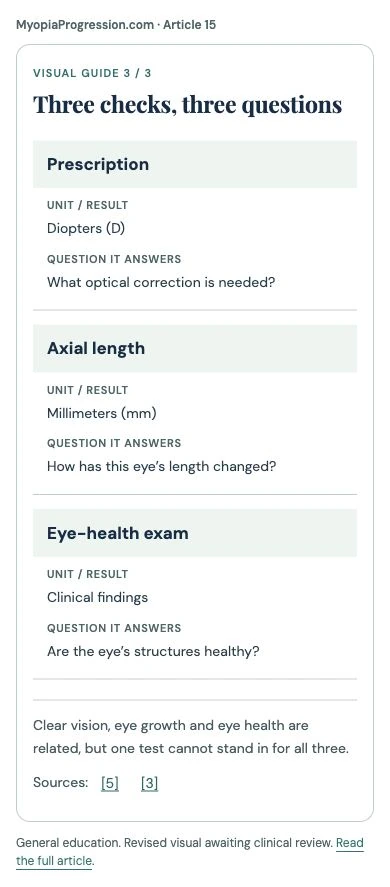
A prescription measures refractive error, commonly expressed in diopters. Axial length is measured in millimeters. A child may see clearly with an updated prescription while still needing assessment of progression. Clear vision tells you that correction is doing its visual job; it is not a direct measurement of eye growth. [5][3]
VISUAL GUIDE 3 / 3
Three checks, three questions
| Check | Unit / result | Question it answers |
|---|---|---|
| Prescription | Diopters (D) | What optical correction is needed? |
| Axial length | Millimeters (mm) | How has this eye’s length changed? |
| Eye-health exam | Clinical findings | Are the eye’s structures healthy? |
Cycloplegic refraction uses drops to temporarily relax the eye's focusing system so the clinician can assess the prescription under appropriate conditions. Whether and when it is needed is part of the examination plan. It is not replaced by measuring eye length. Likewise, a prescription check does not describe all the structures and health findings examined at an eye-care visit. [3][4]
Bring questions about any mismatch rather than assuming one result must be wrong. “The prescription changed little, but the eye-length graph moved. How do you interpret that?” gives the clinician something specific to explain. They may review measurement quality, the interval, other findings, and the treatment plan.
If a practice does not offer axial-length measurement, ask how it assesses progression and whether referral for additional measurements would help. The Association of Optometrists notes that lack of access to biometry should not prevent evidence-based myopia management. [4] Do not postpone an examination or necessary vision correction while searching for one particular machine.
Make follow-up a comparison you can understand
Before leaving, request a short explanation in ordinary words. What changed? Is the comparison reliable? Does it alter the plan? When should the next examination happen? A family should not have to work backward from an unlabeled graph to discover the intended next step.
Record any change in treatment dates separately from the measurements. If new glasses began between visits, or prescribed lenses were unavailable for a period, give the clinician the dates without guessing how much effect that had. Useful records describe what happened. They do not need to assign blame or prove that a treatment caused every change.
If you are seeking another opinion, ask for the full record, not just the most worrying number. A second clinician will need the prescription history, eye-health findings, treatment details, and earlier measurements. A long spreadsheet made from incompatible devices may be less useful than a few complete, well-labeled reports.
Your measurement record questions
Discussion prompts only. Check marks stay on this open page; nothing is submitted or stored. This tool does not diagnose, choose a treatment, or set a dose.
The American Academy of Orthokeratology and Myopia Control (AAOMC) provides patient resources for families learning about myopia management. [6] Use those resources to prepare questions, then ask your child's clinician to connect the explanation to the actual records.
A useful follow-up ends with an understandable plan: which measurements will be repeated, when they will be reviewed, and who to contact with questions. You do not need to become an expert in optical biometry. You do need to know what the number represents, why it is being followed, and what the care team will do with the information.
CHECK THE EVIDENCE
Sources & references
Primary research, guidance, and patient resources. Checked October 21, 2026.
- 1Instrumentation for myopia managementInternational Myopia Institute · 2025
- 2Eye anatomy: parts of the eye and how we seeAmerican Academy of Ophthalmology
- 3Clinical management myopia guidelinesInternational Myopia Institute
- 4Myopia management in clinical practiceAssociation of Optometrists · clinical guidance
- 5Nearsightedness (myopia)National Eye Institute
- 6Patient resourcesAmerican Academy of Orthokeratology and Myopia Control (AAOMC)
General education. This article does not replace an eye examination, individual advice, or the prescribed care plan.