THE EVIDENCE JOURNAL
Low-Dose Atropine for Myopia: What to Ask
Discuss low-dose atropine with your child’s prescriber. Check the exact prescription, pharmacy instructions, possible side effects and follow-up plan.Take these questions to the pharmacy ↓Atropine treatment overview →
Low-dose atropine may slow myopia progression, but results differ by concentration, formulation, and study. It does not replace glasses for distance blur. Choose and monitor it with an eye-care professional; never dilute drops or change the dose yourself.
On this page
Which evidence applies to the exact prescription being offered?
Compare the studies ↓Start with the exact prescription
“Low-dose atropine” describes a range of concentrations and formulations. It is not one interchangeable product. If it is offered for your child, ask which formulation is proposed, why it was chosen, and what evidence supports that choice.
Atropine for myopia control aims to slow progression. It does not provide the distance correction a child needs to see the board or recognize something far away. Keep prescribed glasses or another correction in place unless the eye-care professional changes that plan. [6]
The right discussion includes possible benefit, side effects, supply, storage, and follow-up. Do not start a relative's drops, dilute a stronger bottle, or choose a concentration from a comparison chart online. The prescriber and dispensing pharmacist should give the actual instructions.
Why the research can seem contradictory
The LAMP randomized trial in Hong Kong compared 0.05%, 0.025%, and 0.01% atropine with placebo in children aged four to twelve. At one year, the 0.05% group had the smallest average myopic shift and axial elongation among the tested groups. Higher concentrations also had greater effects on pupil size and near focusing. [1]
A U.S. PEDIG trial found that 0.01% atropine did not slow prescription change or eye elongation more than placebo over two years. It enrolled 187 children aged five to twelve. That result does not prove every atropine concentration or formulation is ineffective, but it does challenge a blanket promise about 0.01%. [2]
LAMP, Hong Kong
Three concentrations versus placebo for one year
What it adds: Results differed by concentration within that trial
PEDIG, United States
0.01% versus placebo for two years
What it adds: This formulation and concentration did not outperform placebo
LAMP phase 4
Longer follow-up with continuation and retreatment plans
What it adds: Stopping and restarting need monitoring
Differences between trials can involve the population, formulation, concentration, duration, and methods. Avoid selecting one percentage and applying it to every child. Ask the clinician how the proposed prescription relates to the evidence and what uncertainty remains.
You can say, “I have seen both positive and negative studies. Why is this a reasonable choice for my child?” A useful answer should address the specific treatment and the child's findings rather than dismissing one study without explanation.
Keep regulatory wording current
U.S. status checked October 21, 2026: AAPOS describes low-dose atropine use for myopia as not yet FDA-approved and commonly supplied through a compounding pharmacy. A specific 0.01% atropine application, NDA 219694, is scheduled for FDA advisory committee discussion on October 30, 2026. A scheduled review is not an approval. [6][4]
The meeting concerns a particular proposed product and indication. It does not automatically approve every concentration, compounded preparation, or use. An advisory committee makes recommendations; the FDA makes the regulatory decision. Check the current status again when treatment is being considered. [4]
Off-label use is a separate concept from a compounded product. Ask the prescriber to explain both in relation to the exact prescription. The presence of an approved atropine product for another purpose would not, by itself, establish approval for that product to slow childhood myopia.
If you are outside the United States, ask about the product and approval status in your own country. A medicine available in one region is not automatically approved for the same use elsewhere. Keep the current product information with the prescription so every caregiver can check the same instructions.
Ask the pharmacy questions that matter
Compounded medicines are prepared for particular needs and are not FDA-approved products. The FDA does not review them for safety, effectiveness, or quality before marketing in the way it reviews an approved drug. Poor compounding can cause problems such as contamination or an incorrect strength. [5]
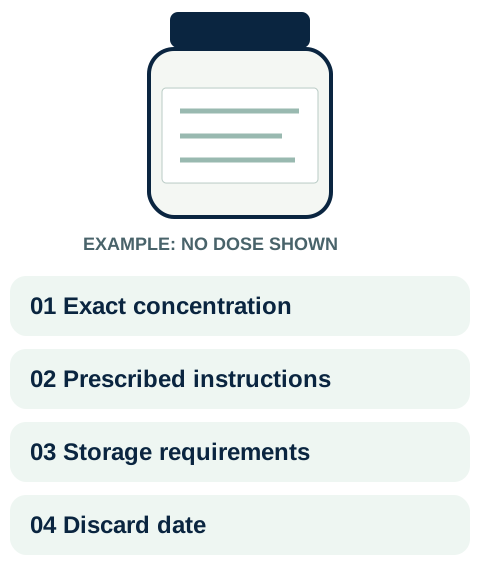
Ask who will dispense the prescription, how the concentration is labeled, how it should be stored, and when the bottle must be discarded. Follow that product's instructions. Do not assume that every low-dose preparation needs the same temperature or has the same usable life.
Four things to confirm with the pharmacy
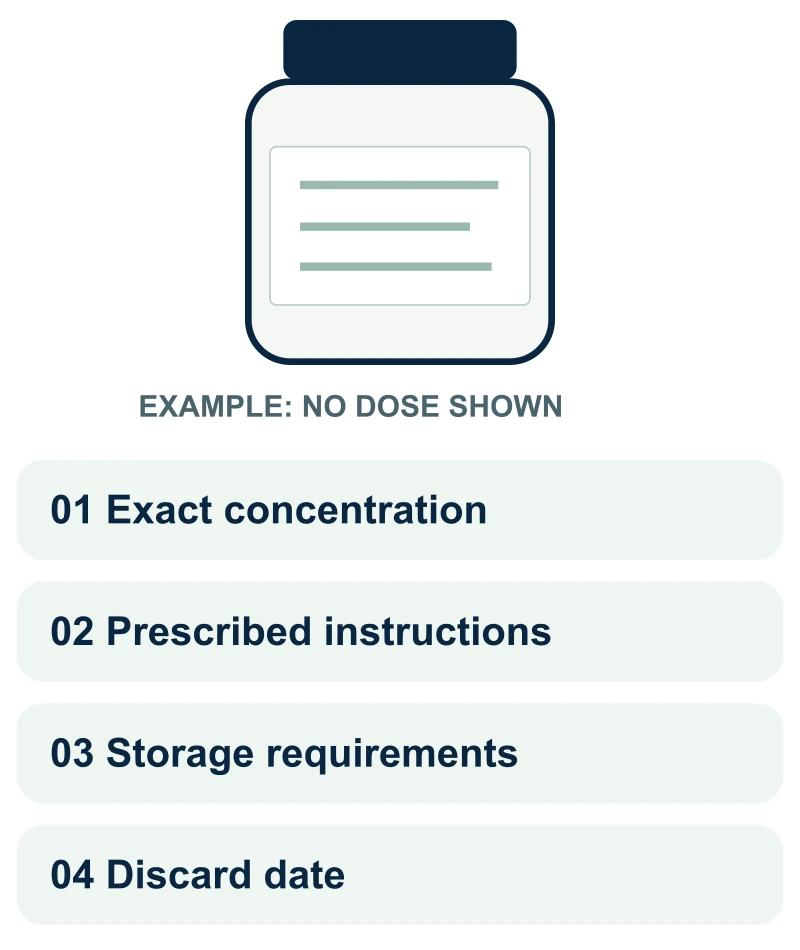
Open the labeled diagram ↗
Check how the supply reaches you. If delivery is delayed or the package is damaged, ask the pharmacy what to do. Do not decide on appearance alone that a bottle exposed to unsuitable conditions is still usable. Keep the prescription and pharmacy contact information together.
If a refill looks different, confirm the name, concentration, and instructions before using it. A change in bottle shape may be harmless, but it is a good moment to check rather than rely on color or memory. Do not transfer drops into an unmarked container for convenience.

Build a calm routine using the taught technique
Ask the practice to demonstrate administration and give instructions for the prescribed eye or eyes, timing, and amount. Have the caregiver who will usually help attend the training if possible. Let your child ask what the step will feel like.
Choose a regular cue that fits the actual prescription. Prepare what is needed before calling the child over so the routine does not become a long search for a bottle. Follow the taught hygiene steps and avoid touching the bottle tip to the eye, skin, or other surfaces.
Keep medicines away from younger children and follow the product's safe-storage requirements. If care is shared between homes, give both caregivers the written instructions and agree how they will avoid duplicate dosing. A child should not have to decide whether one adult already gave a dose.
Ask the prescriber in advance about missed doses, illness, travel, and use with any other eye medicines. Do not double the dose or change timing based on this article. Write the answer beside the routine so an uncertain evening does not become a guess.
An older child can help check supplies and explain when the routine is uncomfortable. Keep an adult involved to the degree the clinician recommends. Independence should include knowing when to ask for help, not simply doing the step alone.
Notice side effects and keep the team informed
Atropine can enlarge pupils and affect near focusing. Light sensitivity, near blur, irritation, or an allergic reaction can matter even when the dose is described as low. Ask which effects are expected, which need a call, and which require urgent assessment. [1][6]
Describe what the child notices in everyday terms. Is reading harder? Does daylight bother them? When did it begin in relation to treatment? A short account is more useful than changing the prescription yourself to see whether symptoms improve.
Severe or sudden symptoms need timely medical advice rather than a wait for the next planned review. Use the practice's urgent contact instructions. If there is a suspected overdose or accidental ingestion, seek urgent poison or emergency medical advice and have the labeled bottle available.
Do not add another eye medicine to manage a problem without checking. The clinician may need to examine the eye, review the formulation, or change the plan. A tolerable routine and a clear safety response are part of treatment, not optional extras.
Monitor benefit and discuss stopping ahead of time
A child may feel no difference while myopia changes. Follow-up therefore needs actual measurements and an eye-health review, rather than a question about whether the drops seem to work. Ask what results will be compared and when a meaningful review is due.
The longer LAMP follow-up examined continued treatment and retreatment after stopping. Many children in the cessation pathway needed treatment again under the study's criteria. That supports planning follow-up when stopping; it is not an instruction to copy the trial's dose or restart threshold at home. [3]
Ask what would lead the prescriber to continue, change, combine, or stop treatment. If another approach is discussed, check the evidence for that combination rather than assuming two treatments always produce a larger benefit. Keep cost and the family's ability to maintain the plan in the conversation.
The American Academy of Orthokeratology and Myopia Control (AAOMC) includes atropine among its patient education resources. Use it to prepare questions, then follow the specific prescription and monitoring plan your child's clinician provides. [7]
Your atropine discussion checklist
Use these prompts with your child and eye-care team. Check marks stay only on this open page. Nothing is submitted or saved.
Questions parents ask
Is 0.01% always the best starting choice?
No concentration is the automatic choice for every child. Results vary, and the U.S. PEDIG trial did not find a benefit from the tested 0.01% treatment. Ask why the specific prescription is recommended. [2][1]
Can I dilute a stronger bottle to save money?
No. Do not prepare or alter eye drops at home. Incorrect strength or contamination can harm the eye. Speak with the prescriber and pharmacist about a safe, affordable supply. [5]
Can we stop when vision is clear with glasses?
Clear corrected vision does not show whether progression has stabilized. Discuss results and a monitored stopping plan with the eye-care team. [3]
CHECK THE EVIDENCE
Sources & references
Primary research, guidance, and patient resources. Checked October 21, 2026.
- 1LAMP: randomized trial of three low atropine concentrationsYam et al. · Ophthalmology · 2019
- 2U.S. trial: 0.01% atropine no better than placeboNational Eye Institute · 2023
- 3Five-year LAMP trial: phase 4 reportZhang et al. · Ophthalmology · 2024
- 4October 30 advisory committee: atropine 0.01% applicationU.S. Food and Drug Administration · October 2026
- 5Understanding the risks of compounded drugsU.S. Food and Drug Administration
- 6Myopia and treatment of myopia in childrenAAPOS
- 7Patient resourcesAmerican Academy of Orthokeratology and Myopia Control (AAOMC)
General education. This article does not replace an eye examination, individual advice, or the prescribed care plan.