A LENS DESIGN STUDIO
Myopia-Control Glasses: DIMS, HAL, and the Questions to Ask
Compare DIMS and HAL lens designs, read each trial in context and prepare questions about frame fit, adaptation and local product labeling.Compare the two studies in context ↓Myopia-control glasses overview →
Specialized myopia-control glasses correct blur and aim to slow progression. DIMS and HAL are different lens designs, not ordinary single-vision lenses. The exact product, your child’s starting prescription and age, frame fit, and follow-up all matter.
On this page
Start with the pair your child will actually wear
A useful glasses appointment starts with a child, a frame, and a clear explanation. Ask your child to look around the room, read something, and tell the professional what feels different. The lens name matters, but so does a frame that stays in position during an ordinary school day. A treatment that spends most of the day in a case cannot follow its intended wear plan.
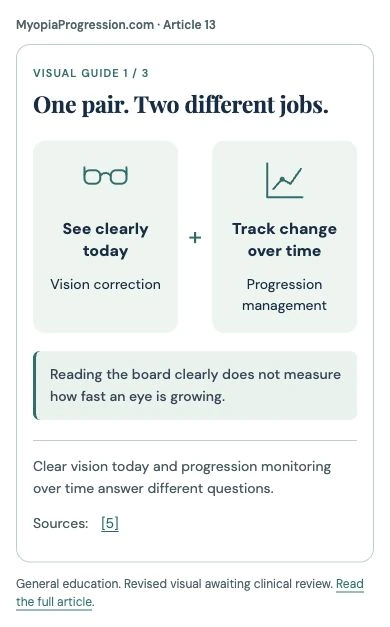
VISUAL GUIDE 1 / 3
One pair. Two different jobs.
Reading the board clearly does not measure how fast an eye is growing.
“Myopia-control glasses” is a broad description. It does not mean every lens sold under that phrase has the same design, evidence, or local authorization. Ask for the exact product name in writing. Keep it with the prescription, fitting details, and follow-up plan. This makes later conversations about replacement or a change in treatment much clearer.

Ordinary single-vision glasses correct distance blur. Specialized designs also aim to slow the worsening of myopia. Those are two separate jobs. Being able to read the board is important, but it does not by itself show how quickly the eye is growing. Your child's care plan needs a way to assess progression over time. [5]
Before discussing a purchase, describe what glasses use is like now. Does the frame slide? Are the lenses scratched? Does your child remove them for close work or feel embarrassed at school? These are useful fitting and routine questions, not evidence that your child has failed treatment. Let them speak before an adult fills in the answers.
DIMS and HAL are designs, not interchangeable labels
DIMS stands for Defocus Incorporated Multiple Segments. Its design combines a central area for vision correction with surrounding segments that provide additional optical signals. MiYOSMART is a commercial example of DIMS technology. A product description is useful for identifying the design; it should not replace the published trial or the local product information. [1][4]
HAL means highly aspherical lenslets. These lenses use small optical elements with a different design from DIMS. Stellest is associated with HAL technology. Similar aims do not make the physical designs identical, and evidence for one particular lens cannot automatically be assigned to another lens with a similar description. [2][3]
Think of the design name as the beginning of a question. “Which exact lens is this, and which study supports it for a child like mine?” is more useful than asking whether all “smart glasses” work. Terms such as advanced, premium, or next generation are not trial outcomes. Neither is a frame brand.
Do not try to judge a lens by photographing its surface or counting visible patterns. Lighting, coatings, the lens power, and how it is viewed can change what you see. Ask the dispensing professional to confirm the ordered product and explain its fitting requirements. A clear invoice and an appropriate follow-up check are better safeguards than a social-media comparison of lens reflections.
What the two-year studies actually tell us
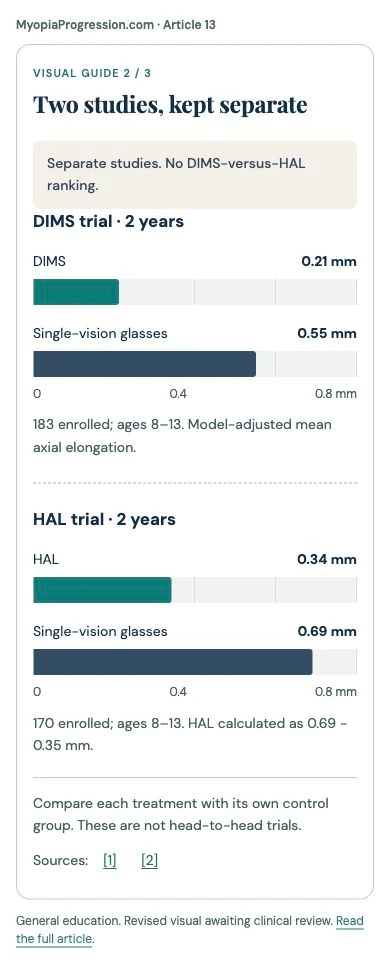
In the original DIMS randomized trial, 183 Chinese children aged eight to thirteen were enrolled. The model-adjusted average increase in eye length over two years was 0.21 mm with DIMS and 0.55 mm with single-vision glasses. These are study-group averages, not the amount every child's eye will grow. [1]
A separate randomized HAL study in China followed children aged eight to thirteen. Over two years, the single-vision group had an average eye-length increase of 0.69 mm; the HAL group had about 0.35 mm less growth. The study involved a different sample and a different comparison. [2]
VISUAL GUIDE 2 / 3
Two studies, kept separate
Separate studies. No DIMS-versus-HAL ranking.
DIMS trial · 2 years
183 enrolled; ages 8–13. Model-adjusted mean axial elongation.
HAL trial · 2 years
170 enrolled; ages 8–13. HAL calculated as 0.69 − 0.35 mm.
The figures belong in separate study panels. They are not a head-to-head DIMS-versus-HAL contest. If one control group grows faster than another, a percentage reduction can look different even when the treatment difference is similar. A sales chart that lines up percentages from unrelated trials can hide that problem.
Ask which outcome a percentage refers to: change in prescription, measured in diopters, or change in eye length, measured in millimeters. Then ask how long the study lasted and who took part. A two-year result is not a lifetime promise. Slowing progression also does not mean reversing myopia or guaranteeing that all progression stops.
Trial results can help narrow a discussion. They cannot tell a parent, without an examination, which lens should be prescribed. Suitability, vision, eye health, practical use, and the available local products still need assessment. Bring the evidence to the appointment as a question rather than as an instruction to order a particular brand.
Check the current local indication
U.S. status checked October 21, 2026: the FDA authorized Essilor Stellest through the De Novo pathway in September 2025. Its starting indication covers children with non-diseased eyes aged six to twelve, spherical equivalent refraction from −0.75 D to −4.50 D, and astigmatism up to 1.50 D. Those boundaries apply to that product. [3]
They do not establish authorization for every specialty lens, every age, or every prescription. A clinical study conducted outside the United States and a U.S. marketing authorization answer different questions. A product available in another country may have different labeling or may not be available through your local practice.
If your child is outside a starting range, ask the prescriber to explain the alternatives and the basis of any proposed use. Do not assume that a website's age range settles the decision. Also distinguish starting treatment from reviewing a child who is already using a prescribed product. Those conversations need the child's records and the exact product instructions.
For MiYOSMART or another DIMS product, confirm current local availability and labeling directly. This guide does not infer U.S. authorization from overseas sales or from research publications. Keep a copy of the product information supplied at fitting, especially if you may move or transfer care.
Make fitting, adaptation, and follow-up part of the choice
A child should be able to explain what they notice without being told that every concern is normal. Ask the practice how it checks the frame position, lens placement, and vision. Request a demonstration of how the frame should sit. Then let your child practice putting it on and taking it off without pushing on the lenses.
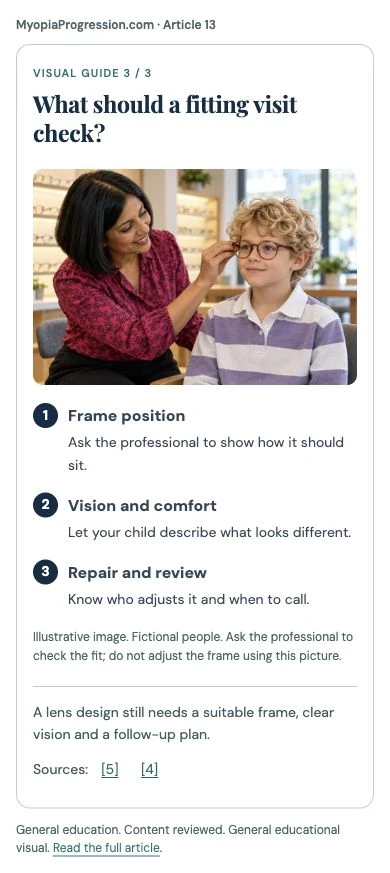
VISUAL GUIDE 3 / 3
What should a fitting visit check?
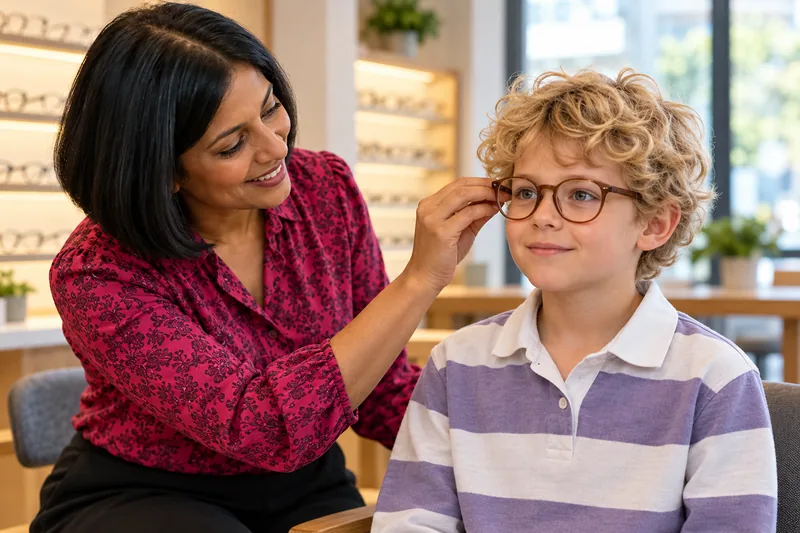
- 1Frame positionAsk the professional to show how it should sit.
- 2Vision and comfortLet your child describe what looks different.
- 3Repair and reviewKnow who adjusts it and when to call.
Illustrative image. Fictional people. Ask the professional to check the fit; do not adjust the frame using this picture.
The first week is a useful time to find practical obstacles. Is the case large enough? Can your child clean the lenses as instructed? Does the frame slip during reading? Does school have a rule about where glasses are stored for particular activities? A short note about the problem is more useful than repeated reminders to “be careful.”
If your child reports troublesome blur, headaches, or difficulty navigating steps, contact the practice for assessment. Do not decide from this page that the symptom is simply adaptation. A new symptom may require a check of the prescription, fit, eye health, or another cause. Ask for the practice's instructions about what to do while waiting for that assessment.
Questions for the fitting desk
What if the frame slips? Ask who will adjust it, how soon the fit should be rechecked, and whether an adjustment visit is included. Avoid bending the frame yourself to solve a recurring problem.
What if the glasses break? Request the repair and replacement policy before paying. Ask about backup vision correction and how to contact the practice if the intended treatment glasses are unavailable for a time.
How will we know whether the plan is helping? Ask which measurements will be compared, when they will be repeated, and what would lead the clinician to reconsider the plan. A clearer view through new glasses is only one part of that review.
Your glasses fitting note
Discussion prompts only. Check marks stay on this open page; nothing is submitted or stored. This tool does not diagnose, choose a treatment, or set a dose.
Leave with a complete plan, not only a product
Request a quote that separates the frame, treatment lenses, fitting, follow-up, and any measurements. Check which replacements are covered and for how long. A higher initial fee may include services that another quote lists separately. Compare the same period of care before comparing totals. The myopia-care cost guide provides a worksheet for that conversation.
Write the agreed wear instructions in words your child understands. Put the next review date on the family calendar. If care is shared between homes, give each caregiver the same instructions and contact details. The aim is a routine that can be followed consistently, without turning a child's glasses into a source of daily blame.
The American Academy of Orthokeratology and Myopia Control (AAOMC) offers patient resources. [6] Use them alongside the product information and your child's examination. The treatment comparison workshop can help organize questions if glasses are one of several options being discussed.
Before leaving, ask your child one final question: “What do you want us to remember about these glasses?” Their answer might be about a slipping frame, a school activity, or something they did not want to say in front of everyone. That practical detail can make the difference between a plan on paper and a pair that gets used as intended.
CHECK THE EVIDENCE
Sources & references
Primary research, guidance, and patient resources. Checked October 21, 2026.
- 1DIMS lenses: two-year randomized clinical trialLam et al. · British Journal of Ophthalmology · 2020
- 2Aspherical lenslets: two-year randomized clinical trialBao et al. · JAMA Ophthalmology · 2022
- 3Stellest: De Novo authorization and exact starting indicationU.S. Food and Drug Administration · September 2025
- 4MiYOSMART and DIMS: product informationHOYA Vision Care · manufacturer information
- 5Interventions for controlling myopia onset and progressionInternational Myopia Institute · 2025
- 6Patient resourcesAmerican Academy of Orthokeratology and Myopia Control (AAOMC)
General education. This article does not replace an eye examination, individual advice, or the prescribed care plan.