A CONTINUING-CARE TIMELINE
How Long Does Myopia Treatment Last?
Understand years of myopia care, review points and questions about stopping. Keep early response, long-term monitoring and transitions separate.Explore the treatment-review timeline ↓
Myopia management often continues for years. Stopping depends on the child’s progression, age, treatment, tolerability, and follow-up plan, not a birthday alone. Some treatments need careful observation after stopping because progression can resume or increase. Keep vision correction and monitoring in the plan.
On this page
Think in review points, not a finish date
Parents often want to know how many months or years a child will need myopia treatment. It is a fair question, especially when care affects the family budget, school routines, and a teenager's independence. The answer usually starts with a series of reviews, rather than a fixed course that ends on a particular birthday. Clinical guidance bases management on the individual child's progression and circumstances. [1]
VISUAL GUIDE 1 / 3
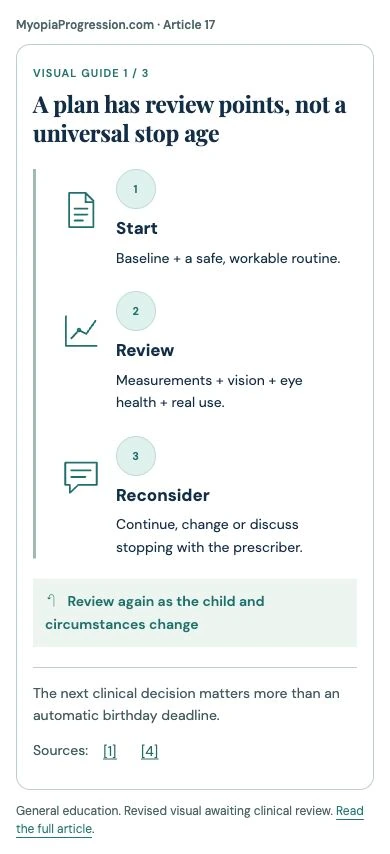
A plan has review points, not a universal stop age
A useful plan names the next decision. That might be checking comfort after fitting, comparing measurements after an agreed interval, or discussing whether the current approach still makes sense. Ask for the purpose of each visit. A calendar full of appointments is easier to understand when every appointment has a job.
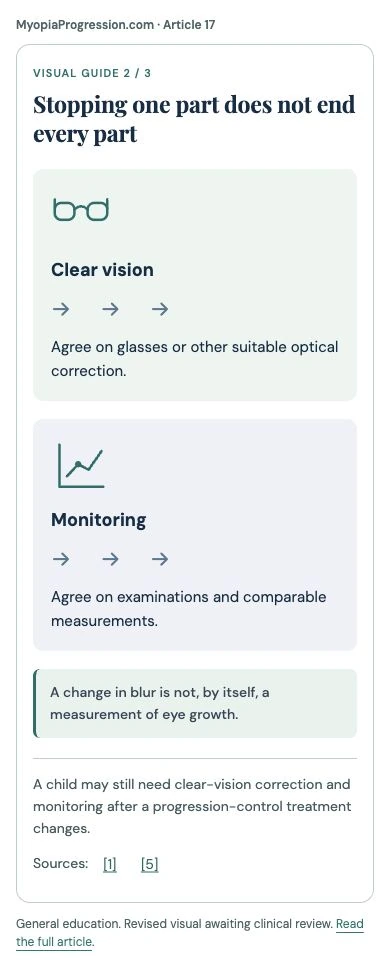
“Myopia treatment” also covers different things. Correcting blur and trying to slow progression are related but separate goals. A child may still need glasses or contact lenses for clear vision even when a clinician decides to change or stop a particular progression-control treatment. Myopia management should not be described as a temporary course that cures the underlying refractive error. [1][5]
VISUAL GUIDE 2 / 3
Stopping one part does not end every part
A change in blur is not, by itself, a measurement of eye growth.
Before discussing duration, ask the practice to define what it means by treatment in your child's plan. Does the quoted period include lenses, monitoring, fitting, or medication? Does it describe a package of services or a clinical recommendation? A one-year payment agreement is not proof that the biological need ends after one year.
The first stage: learn whether the routine works
When treatment begins, the family needs a workable routine as well as a baseline record. Ask which findings will be used for later comparison and what the team expects to reassess. Follow-up is also a chance to find problems with fit, handling, comfort, or the practical instructions before they become entrenched habits. [1]
Let the child describe the routine. Can they see comfortably during school tasks? Do they know who helps when a supply runs out? Can a caregiver find the exact instructions in another home? These questions do not replace clinical measurements. They help the clinician understand whether the intended plan is actually being carried out.
If a routine is not working, report the obstacle rather than waiting for the annual review. A child who cannot manage a particular lens may need further teaching or a different discussion. A teenager who feels unable to mention discomfort may quietly stop using a treatment. Neither situation is solved by promising that treatment will end at a certain age.
Keep start dates and changes in a simple private record. There is no need for a daily performance score. Write down the treatment, when it began, any clinician-directed change, and the next review. If supplies are unavailable for a period, tell the practice. The information helps interpret the record without blaming the child for every later measurement.
The middle stage: ask what the trend means
A treatment can slow progression without stopping every change. The question at review is how the measurements, vision, eye health, and practical use fit together. Ask the clinician what would count as a reason to continue, adjust, or reconsider the plan. The answer should relate to the child's own history rather than a promise copied from a trial average. [1]
Two children of the same age may be in different situations. One may have a recent prescription change; another may have a longer record of relative stability. Age gives context, but it does not reveal the whole trajectory. Longitudinal research in teenagers and young adults shows that progression can continue beyond childhood. [4]
Avoid interpreting a single quiet interval as a permanent finish. Ask whether there is enough comparable information to judge a trend. Also avoid assuming that any progression proves failure. A review should explain what can reasonably be concluded and what remains uncertain.
Questions that clarify a review
- What changed since the last comparable visit?
- How much confidence do you have in that comparison?
- Are vision and eye health satisfactory?
- Does the current plan still fit this child's routine?
- When will we reconsider the next step?
Write down the clinician's answer in a sentence or two. If the explanation is only “keep going,” ask what will be reviewed next time. Knowing the next decision helps a family plan without pretending that the whole future is settled.

Teen years call for a handoff, not an automatic stop
A teenager needs a greater voice in the care plan. Ask them to explain the instructions back in their own words and name the part they find hardest. Independence can mean managing an appointment question or reporting a problem, not simply taking over every task at once.
School schedules, sports, travel, and leaving home can change what is practical. Bring those changes to the eye-care team before a treatment interruption is forced by circumstances. If the teen will study elsewhere, ask how records, supplies, and urgent advice will be handled. A planned transfer of care is different from quietly running out of treatment.
There is no universal birthday at which all myopia progression ends. Evidence of continuing progression in some teenagers and young adults is one reason to base decisions on the record as well as age. [4] A friend stopping at sixteen does not establish the right plan for another sixteen-year-old.
At the same time, continuing forever without a review is not a useful answer. Ask what evidence would support considering a change and how that discussion will happen. Teenagers are more likely to understand an ongoing plan when the reasons are clear and their own concerns are taken seriously.
Stopping evidence depends on the treatment
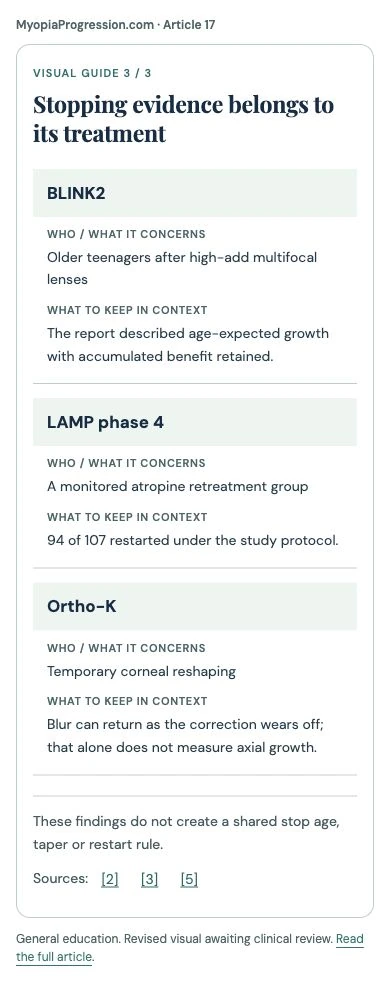
Research about one method should not be turned into a rule for every method. The BLINK2 follow-up, reported by the National Eye Institute in 2025, studied older teenagers after discontinuing high-add multifocal contact lenses. The report described a return to age-expected growth without losing the accumulated treatment benefit. That finding concerns that study and age group. It does not show that every child can stop any myopia treatment without follow-up. [2]
Atropine has a different evidence base. In the five-year LAMP report, a monitored as-needed retreatment group included children who restarted atropine under the study protocol. Ninety-four of 107 participants in that group, or 87.9%, restarted. The number describes a particular population and retreatment rule; it is not a probability that applies to every child using every atropine formulation. [3]
For Ortho-K, the temporary corneal reshaping effect is another consideration. The FDA describes orthokeratology as temporary correction. When that effect wears off, blur can return. Returning blur is not by itself proof of unusually fast axial growth. Clear-vision correction and progression monitoring both need a plan if overnight lenses are stopped. [5]
VISUAL GUIDE 3 / 3
Stopping evidence belongs to its treatment
| Evidence | Who / what it concerns | What to keep in context |
|---|---|---|
| BLINK2 | Older teenagers after high-add multifocal lenses | The report described age-expected growth with accumulated benefit retained. |
| LAMP phase 4 | A monitored atropine retreatment group | 94 of 107 restarted under the study protocol. |
| Ortho-K | Temporary corneal reshaping | Blur can return as the correction wears off; that alone does not measure axial growth. |
These examples explain why a parent should ask, “What do we know about stopping this particular treatment at this stage?” A general claim that there is either always rebound or never rebound is too broad. Do not copy another family's taper, restart threshold, or lens schedule.
Agree on the follow-up before changing the plan
If a clinician recommends a trial of stopping or changing treatment, ask what will happen next. Which vision correction should be used? When will the child be examined? Which measurements will be compared? What finding would prompt reconsideration? Arrange those details before the change rather than waiting to see whether the child notices blur.
Do not make a medication taper from an online article or change overnight lens use without the prescriber's instructions. A plan may need to account for the exact treatment, eye health, age, and previous progression. This guide does not supply an individual stopping schedule.
Ask what to do if the planned follow-up is missed. Families move, exams are rescheduled, and supplies can be delayed. Knowing whom to contact is more useful than assuming that a gap means it is too late to ask for help. Keep the latest records available for any clinician taking over care.
Your next care milestone
Discussion prompts only. Check marks stay on this open page; nothing is submitted or stored. This tool does not diagnose, choose a treatment, or set a dose.
The American Academy of Orthokeratology and Myopia Control (AAOMC) provides patient education on myopia management. [6] Use it to prepare for a discussion about your child's stage of care, while keeping the actual stopping or continuation decision with the prescribing team.
A good duration conversation ends with a near-term plan the family understands. It explains why care continues now, what will be reviewed next, and how a later change will be monitored. That is more useful than an exact finish date that the available evidence cannot promise.
CHECK THE EVIDENCE
Sources & references
Primary research, guidance, and patient resources. Checked October 21, 2026.
- 1Clinical management myopia guidelinesInternational Myopia Institute
- 2Multifocal contact lenses: benefit after stopping in older teensNational Eye Institute · 2025
- 3Five-year LAMP trial: phase 4 reportZhang et al. · Ophthalmology · 2024
- 4Progression of myopia in teenagers and adults: nationwide longitudinal studyDucloux et al. · British Journal of Ophthalmology · 2023
- 5Types of contact lenses: orthokeratologyU.S. Food and Drug Administration
- 6Patient resourcesAmerican Academy of Orthokeratology and Myopia Control (AAOMC)
General education. This article does not replace an eye examination, individual advice, or the prescribed care plan.