A FAMILY DECISION WORKSHOP
Choosing a Myopia-Control Treatment for Your Child
Compare what myopia care asks of your family: routines, costs, clinical questions and uncertainty. Prepare priorities to discuss with your clinician.Clarify your family’s decision priorities ↓Compare treatment options →
The right treatment depends on your child’s eyes and the routine your family can carry out safely. Compare the exact product and evidence, starting eligibility, handling requirements, follow-up, and cost. Percentages from different trials do not create a reliable best-treatment ranking.
On this page
Begin with the decision your family needs to make
There is no single myopia-control treatment that an article can select for every child. The right discussion considers the examination, exact product, evidence, safety, and a routine the family can follow. A useful comparison helps you ask better questions. It does not turn trial percentages into a shopping leaderboard. The International Myopia Institute and the Cochrane living review describe a varied evidence base across interventions. [1][2]
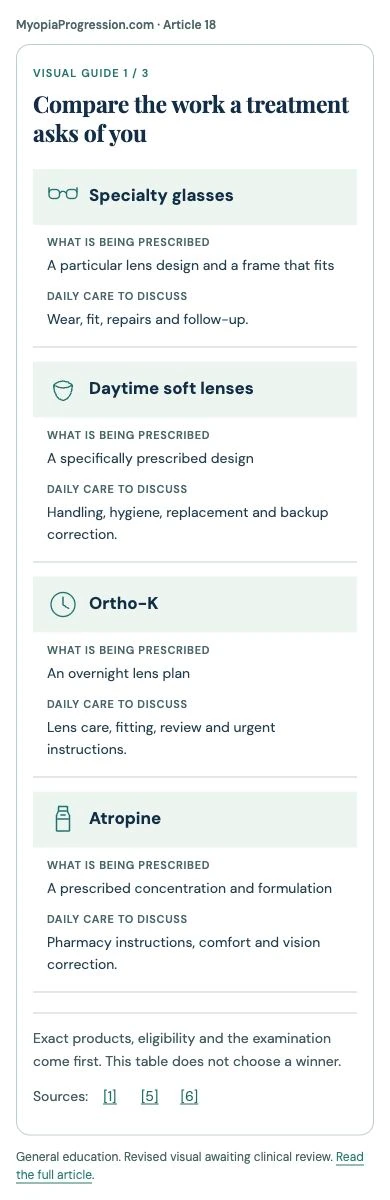
VISUAL GUIDE 1 / 3
Compare the work a treatment asks of you
| Approach | What is being prescribed | Daily care to discuss |
|---|---|---|
| Specialty glasses | A particular lens design and a frame that fits | Wear, fit, repairs and follow-up. |
| Daytime soft lenses | A specifically prescribed design | Handling, hygiene, replacement and backup correction. |
| Ortho-K | An overnight lens plan | Lens care, fitting, review and urgent instructions. |
| Atropine | A prescribed concentration and formulation | Pharmacy instructions, comfort and vision correction. |
Start by writing the decision in plain words: “We need to choose an approach for a child who has recently become more myopic,” or “We need to review a plan that is difficult to follow.” Those are different conversations. A child already using treatment should bring the earlier records, rather than beginning with an online comparison as though there were no care history.
Next, ask the child what matters to them. They may want to see the board clearly, take part in an activity, or avoid feeling rushed during the morning routine. Adults may be thinking about costs and long-term progression. Put both sets of concerns on the table before discussing product names.
This workshop covers specialty glasses, daytime soft contact lenses, overnight orthokeratology, and atropine. It does not claim these categories are identical or that every product within a category has the same evidence. Availability and regulatory status depend on the exact product and country. [1]
Set the clinical boundaries first
Ask the clinician which options are suitable after examining your child. Age, prescription, eye health, and the ability to use a treatment safely can affect that answer. A parent preference is important, but it cannot establish medical suitability from home.
U.S. product labels illustrate why the details matter. Stellest glasses received FDA authorization in September 2025 for starting use in children with non-diseased eyes aged six to twelve, within specified prescription limits. The FDA documentation lists spherical equivalent refraction from −0.75 D to −4.50 D and astigmatism up to 1.50 D. Those are product-specific boundaries. [3]
MiSight 1 day has a different U.S. starting indication: children aged eight to twelve, spherical equivalent refraction from −0.75 D to −4.00 D, and astigmatism no greater than 0.75 D. Its label should not be transferred to other soft lenses or to specialty glasses. [4]
Starting eligibility is also different from reviewing ongoing care. If your child is outside a listed range, ask the prescriber to explain the basis of any proposed use and the alternatives. Do not decide that a treatment is appropriate merely because a study included children of a similar age.
Compare what each approach asks you to do
Specialty glasses: a familiar object with a specific design
Glasses can be a practical choice for a child who prefers a familiar routine. Specialty designs aim to correct blur and slow progression. Fit, the exact lens design, intended wear, and monitoring matter. Evidence for one design does not automatically support every lens described as myopia control. [1][3]
Ask how the frame will be checked, what happens if it breaks, and how vision concerns will be assessed. A child who repeatedly removes glasses may be dealing with a fit, comfort, or social problem that needs discussion. The question is how the plan will work in daily life, not whether the child can be persuaded to accept a product name.
Daytime soft contact lenses: handling and support
Some soft lens designs have evidence for slowing myopia progression. A child needs appropriate fitting, teaching, hygiene, and follow-up. The exact lens, replacement schedule, and permitted wear come from the prescribed plan. MiSight's specific authorization is one example, not a general authorization for all multifocal contacts. [4][1]
Ask who will supervise learning, what to do if handling is difficult, and how the child should report a sore or red eye. A child should not feel required to keep a lens in because it was expensive or because a sports event is approaching. Discuss safe backup vision correction with the practice.
Ortho-K: an overnight routine with daytime effects
Orthokeratology uses specially fitted lenses to temporarily reshape the cornea. The lenses are worn according to a prescribed overnight plan. The FDA describes the temporary vision-correction effect; that is distinct from the clinical evidence and prescribing discussion about myopia control. [5][1]
Ask about cleaning, review visits, replacement, and urgent instructions. A family considering overnight lenses should understand the routine in detail before committing. “No glasses during the day” describes a possible practical appeal, but it is not a full explanation of the care required.
Atropine: a prescription discussion, not a concentration contest
Atropine drops are another approach used in myopia management. Concentration, formulation, possible near blur or light sensitivity, and monitoring need discussion. AAPOS provides family guidance, while the IMI review places the treatment evidence in context. [6][1]
Drops do not correct distance blur on their own. A child may still need glasses or another form of vision correction. Ask about the exact prescribed product, storage, pharmacy instructions, and what to do if symptoms occur. Do not assume that a higher percentage is automatically the right choice or that every formulation produces the same result.
Ask what an effectiveness figure actually measures
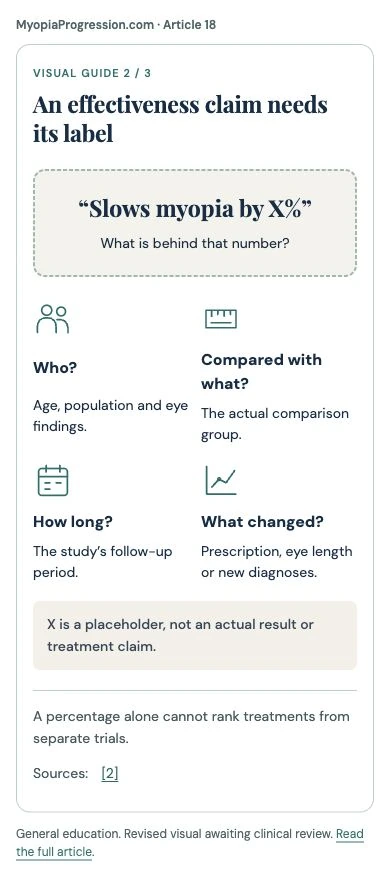
A claim such as “slows myopia by a percentage” needs a denominator and an outcome. Is it about change in glasses prescription, change in axial length, or a proportion of children meeting a study definition? How old were the participants? How long were they followed? What did the comparison group receive? [2]
Those details matter when comparing studies. A large percentage from one trial and a smaller percentage from another do not create a fair head-to-head ranking. Different control-group progression, populations, follow-up periods, and study methods can change the numbers. The Cochrane review also considers certainty of evidence, rather than treating every estimate as equally secure. [2]
Ask the clinician to explain the expected benefit in ordinary language and to describe the uncertainty. Trial averages can support a choice; they cannot guarantee your child's result. Continued progression does not automatically mean a treatment provided no benefit, and a short quiet interval does not prove lifelong protection.
A useful written comparison has three parts: the evidence for the exact intervention, the reasons it may fit this child, and the plan for checking response. A sales sheet that gives only a reduction percentage leaves out much of the decision.
VISUAL GUIDE 2 / 3
An effectiveness claim needs its label
X is a placeholder, not an actual result or treatment claim.
Compare a year of care, not just the first price
Request a written quote covering the same time period for each suitable option. Ask which visits, fitting services, measurements, lenses or drops, and replacements are included. Check what happens if an item breaks, a prescription changes, or the child cannot continue that approach.
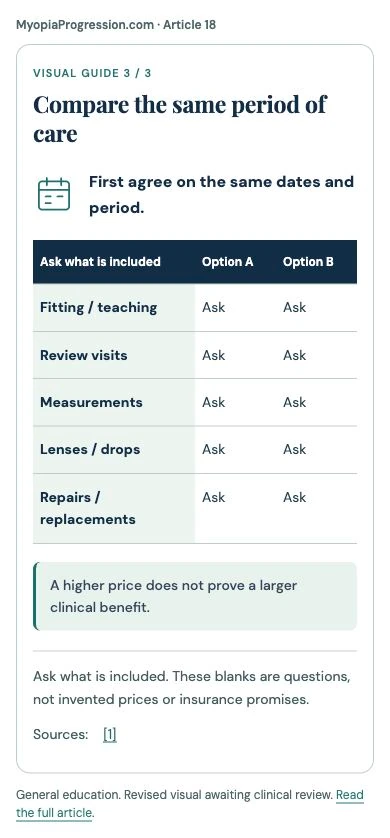
VISUAL GUIDE 3 / 3
Compare the same period of care
| Ask what is included | Option A | Option B |
|---|---|---|
| Fitting / teaching | Ask | Ask |
| Review visits | Ask | Ask |
| Measurements | Ask | Ask |
| Lenses / drops | Ask | Ask |
| Repairs / replacements | Ask | Ask |
A higher price does not prove a larger clinical benefit.
Do not assume that a lower initial price is a lower total cost, or that a higher price proves better clinical results. A quote describes services and products, while evidence describes outcomes under study conditions. Those are different kinds of information.
If travel, appointments, or divided caregiving make a routine difficult, say so. The team may be able to clarify instructions or discuss another suitable approach. A family should not have to pretend it can manage a routine that is unrealistic in order to have its concerns taken seriously.
Use the myopia-care cost guide to organize written figures. It is a planning aid, not an insurance determination. Confirm actual coverage and payment details with the relevant provider rather than treating an online estimate as a benefit promise.
Make a discussion note, then choose with the clinician
Write down the suitable options the clinician has identified. Beside each one, note the child's main concern, the routine required, the evidence question you still have, and the full period of quoted care. Leave an answer blank when it is not known. A blank is a question to resolve, not a reason to invent a score.
Your treatment discussion note
Discussion prompts only. Check marks stay on this open page; nothing is submitted or stored. This tool does not diagnose, choose a treatment, or set a dose.
This worksheet does not calculate a winning treatment. It helps a family prepare a conversation. The next step is a decision with the clinician, followed by clear start instructions, a safety contact plan, and a review date. If a combination is proposed, ask which evidence supports that particular pairing rather than assuming two approaches must be better than one.
The American Academy of Orthokeratology and Myopia Control (AAOMC) offers patient resources for learning about myopia management. [7] Read them alongside independent research, product labeling, and your child's examination findings. Their inclusion here does not imply endorsement of a particular product or this website.
Before leaving, ask your child to explain the agreed routine in their own words. Then ask the clinician to explain how the plan will be reviewed. A sound choice is one the family understands, can use safely, and can reassess as the child grows.
CHECK THE EVIDENCE
Sources & references
Primary research, guidance, and patient resources. Checked October 21, 2026.
- 1Interventions for controlling myopia onset and progressionInternational Myopia Institute · 2025
- 2Myopia-control interventions: living systematic reviewCochrane Eyes and Vision · 2025
- 3Stellest: De Novo authorization and exact starting indicationU.S. Food and Drug Administration · September 2025
- 4MiSight 1 Day: FDA premarket approval P180035U.S. Food and Drug Administration
- 5Types of contact lenses: orthokeratologyU.S. Food and Drug Administration
- 6Myopia and treatment of myopia in childrenAAPOS
- 7Patient resourcesAmerican Academy of Orthokeratology and Myopia Control (AAOMC)
General education. This article does not replace an eye examination, individual advice, or the prescribed care plan.