OVERNIGHT LENSES · DAYTIME QUESTIONS
Ortho-K for Children: Benefits, Limits, and Daily Care
Considering overnight Ortho-K for a child? Explore readiness, fitting, daily care, costs and questions to discuss before choosing a treatment plan.Check whether the routine fits ↓Ortho-K treatment overview →
Ortho-K uses specially fitted rigid lenses overnight to temporarily reshape the cornea and improve daytime vision. Research also supports slowing eye growth in children. It needs careful fitting, lens care, and follow-up; it does not cure myopia.
On this page
Understand the two reasons Ortho-K is discussed
Orthokeratology, usually called Ortho-K, uses specially fitted rigid gas-permeable contact lenses during sleep. They temporarily change the shape of the cornea, the clear front surface of the eye. This can improve daytime vision after the lenses are removed. The effect needs the prescribed ongoing wear to be maintained. [1]
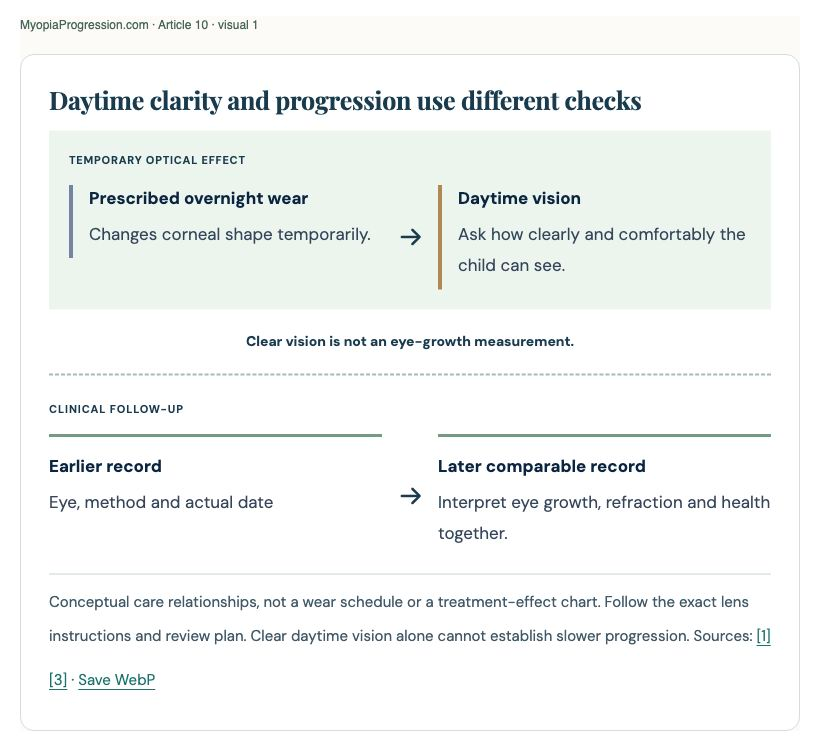
A separate question is whether the treatment slows myopia progression. Clinical trials have found less axial elongation, or front-to-back eye growth, in children using Ortho-K than in comparison groups. Clear daytime vision and slower eye growth are related treatment goals, but they are not the same measurement. [2]
Daytime clarity and progression use different checks
Changes corneal shape temporarily.
Ask how clearly and comfortably the child can see.
Eye, method and actual date
Interpret eye growth, refraction and health together.
In the United States, distinguish a lens's approved temporary-correction labeling from its use for myopia control. Do not assume FDA approval for overnight vision correction is the same as approval to slow progression. Ask the prescriber about the exact product, its labeling, and any off-label use being proposed. [1]
- Will my child see clearly in the day?
- Temporary optical correctionWhat vision can we expect during fitting and later?
- Is eye growth slowing?
- Myopia-control response over timeHow will axial length and other results be monitored?
- Can we manage it safely?
- Overnight wear and daily careWho helps, and what happens if an eye is uncomfortable?
Decide whether the routine fits the child
Ortho-K begins with an eye-care assessment and a specialized fitting. The clinician considers the prescription, corneal shape, eye health, and the child's circumstances. A treatment that works well for another family may not suit your child's eyes or daily life. [1][3]
Ask why the proposed design is appropriate and what alternatives are reasonable. Bring up allergies, discomfort, sleep patterns, travel, and any difficulty handling lenses. The discussion should include the adult's role, not only whether the child is interested in daytime freedom from glasses.
A child should have an opportunity to learn the handling steps without being rushed. Ask the practice what skills need to be demonstrated before starting at home and what support is available if removal is difficult. A willingness to report a problem matters as much as the ability to put a lens in.
Consider the practical setting. Is there a clean, dry place for care? Who supervises when the child stays in another home? Can the family attend the early fitting checks? If those questions have no workable answer yet, ask the prescriber to help build one before beginning.
Read the evidence without turning it into a promise
The two-year ROMIO randomized trial enrolled 102 children aged six to ten. Seventy-eight completed the study. Mean axial elongation was 0.36 mm in the Ortho-K group and 0.63 mm in the single-vision-glasses group, a difference of 0.27 mm over two years. [2]
ROMIO: eye growth over two years
Those are group averages from a particular trial. They do not predict the exact result for your child. The reported relative difference, about 43%, concerns axial elongation in that study. It does not mean myopia was cured, that an eye became 43% shorter, or that every wearer has the same response. Five participants stopped Ortho-K because of adverse events. [2]
The broader evidence includes different designs, populations, and durations. The 2025 International Myopia Institute review places Ortho-K among researched myopia-control approaches. Ask the clinician which evidence is relevant to the design and plan they are offering. [3]
Be cautious about a league table of treatment percentages. A result from a one-year trial in one population is not directly comparable with a three-year result from another. The useful clinical question is how to choose a suitable option and monitor the individual response.
Expect fitting to be a process
The first assessment may include corneal mapping and baseline measurements. The lenses then need checks for fit, eye health, and the quality of daytime vision. Ask the practice to explain the early schedule and how it differs from longer-term progression reviews. [3]
Vision may change during the fitting period. Before the first night, ask how your child should manage school, travel, and activities if vision is not yet clear enough. An old pair of glasses may not be the right backup after corneal reshaping, so get a specific plan rather than improvising.
Bring a simple account to each check: when lenses were worn, any handling difficulty, when vision became less clear, and any discomfort. You do not need to diagnose the cause. Clear observations help the fitter decide what needs assessment.
Do not change the overnight schedule, use another person's lenses, or alter cleaning products to improve the result yourself. If the routine is hard to maintain, contact the practice. A fitting adjustment or another treatment may be more appropriate than repeatedly pushing through a problem.

Learn the daily care steps from the practice
Ask for a demonstration using the actual lenses and care system. Wash and thoroughly dry hands before handling lenses. Use the prescribed products and fresh solution as directed. Never clean or store lenses in tap water or saliva. [4][5]
Care systems are not interchangeable. A peroxide-based product, for example, has a required neutralization process and should never be placed directly in the eye. Follow the specific product and prescriber instructions rather than substituting a familiar bottle or copying a routine from a video. [4]
Keep the case clean and replace it on the instructed schedule. Do not top off old solution. Ask which steps an adult must supervise and what to do if supplies run out. Replacing a needed product safely is better than stretching it with water or an unsuitable substitute. [4]
Set up a clean, dry care area and keep the written steps nearby. In a shared bathroom, store products so they will not be confused with another person's supplies. Keep younger children from handling the lenses or chemicals.
Ortho-K is specifically prescribed for overnight wear. That does not make sleeping in ordinary daytime contacts safe. Keep those instructions distinct if different family members use different lens types. [6]
Keep a clear response plan for problems
Contact lenses can cause serious eye infections, including corneal ulcers and vision loss. Care and follow-up reduce avoidable risks but do not make lens wear risk-free. Ask the prescriber how those risks apply to your child and how to get help promptly. [6]
For pain, redness, light sensitivity, discharge, or unexpected blurred vision, stop lens wear and obtain prompt professional advice. Do not put a problem lens back in to see whether it settles or wait until a routine appointment if symptoms are concerning. Use the practice's urgent instructions. [6]
If removal is difficult, follow the technique taught by the practice and contact them for help. Avoid pressing or scraping the eye or using an improvised tool. Make sure a second caregiver knows the contact route before an overnight stay.
Ask about water activities separately. Ortho-K lenses should not be worn in water. Daytime vision without lenses may simplify swimming for some wearers, but the child still needs an individual vision and protection plan. Sports protection is a separate issue from myopia treatment. [5]
Compare the whole plan and think ahead
Ask for an itemized quote that explains fitting, lenses, early checks, progression measurements, replacements, and ongoing care. Find out what happens if a lens is lost, fitting takes longer, or another approach is recommended. The cost guide helps compare packages with different inclusions.
Plan for school trips, illness, and moving between households. Get instructions before a disrupted night rather than assuming a missed night should be made up with extra wear. Keep a backup vision plan that is current for the stage of treatment.
If your child wants to stop, discuss it with the prescriber. The temporary corneal effect wears off after lens use stops. Monitoring and suitable correction still need planning; a return of distance blur is not the same as a measured loss of all myopia-control benefit. [1]
The American Academy of Orthokeratology and Myopia Control (AAOMC) offers patient information and a provider directory. Use those resources to prepare questions about fitting and care. A directory listing or an educational article does not replace an individual assessment or guarantee a result. [7]
Your Ortho-K discussion checklist
Use these prompts with your child and eye-care team. Check marks stay only on this open page. Nothing is submitted or saved.
Questions parents ask
Does Ortho-K permanently fix myopia?
No. Its daytime vision effect is temporary and depends on prescribed continued wear. Myopia control aims to slow progression, not erase the underlying condition. [1][3]
Can any child who wears glasses use it?
No. Suitability depends on the eyes, prescription, lens design, safe routine, and follow-up. Ask for the reasons behind the recommendation and the alternatives. [1]
Can we skip reviews if daytime vision is clear?
Clear vision does not establish healthy lens wear or a stable growth pattern. Keep the fitting and monitoring schedule the prescriber sets. If the schedule is difficult, discuss that obstacle rather than silently missing checks. [3]
CHECK THE EVIDENCE
Sources & references
Primary research, guidance, and patient resources. Checked October 21, 2026.
- 1Types of contact lenses: orthokeratologyU.S. Food and Drug Administration
- 2ROMIO: two-year randomized Ortho-K clinical trialCho & Cheung · IOVS · 2012
- 3Interventions for controlling myopia onset and progressionInternational Myopia Institute · 2025
- 4Cleaning, disinfecting, and storing contact lensesCenters for Disease Control and Prevention
- 5Keeping water away from contact lensesCenters for Disease Control and Prevention
- 6What to know if your child wants contact lensesU.S. Food and Drug Administration
- 7Patient resourcesAmerican Academy of Orthokeratology and Myopia Control (AAOMC)
General education. This article does not replace an eye examination, individual advice, or the prescribed care plan.