A BEFORE-AND-AFTER RESEARCH DESK
Pandemic Myopia Research: What Changed and What We Can Learn
Revisit pandemic-era myopia findings with their study dates and measurement limits. Use the practical continuity plan without blaming families.Use the care-continuity plan ↓
Pandemic studies found changes in children’s vision during periods when routines changed sharply. Those studies do not prove that the virus, one device or one household decision caused an individual case. The useful lessons are access to eye care, comparable measurements and realistic opportunities for outdoor activity and breaks.
On this page
A research finding is not a verdict on a family
During school closures, many families had little choice about where children learned or how lessons reached them. A screen could be a classroom, a connection to friends and an accessibility tool in the same afternoon. Outdoor space and routine appointments were not equally available to everyone.
That context matters when reading pandemic myopia research. A change measured during a period of home confinement is a finding to investigate. It is not evidence that a parent failed, that every online lesson was harmful or that a particular child’s prescription changed for one known reason.
This guide looks at one influential school study and separates what it measured from the explanations people sometimes attach to it. The aim is to make the findings useful for future disruptions, while keeping your child’s current care based on their own examination.
Start with the dates and the measurements
Researchers in Feicheng, China, examined school photoscreening records from 2015 through 2020. The study included 123,535 children aged 6–13 across ten elementary schools and 194,904 test results. Some children contributed results in more than one year. Those two totals describe different things: children and screening encounters. [1]
The 2020 screening followed a period of home confinement. The strongest shift toward more negative readings appeared among children aged 6–8. Differences were smaller in the older groups. These were population observations, not a record proving how each child’s eye changed because of a particular activity. [1]
VISUAL GUIDE 1 / 3
The dates are part of the evidence
- 2015–2019
School photoscreening took place in September.
- January–May 2020
Home confinement changed school and household routines. Individual exposures were not fully measured.
- June 2020
School photoscreening was conducted after confinement.
- 2021 publication
Researchers reported a population pattern, with the strongest shift among ages 6–8.
Different screening months and several simultaneous changes matter when interpreting the comparison.
The distinction may sound technical, but it changes the headline. “More myopic readings were found in this setting” is more defensible than “online school permanently damaged a generation’s eyes.” The second statement adds permanence, a cause and a worldwide conclusion that this study could not establish.
Why a screening result has limits
The study used noncycloplegic photoscreening. This means the measurements were taken without drops used to relax focusing. The investigators also did not have axial-length measurements, detailed individual exposure records or a complete account of previous orthokeratology use. Screening took place in September in earlier years and in June in 2020. [1]
These details do not make the study worthless. They tell us which questions remain open. A screening measurement can flag a pattern worth investigating without answering every question about the eye’s structure, a child’s diagnosis or the mechanism behind the pattern.
VISUAL GUIDE 2 / 3
Children and test results are different totals
Some children contributed results in more than one year. Do not label every test as a different child.
| Measured | Not established by this dataset |
|---|---|
| Noncycloplegic screening readings | Axial-length change for each child. |
| A school-population pattern | An individual child’s cause or exact exposure history. |
Suppose a parent asks whether the paper proves their child’s eye grew longer during remote learning. The honest answer is no: that would require measurements and clinical information the study did not collect. A clinician may have separate records that answer part of that question for the individual child.
When bringing research to an appointment, describe it as a question rather than a conclusion. “Does this finding change what you want to measure for my child?” opens a more useful discussion than assuming that a headline already explains the examination.
Screens were one part of a much larger change
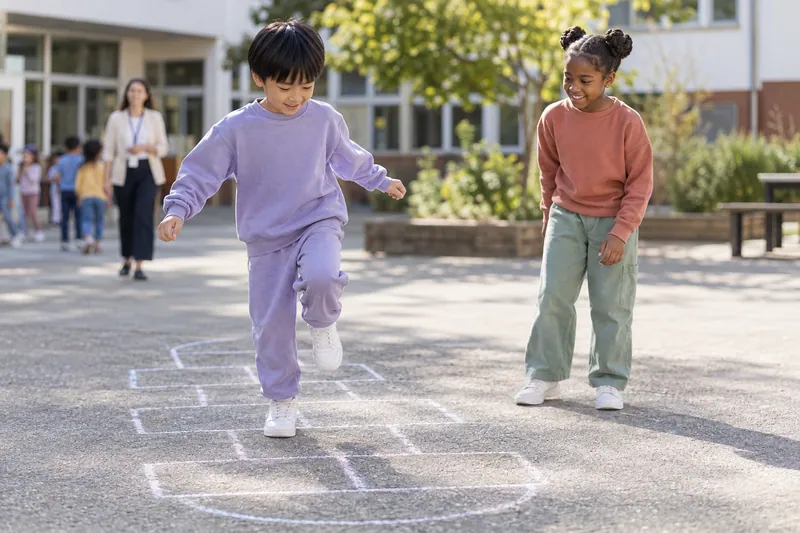
School closures altered several things together. Some children did more close work, spent less time outside, lost their journey to school or had fewer breaks between tasks. Others had a different experience. Household space, caregiver work, disability, weather and local restrictions all affected the available options.
A later systematic review found an association between digital screen time and myopia across studies. Association does not identify which element caused an individual case. Screen use can travel with close working distances, prolonged near tasks and less outdoor time. Researchers must account for these connected exposures when interpreting results. [2]
For a family, the practical question is therefore broader than “Which device should we remove?” It is “What does the whole day ask of this child’s eyes, and where can we make useful changes?” A laptop required for a lesson should be considered differently from an optional stream that continues through bedtime.
A schedule also needs room for ordinary life. A child who finishes online lessons may still need close-up homework or a video call with a friend. Moving one of those activities to paper does not automatically turn it into distance viewing. Look at the task, its duration and the opportunities around it rather than counting glowing screens alone.
What outdoor research adds to the picture
Studies of increased outdoor time address a different question from studies of digital exposure. A Cochrane review found that efforts to increase outdoor time may reduce the development of myopia. Evidence about slowing progression after myopia has developed was less certain. [3]
That difference matters after a disrupted school year. Outdoor opportunities are a reasonable part of a child’s routine, but they are not a way to erase an established prescription or replace a treatment review. A family can make outdoor time more feasible while still arranging the care their child needs.
Choose safe opportunities that fit the child and the local conditions. A shaded break, accessible courtyard or short walk with a caregiver can be more realistic than a new sports commitment. The purpose is a sustainable routine, not a test of how many activities a parent can organize.
A continuity plan is more useful than a blame list
The next disruption may be a long illness, a school closure, severe weather or a move between homes. A simple plan can keep eye care from disappearing among more immediate concerns. It does not need an elaborate tracking app.
Start with access to correction. Does the child have usable glasses? Does the school know that a presentation is hard to see? Is there a practical way to contact the eye-care team if glasses break, symptoms appear or a follow-up becomes difficult to attend?
Then consider the learning space. The American Association for Pediatric Ophthalmology and Strabismus discusses working distance, breaks and screen-related discomfort. Bigger text, a supported device and planned pauses can make required tasks easier to manage. These are practical adjustments, not evidence that a child no longer needs an examination. [4]
VISUAL GUIDE 3 / 3
If routines change again, protect these connections
Keep usable correction and tell school about difficulty viewing material.
Know how to arrange care if supplies, appointments or transport are disrupted.
Consider text size, device support and natural pauses in required close work.
Look for realistic outdoor access with supervision and suitable conditions.
Keep any treatment-specific instructions separate from the general household plan. Contact-lens wear, prescribed drops and follow-up examinations have their own requirements. If supplies or appointments become unavailable, ask the treating team what to do rather than improvising a replacement regimen.
What to do with a prescription change now
A change deserves attention on its own terms, even if it happened after a period of disrupted routines. Bring the dates of previous examinations, the correction used and any available measurement reports. Let the clinician judge how comparable those records are.
Describe what the child notices. Trouble seeing the board, holding things unusually close, eye discomfort or difficulty using the current correction are more useful details than a guess about which month caused the problem. If the child has no complaints, keep scheduled care rather than assuming everything can be judged at home.
Ask what the next visit is intended to establish. The answer might involve checking vision, reviewing progression, evaluating treatment use or repeating a measurement under suitable conditions. Understanding that purpose helps a family protect the appointment when transport, school or work schedules are difficult.
A missed appointment can be rescheduled without turning it into a moral failure. Tell the team what got in the way. A workable plan for the next step is more valuable than an ideal plan the household cannot follow.
How to spot an overstated pandemic headline
Check whether an article names the country, ages and measurement method. A report from one school population should not silently become a claim about all children. A pattern in screening results should not be described as confirmed structural damage unless the study actually measured that outcome.
Look for the difference between prevalence and progression. Prevalence describes how common a condition is in a group at a time. Progression concerns change after it develops. Neither word should be used as a substitute for the other, and a rise in one group does not predict exactly what will happen to one child.
Be cautious when a historical finding is used to sell a current product. The fact that routines changed does not prove that a particular lamp, supplement, lens or app prevents the problem. A product needs evidence for its own purpose, population and use.
The American Academy of Orthokeratology and Myopia Control (AAOMC) provides patient resources for learning about myopia and treatment discussions. Use those resources alongside your child’s clinical records, rather than treating a news story as an individual treatment plan. [5]
Keep the lesson practical
The lasting lesson is to protect access to care and build routines that can survive imperfect weeks. Children should be able to learn, move, communicate and use the correction they need. Families should be able to ask for help when a plan becomes difficult.
Choose one concrete next step: replace unusable glasses, book the overdue visit, adjust the learning space or identify an outdoor break that is possible most days. Review that change with the child. Research becomes more useful when it leads to a feasible action and an honest question, rather than another reason for worry.
For practical follow-through, use the screen-research guide and the outdoor opportunity planner. They separate evidence interpretation from changes you can make to a normal day.
Your continuity plan
Discussion prompts only. Checks stay on this open page; nothing is submitted or saved. This sheet does not diagnose, choose treatment or determine urgency. Do not delay urgent care to complete it.
CHECK THE EVIDENCE
Sources & references
Research, professional guidance and patient resources. Checked October 21, 2026.
- 1Myopia in School-Aged Children After COVID-19 Home ConfinementWang et al. · JAMA Ophthalmology · 2021
- 2Digital Screen Time and Myopia: systematic review and dose-response meta-analysisHa et al. · JAMA Network Open · 2025
- 3Increasing time outdoors to prevent onset and progression of myopiaKido et al. · Cochrane · 2024
- 4Screen Time and Online LearningAmerican Association for Pediatric Ophthalmology and Strabismus
- 5Patient Resources: Myopia and OrthokeratologyAmerican Academy of Orthokeratology and Myopia Control (AAOMC)
General education. This article does not replace an eye examination, individual advice, or the prescribed care plan.