A SUMMER PLANNING BOARD
Summer and Myopia: Plan Outdoor Time Without Losing the Routine
Plan myopia care around summer activities, camps, weather and appointments. Keep water activities and lens instructions clear for supervising adults.Prepare the summer care handoff ↓
Use summer to create safe daylight opportunities while keeping eye-care appointments and prescribed treatment consistent. Outdoor time may help delay myopia onset; it does not erase an existing prescription. Plan around heat, sun protection, water safety and the child’s interests rather than a perfect daily score.
On this page
Use the change of season as a planning opportunity
Summer can make outdoor time easier, but it can also remove the routines that kept care organized. A school bag has a usual place for glasses. A school week has familiar sleep and appointment patterns. Camps, trips and changing childcare arrangements can interrupt those habits.
Begin by asking what will actually be different. Will the child spend more time with grandparents? Is there a day camp with swimming? Will an older sibling supervise some afternoons? A useful summer plan connects those changes with the child's existing needs.
Outdoor time belongs in a wider prevention approach. It may reduce the chance that myopia begins, but it does not undo an existing prescription. Evidence for controlling established myopia through outdoor time alone is less certain. Keep the child's correction, appointments and prescribed care in place. [1]
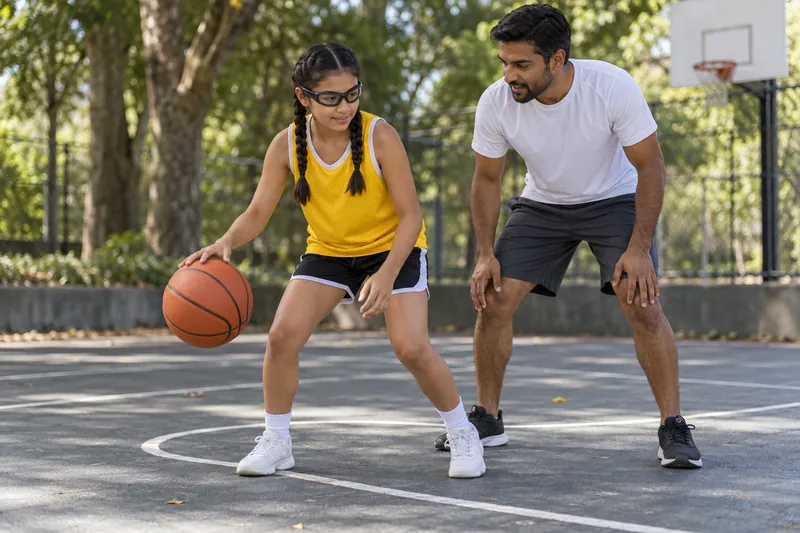
The illustrated basketball scene shows protective sports eyewear. Ordinary glasses are not a substitute for appropriate sports protection. Choose equipment suited to the activity with professional advice when needed. [3]
Build opportunities into the day you have
Start with an activity the child already enjoys. A shaded playground visit, a walk to a nearby errand, gardening or time in an accessible courtyard may be more repeatable than a large trip. An ordinary afternoon can include several chances to be outdoors without becoming a tightly controlled schedule.
Ask the child which part of the idea is appealing. A child who dislikes organized sport might enjoy looking for birds or drawing outside. A child who enjoys a team may want a regular practice session. The activity should fit the person rather than serve as proof that the family is doing summer correctly.
VISUAL GUIDE 1 / 3
Build a summer day from opportunities, not a score
| Part of the day | One possible opportunity | Easier alternative |
|---|---|---|
| Before the busiest period | A shaded park or garden visit | A shorter nearby outdoor stop |
| Between planned activities | A suitable courtyard game | A quiet outdoor conversation |
| When conditions allow later | A family route or supervised sport | An accessible place to sit and notice |
The planning board is a set of opportunities, not a research-tested dose. It deliberately leaves room for weather, care duties and different levels of energy. Do not interpret an empty space as a medical failure or a filled space as evidence of controlled eye growth.
For the evidence behind common outdoor-time targets, see the two-hour discussion. This article focuses on making the summer transition workable.
Check the weather before protecting the schedule
A plan to go outdoors should adapt to conditions. Heat, smoke, air quality and strong sun can change what is sensible on a particular day. Check local advice and the child's health needs. Shorter outings or another time of day may be more suitable than insisting on the original plan.
The American Academy of Pediatrics recommends paying attention to sun, heat and air quality when children play outdoors. Clothing, shade and appropriate sun protection belong in the plan. Myopia prevention is not a reason to remove sunglasses or expose a child to unsafe heat. [2]
Choose a familiar alternative in advance. You might use a shaded route, a shorter accessible visit or an indoor activity until conditions improve. An indoor alternative is valuable for participation and safety even though it is not the same light environment as being outdoors.
VISUAL GUIDE 2 / 3
Change the outing when the conditions change
Check the setting, supervision, correction and relevant protection before starting.
Use shade and suitable protection. Consider another time, a shorter outing or a safer alternative.
Use local health guidance and the child’s care plan. Do not chase an outdoor-time score.
Never ask a child to look toward the sun or a bright light as an eye exercise. Time outdoors does not require sun-gazing. If the child has an individual restriction or medical concern, follow the advice from their usual care team.
Plan water activities separately from lens wear
Swimming is often part of summer, so deal with it before the child arrives at a pool. Contact lenses and water are a poor combination. The CDC advises removing lenses before swimming or showering because water exposure can increase infection risk. This applies even when the pool looks clean. [4]
Ask the eye-care professional about a suitable vision plan for swimming and other water activities. Prescription swim goggles may be one option to discuss. Do not assume ordinary goggles make wearing contacts risk-free, and do not leave a child unable to navigate safely without arranging an alternative.
If the child wears prescribed overnight Ortho-K, follow the fitter's instructions about wear and care. The fact that these lenses are normally used during sleep does not make them suitable for a pool or allow water in the lens-care routine.
If water touches a lens, follow the professional's instructions and the lens-specific advice about removal, disposal or disinfection. Pain, redness, light sensitivity or a new change in vision needs prompt professional advice. Do not keep wearing an uncomfortable lens to avoid interrupting a holiday.
Keep prescribed care recognizable away from school
Write the current instructions in one place. Include the routine, the responsible adult and the care team's contact details. Use the actual prescription and product instructions. A website cannot decide how to move a treatment schedule around a late night, a camp event or a flight.
If drops are prescribed, check storage and transport requirements for that product. If lenses are used, check that the required cleaning and handling conditions will be available. Do not transfer a product into an unlabelled container or substitute a different solution because it is easier to pack.
A camp may have its own process for medicines and medical devices. Contact staff ahead of time. Ask what documentation is required and who can help. A child who manages part of a routine at home may still need adult support in unfamiliar surroundings.
VISUAL GUIDE 3 / 3
Before camp, during camp, after camp
- Before
Confirm the actual care instructions, staff process, supplies and backup correction.
- During
The responsible adult supports the agreed routine and knows who to contact.
- After
Check supplies, report problems and keep the follow-up appointment connected.
The handoff board helps people organize responsibilities. It is not a replacement for the prescription, a lens-fitting visit or the camp's own requirements. If the planned setting cannot support safe care, discuss an alternative with the prescriber before departure.
Make sports and ordinary play accessible
A child should be able to see the activity and use suitable protection. Ask about correction for the specific sport, rather than choosing between seeing clearly and protecting the eyes. The National Eye Institute explains that sports-related eye injuries can be serious and that appropriate protective eyewear matters. [3]
Check comfort as the activity changes. A frame that works at a desk may slip when a child runs. A strap, fit review or different prescribed option may need discussion. Do not improvise a repair that makes equipment unsafe or limits vision.
Plan for the less visible barriers too. An unfamiliar route, glare, a difficult changing area or a group that moves too quickly can discourage participation. Ask the child what would make the activity easier. The answer may be a different location or a trusted companion rather than a new purchase.
For a range of ideas, use the family outdoor activity guide. A plan can include gentle exploration and accessible play as well as organized sport. Intensity alone does not determine the value of the outing.
Keep appointments connected to the summer calendar
Check the next review date before booking long trips. If an appointment clashes, contact the clinic to agree a new date rather than silently skipping it. Ask what changes or symptoms should prompt earlier contact while you are away.
Bring the information the clinician needs to understand the routine. That might include current glasses, lens details and any difficulty following the plan. Be direct about missed steps or supply problems. The purpose is to make care workable, not to present a perfect record.
The American Academy of Orthokeratology and Myopia Control (AAOMC) provides patient resources about myopia and treatment options. These can support a discussion with the care team, but they cannot choose a summer treatment schedule for an individual child. [5]
If several adults share childcare, agree who receives appointment messages and who arranges transport. A reminder seen by everyone can still be acted on by nobody. Assigning one adult to confirm the booking makes the next step clear without placing that responsibility entirely on the child.
Review what worked before the next school term
Near the end of summer, ask which routines were easy enough to keep. A regular outdoor visit may have become a favorite. A care handoff may have exposed a missing backup pair or an unclear instruction. Use that information to improve the school-term plan.
Avoid judging the season through one prescription result. A clinician interprets changes in the context of the examination and monitoring. A family cannot calculate a treatment effect from a list of activities or decide that a single rainy week explains progression.
The useful questions are practical: could the child see, was care supported, were concerns assessed, and did the plan fit the household? If the answer to one is no, identify the person or adjustment that can help.
Take one successful habit into the next term. Preserve space for play, keep correction available and confirm the follow-up plan. Summer works best as a chance to build a sustainable routine, rather than a deadline to fix the child's eyes before school begins.
Your summer handoff
Discussion prompts only. Checks stay on this open page; nothing is submitted or saved. This sheet does not diagnose, choose treatment or determine urgency. Do not delay urgent care to complete it.
CHECK THE EVIDENCE
Sources & references
Research, professional guidance and patient resources. Checked October 22, 2026.
- 1IMI Risk Factors for MyopiaInternational Myopia Institute · 2021
- 2Summer Sun, Heat & Air Quality: Tips to Keep Kids SafeAmerican Academy of Pediatrics
- 3Sports and Your EyesNational Eye Institute
- 4Healthy Habits: Keeping Water Away from Contact LensesCenters for Disease Control and Prevention · 2025
- 5Patient Resources: Myopia and OrthokeratologyAmerican Academy of Orthokeratology and Myopia Control (AAOMC)
General education. This article does not replace an eye examination, individual advice, or the prescribed care plan.