AN EVENING ROUTINE AND EVIDENCE CHECK
Sleep and Children’s Eyes: Build a Routine Without Overstating the Science
Read sleep and childhood-myopia evidence with its limits. Use age-based sleep guidance and a realistic evening plan alongside prescribed eye care.Work backward to an evening plan ↓
Adequate sleep supports children’s health and learning. Research linking sleep patterns and myopia does not establish a bedtime or sleep duration that treats myopia. Build a workable sleep routine, use contact lenses only as prescribed and discuss persistent sleep or vision problems with the appropriate clinician.
On this page
Give sleep a clear purpose in the care plan
Children need sleep for health, learning and daily functioning. That is a strong reason to support a workable routine. It is different from claiming that a particular bedtime will prevent myopia or that an extra hour of sleep will slow an individual child's eye growth.
Parents often encounter a stronger promise than the evidence supports. A headline may link short sleep with myopia, while leaving out how the study was designed or what else differed between the children. Before changing the eye-care plan, ask what the research actually measured.
Start with two separate questions. Is the child getting appropriate sleep and functioning well? And what does the eye examination show about vision and any myopia progression? The questions can inform the same family conversation without being treated as the same measurement.
VISUAL GUIDE 1 / 3
General sleep guidance by age, not a myopia dose
Per 24 hours
Per 24 hours
They do not predict eye growth, diagnose a sleep problem or prescribe a bedtime that treats myopia.
The sleep ranges in the visual are general health recommendations reported by the CDC. They are not a treatment dose for myopia or a target for changing a prescription. [1]
Read sleep-and-myopia studies without turning them into a rule
Research has examined sleep duration, timing, quality and consistency alongside eye measurements. These are different exposures. A study about bedtime does not automatically establish the effect of total sleep, and an association does not demonstrate that changing sleep will change eye growth.
For example, an analysis of elementary school-age children from Singapore's GUSTO cohort did not find independent associations between the measured sleep factors and myopia, refraction or axial length. It was a cross-sectional analysis, so it could not settle the effect of changing sleep over time. [2]
A four-year follow-up in the Anyang Childhood Eye Study also did not establish an overall significant association between sleep duration or bedtime and myopia progression or axial elongation after adjustment. Some subgroup findings needed cautious interpretation. [3]
VISUAL GUIDE 2 / 3
A sleep association is not a tested myopia treatment
| Research example | What it examined | Limit to keep |
|---|---|---|
| Singapore GUSTO analysis, 2022 | Sleep factors and eye measurements at school age; no independent associations reported | Cross-sectional analysis does not test the effect of changing sleep |
| Anyang follow-up, 2020 | Sleep and four-year progression; no overall significant association after adjustment | Observational findings and subgroups do not prescribe a bedtime |
| An individual child | Sleep difficulties and vision concerns may both need assessment | One explanation should not close the other care route |
These studies do not prove sleep is irrelevant to eye biology. They show why it is premature to prescribe a bedtime as myopia treatment. Keep general sleep support and clinical eye care connected, while being honest about the remaining uncertainty.
Begin with the morning the child must manage
A sleep routine needs to fit the real day. Look at the time the child must wake, travel to school and take part in ordinary activities. Then consider whether the evening leaves a realistic opportunity for sleep, rather than starting with a bedtime copied from another family.
The CDC reports recommended sleep ranges of nine to twelve hours per twenty-four hours for ages six to twelve and eight to ten hours for ages thirteen to eighteen. Individual concerns, including persistent sleep difficulty, deserve a discussion with the child's healthcare professional. [1]
Do not turn the range into a nightly performance score. One disrupted evening is not proof of harm, and reaching a number does not guarantee that a child is rested. Look at the pattern, the opportunity to sleep and how the child functions.
VISUAL GUIDE 3 / 3
Build the evening backward from the real morning
- Start with the morning
Identify the required wake and travel routine and the child’s support needs.
- Notice the pressure point
Look at work, activities or care tasks that repeatedly consume the evening.
- Prepare a workable transition
Have supplies ready and choose a quieter activity that fits the household.
- Review the pattern
Discuss persistent sleep difficulty or daytime problems with the appropriate clinician.
The planning tool helps connect a required wake time with a possible evening routine. It does not diagnose a sleep disorder or calculate a medically correct bedtime. Use it to notice whether homework, activities or care tasks repeatedly crowd sleep out.
Keep the evening routine simple enough to repeat
An evening can include a few familiar transitions: prepare for tomorrow, complete the prescribed care routine, choose a quieter activity and get ready for bed. The order should suit the household and the child's support needs. It does not need to look like a photograph of an ideal bedroom.
Ask the child which transition causes difficulty. A teen may not know when an assignment is finished. A younger child may worry about losing glasses overnight. Another child may need more notice before stopping an activity. A practical solution should address that difficulty rather than add another alarm.
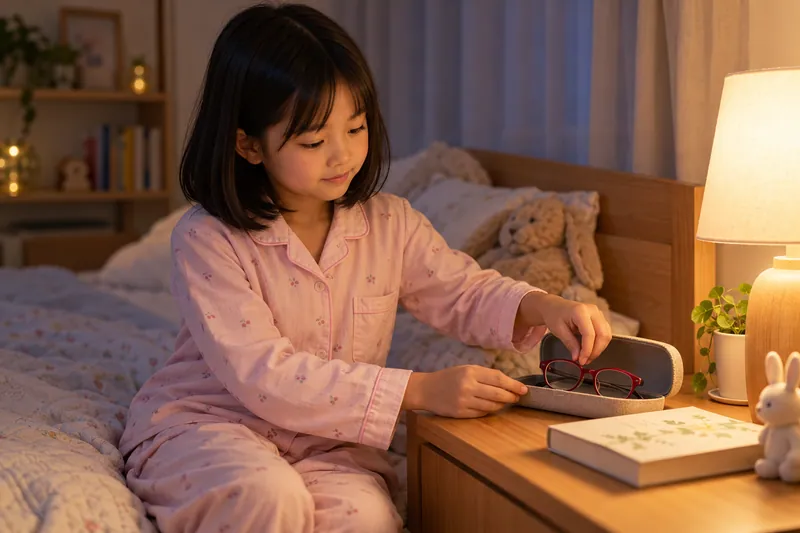
The illustration shows a child storing glasses before sleep. It is an organization example. A glasses case does not establish that a child has myopia or that the evening routine changes eye growth.
Leave room for different homes, shift work and shared rooms. If a routine fails because the environment cannot support it, focus on an achievable adjustment. A family should not have to purchase a complete set of sleep products before discussing what is making evenings hard.
Separate lens instructions from general sleep advice
The phrase “sleep and eyes” can become confusing when contact lenses are involved. Daily-wear contacts are not intended for sleep. Prescribed overnight orthokeratology has a different intended schedule and must follow the fitter's instructions. A child's actual lens type matters.
Do not change wear time, skip a required care step or borrow a sibling's routine to fit bedtime. Ask the prescriber what to do when sleep schedules are disrupted. The American Academy of Orthokeratology and Myopia Control (AAOMC) offers patient resources explaining Ortho-K and other myopia options, but individual instructions come from the fitting and care team. [5]
If drops are prescribed, keep the product's timing and storage instructions available. A general sleep-planning article cannot decide whether a missed dose should be moved, repeated or omitted. Contact the appropriate professional when instructions are unclear.
For travel and time-zone changes, the travel guide helps organize the questions before departure. Planning ahead is easier than inventing a new routine when everyone is tired in an unfamiliar place.
Notice when tiredness or visual symptoms need assessment
A child who seems tired may need a conversation about sleep, workload, health or emotional concerns. A child who describes blur may need an eye assessment. Both can be true at the same time. Avoid using one explanation to close the other route to care.
Describe what you notice. Does the child struggle to wake, fall asleep during the day or report that a particular task is hard to see? Does the difficulty happen with prescribed correction in place? These observations help the relevant clinician ask better questions.
Persistent sleep problems, significant daytime sleepiness or concerns such as repeated loud snoring should be discussed with the child's healthcare professional. Do not diagnose the cause from a sleep tracker or assume that a new pillow will resolve a wider problem.
Sudden vision loss, severe eye pain or an eye injury needs prompt medical attention rather than an experiment with an earlier bedtime. For persistent, less sudden vision concerns, contact the usual eye-care team and ask what to bring to the appointment.
Keep schoolwork and outdoor opportunities in proportion
Sleep can be squeezed by long work sessions, travel and activities. Look at the schedule with the child rather than treating bedtime as an isolated act of willpower. A difficult assignment may need help from a teacher; a care task may need earlier adult support.
A varied day can include appropriate outdoor opportunities and breaks from sustained close work. Those habits have their own reasons and evidence. They should not be used to claim that sleep alone prevents myopia or that enough outdoor time makes sleep unnecessary. [4]
If the family needs to change one part of the schedule, choose the pressure point that is most realistic to address. Perhaps supplies can be prepared earlier or an unclear assignment can be clarified before evening. An achievable change is more useful than a complete timetable nobody can maintain.
The study-session guide offers practical ways to organize learning. Use the pages together to support the whole day, while keeping diagnosis and treatment decisions with the professionals involved.
Judge the routine by its purpose
After trying a change, ask whether evenings are easier and whether the child has a reasonable opportunity for rest. That is the purpose of the sleep plan. It is not a home test of myopia control.
If symptoms or difficulties continue, share the actual pattern with the care team. A short description of what happens and when is more helpful than a claim that the child has “failed” at sleep. Bring relevant eye-care instructions if the routines are interacting.
Be careful with products promising that a lamp, supplement, sleep device or fixed bedtime will stop myopia. Ask what outcome was measured and whether the evidence applies to children like yours. General health benefits do not automatically establish an effect on eye growth.
Keep the next steps clear: support a workable evening, assess persistent concerns and attend the planned eye review. Sleep deserves attention because it matters to children. It does not need an exaggerated vision claim to justify that care.
Your evening routine review
Discussion prompts only. Checks stay on this open page; nothing is submitted or saved. This sheet does not diagnose, choose treatment or determine urgency. Do not delay urgent care to complete it.
CHECK THE EVIDENCE
Sources & references
Research, professional guidance and patient resources. Checked October 22, 2026.
- 1Sleep and HealthCenters for Disease Control and Prevention · 2026
- 2Sleep Patterns and Myopia Among School-Aged Children in SingaporeGUSTO cohort analysis · 2022
- 3Sleep Duration, Bedtime, and Myopia Progression in a 4-Year Follow-upAnyang Childhood Eye Study · 2020
- 4IMI Risk Factors for MyopiaInternational Myopia Institute · 2021
- 5Patient Resources: Myopia and OrthokeratologyAmerican Academy of Orthokeratology and Myopia Control (AAOMC)
General education. This article does not replace an eye examination, individual advice, or the prescribed care plan.