AN OUTDOOR OPPORTUNITY PLANNER
Two Hours Outdoors for Myopia: A Useful Goal, Not a Guarantee
Turn an outdoor-time goal into workable opportunities for your child. Use a day planner, access alternatives and clear limits on prevention claims.Build outdoor opportunities into the day ↓Understand the outdoor-time evidence →
More outdoor time may reduce the chance that myopia begins, but two hours is not a protective shield or a treatment dose. Evidence is less certain for slowing established myopia. Build safe, enjoyable daylight opportunities around the child’s needs, alongside examinations and any prescribed treatment.
On this page
A goal that should fit a real day
“Two hours outdoors” can sound simple until you try to fit it around school, work, transport, weather and a child’s needs. Some families have a garden and flexible afternoons. Others have unsafe roads, limited shade, mobility barriers or a school day that leaves little daylight at home.
Use the phrase as a planning goal, not a verdict on whether you are doing enough. The useful question is where safe outdoor opportunities can fit into the day. They can be shared between home and school and spread across several periods.
The International Myopia Institute identifies outdoor time as an important factor in myopia prevention and discusses about two hours daily as a practical target. It is not a promise that a child who reaches a particular minute will avoid myopia, or that a child who misses it has failed. [2]
First separate prevention from progression
A child who has not developed myopia and a child already being treated for it have different care questions. Outdoor research is more encouraging for reducing the development of myopia than for controlling progression once it exists.
A Cochrane review examined interventions intended to increase outdoor time. It found that these efforts may reduce the onset of myopia. Evidence about slowing progression was less certain. That is why an outdoor plan should sit beside an established treatment plan rather than replace it. [1]
VISUAL GUIDE 1 / 3
One routine, two different clinical questions
Outdoor-time interventions may reduce new myopia. That is the prevention question.
Evidence about slowing established progression is less certain. Keep the child’s clinical treatment and monitoring plan.
About two hours daily is a practical goal, not a proven protective threshold for each child or a promise that a prescription will remain stable.
If your child already wears myopia-control glasses, contact lenses or prescribed drops, do not stop or alter them because a new outdoor routine feels successful. Ask the clinician how the routine fits with the care already recommended and which measurements will be reviewed.
Likewise, a child who enjoys outdoor sports can still develop myopia. Time outside does not remove inherited risk, guarantee a stable prescription or make examinations unnecessary. The goal is a helpful opportunity, not a protective shield.
Count opportunities rather than chasing a perfect block
A family does not need to find an uninterrupted two-hour session. Look across the whole day: a school break, an outdoor lunch where permitted, time before pickup or a brief trip to a nearby accessible space.
Ask what the school already provides before adding more demands at home. A parent may not know whether breaks take place indoors, outside or in a covered area. Understanding the actual routine can reveal an opportunity without changing the school’s teaching priorities.
VISUAL GUIDE 2 / 3
Build from opportunities already in the day
| Opportunity | Who can help? | What to check? |
|---|---|---|
| Before school | Caregiver, where feasible | A safe route or accessible space; no requirement to add a journey. |
| School break | School staff | Supervision, shade and inclusion for the child’s needs. |
| Later daylight | Family or support person | An enjoyable activity, local conditions and a safe way home. |
Planning examples, not prescribed minutes or activities proven equivalent. Outdoor periods can be spread through the day.
Keep the plan easy enough to remember. For example, name the opportunity, the person who can help and the safe alternative if conditions change. You do not need to record every minute or send a child outside to complete a quota late in the day.
If a diary helps, use it briefly to notice patterns. Does the plan repeatedly fail because the activity needs a car, special equipment or an adult who is at work? Change that barrier rather than making the child responsible for it. A simpler routine often lasts longer than an ambitious schedule.
Outdoor time does not have to mean organized sport
Sport can be enjoyable, but competition, fees and transport are not requirements. Children may prefer birdwatching, chalk games, a conversation on a shaded path, gardening with suitable support or reading a story together in an outdoor space.
Choose activities that suit the child’s movement, sensory and communication needs. A wheelchair-accessible route, predictable quiet setting or place to sit can make participation more comfortable. Ask the child what would make the plan welcoming rather than assuming one activity works for everyone.
The outdoor environment matters more to this discussion than an exercise score. A child does not need to run continuously to make an outdoor break worthwhile. Physical activity has its own benefits, but it should not become a condition for including a child in the plan.
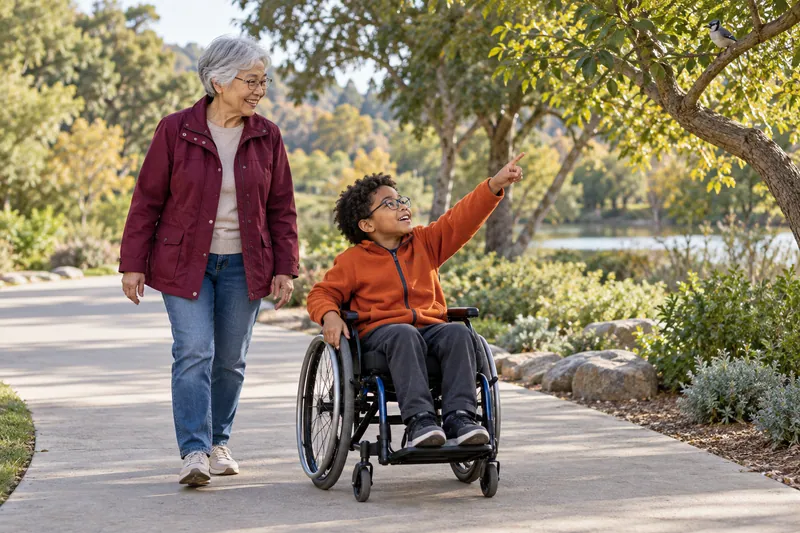
Avoid presenting the photograph on this page as a medical prescription. It illustrates one possible shared activity. The right setting for your family may look very different and may need advice from the child’s usual health or support team.
Protect the child while making the plan
More outdoor time does not mean more unprotected sun. The National Eye Institute recommends protecting eyes from ultraviolet exposure, including sunglasses that block 99–100% of UVA and UVB radiation. Appropriate shade, clothing and local sun-safety guidance still matter. Never look directly at the sun. [3]
Consider heat, air quality, storms, traffic and safe supervision. Follow local advice when conditions are unsafe. A myopia-related goal is not a reason to override a heat warning or take a child into an environment that creates another health risk.
For sports, use eye protection appropriate to the activity and the child’s vision needs. Everyday glasses and contact lenses are not automatically protective sports equipment. If you are unsure about what fits safely with the child’s correction, ask the eye-care team.
Bring ordinary practical needs into the plan too: water to drink, access to a toilet, a place to rest and a way home. These details can determine whether an outing is sustainable. They are not signs that a family is overcomplicating a simple recommendation.
When outdoor access is limited
Start by naming the actual problem. Is the route unsafe? Is the schoolyard inaccessible? Is the caregiver’s shift during daylight? Is the child uncomfortable in noisy spaces? The next step will differ for each barrier.
VISUAL GUIDE 3 / 3
Name the barrier before choosing Plan B
- Access problem?
Ask about an accessible route, place to sit, quiet setting or supervised school opportunity.
- Unsafe conditions?
Follow local heat, air-quality and weather advice. Change the time or activity; do not force the outing.
- Schedule problem?
Share opportunities across home and school rather than adding a commitment nobody can sustain.
- Still difficult?
Tell the eye-care team what is realistic. Keep correction, treatment instructions and follow-up steady.
School staff, community services or the child’s support team may know of options that are easy to miss. Ask a specific question, such as whether there is a supervised accessible outdoor break, rather than asking for a completely new daily program.
On a day when outdoor time is not practical, keep the rest of the child’s care steady. Use prescribed correction, protect scheduled follow-up and make required near tasks comfortable. A missed opportunity is not a reason to abandon the plan for the week.
A sunny window, indoor lighting product or a brief look toward a bright lamp should not be advertised as an equivalent myopia-prevention treatment. The evidence behind an outdoor recommendation does not automatically transfer to a product that resembles one part of the environment.
Ask the school for a workable contribution
A helpful conversation begins with shared aims: access to learning, safe breaks and an inclusive routine. Explain the child’s practical needs without asking a teacher to diagnose myopia or monitor a treatment.
You could ask when children usually go outside, whether a break can be taken in shade and how a child using glasses or mobility equipment can participate. If the school has weather-related restrictions, ask how families learn about them and whether an alternative opportunity exists.
Try to avoid making the child’s day feel like a medical checklist in front of classmates. A change that benefits the whole class may be easier to sustain and less likely to single out one pupil. The family can keep treatment details between the appropriate adults.
If the school cannot change a particular part of the timetable, note what is possible elsewhere. The plan can be shared across settings without assigning blame to a teacher or expecting the child to negotiate access alone.
What to discuss at the next eye appointment
Tell the clinician whether the child has myopia, what treatment is being used and what outdoor access is realistically available. Ask which part of the recommendation concerns prevention and which part concerns the child’s existing condition.
Clinical management includes more than lifestyle advice. The International Myopia Institute’s clinical guidance covers assessment, monitoring and a discussion of suitable management options. Outdoor time is one element of a broader conversation, not a substitute for establishing what is happening in the individual child’s eyes. [4]
Bring barriers into that conversation. “We can manage school breaks and a short accessible walk, but not a daily sports club” gives the clinician something useful to work with. You do not need to present a perfect schedule to deserve a thoughtful plan.
The American Academy of Orthokeratology and Myopia Control (AAOMC) offers patient resources about myopia and care options. Read them to prepare questions about the whole plan, including how routines, correction and follow-up work together. [5]
Build a routine you can revisit
Choose one or two opportunities that already fit the day. Agree on a safe backup, tell the adults involved and give the child a say in the activity. Review the plan after an ordinary week rather than judging it from the best or worst day.
Notice enjoyment and access as well as time. A child who feels included is more likely to return to the activity. If the plan creates repeated conflict, simplify it or change the setting. The goal is a sustainable part of family life, supported by appropriate eye care, rather than a daily test that nobody can pass consistently.
The family screen-use guide can help organize required and optional activities around the same day. If myopia is already diagnosed, the younger-child care discussion explains why individual assessment still matters.
Your outdoor opportunity plan
Discussion prompts only. Checks stay on this open page; nothing is submitted or saved. This sheet does not diagnose, choose treatment or determine urgency. Do not delay urgent care to complete it.
CHECK THE EVIDENCE
Sources & references
Research, professional guidance and patient resources. Checked October 21, 2026.
- 1Increasing time outdoors to prevent onset and progression of myopiaKido et al. · Cochrane · 2024
- 2IMI Risk Factors for MyopiaInternational Myopia Institute · 2021
- 3Healthy Vision Tips for KidsNational Eye Institute
- 4Clinical Management Myopia Guidelines ReportInternational Myopia Institute · 2019
- 5Patient Resources: Myopia and OrthokeratologyAmerican Academy of Orthokeratology and Myopia Control (AAOMC)
General education. This article does not replace an eye examination, individual advice, or the prescribed care plan.