A CHOOSE-YOUR-ACTIVITY GUIDE
Hobbies and Children’s Eyes: Choose Variety, Comfort and Protection
Adapt the hobbies your child enjoys with readable materials, useful protection and accessible choices. Avoid activities marketed as vision cures.Adapt the interest your child already enjoys ↓
A useful hobby plan mixes interests, viewing distances and opportunities outdoors. Reading, crafts and music remain valuable, even when they involve close work. Match text size, lighting, breaks and protective eyewear to the activity. No hobby or eye exercise has been shown to replace prescribed myopia management.
On this page
Keep the interest, then adapt the activity
A child who enjoys reading, drawing or music should not be told that a favorite hobby is ruining their eyes. Start with the interest and look at how the activity is done: viewing distance, text size, lighting, time without a change of task and any safety equipment required.
“Eye-friendly” is a useful phrase only when it leads to a practical question. Can the child see the material? Is the setup comfortable? Does the activity need protective eyewear? Does the wider day include opportunities to look around and go outdoors when feasible?
A hobby is not a treatment for myopia. Do not use an activity list to remove prescribed correction or replace follow-up. The National Eye Institute encourages healthy habits, appropriate protection and reporting vision changes as part of children's everyday lives. [1]
VISUAL GUIDE 1 / 3
Different hobbies, different demands
Text size, contrast and stable material
Detail size, support and any tool risks
Readable notation, listening and teacher sightline
Access, weather, supervision and sun protection
Useful vision and activity-specific protective eyewear
Purpose, usable display and opportunities to change tasks
The menu sorts recognizable activities by their demands. It does not score them as good or bad for a prescription, or rank them by a measured effect on eye growth. Use it to find variety and practical adjustments.
Read and make things without turning close work into a warning
Books, crafts and models can be valuable parts of childhood. Make the material usable. A larger-print book, clearer instructions or stable work surface may help a child participate without leaning unusually close or repeatedly losing their place.
Ask what is difficult before changing everything. A child making a small model may need better contrast or a different way to hold the piece. Another child may need instructions read aloud or an accessible digital version. The appropriate adjustment depends on the task and the person's needs.
Allow natural changes of activity. Finishing a page, putting materials away or going to another part of the room can create a pause. A break should support participation rather than imply that the hobby is dangerous or that the child must earn the right to continue.
If the child reports persistent blur or difficulty with current correction, arrange assessment. Do not assume a larger font has explained every symptom. For a detailed physical setup, see the reading-habits guide.
Let music offer a different kind of focus
Music can involve near material, a teacher across the room, an instrument and listening without looking at a page. Those demands vary by the activity. A pianist using small printed notation needs a different setup from a child learning a rhythm by ear.
Place the material where it is useful and stable. Ask whether the child can see the notes and the teacher comfortably with the prescribed correction. Avoid forcing an unfamiliar distance that makes the task less accessible. If equipment or support has been prescribed for another need, keep it in place.
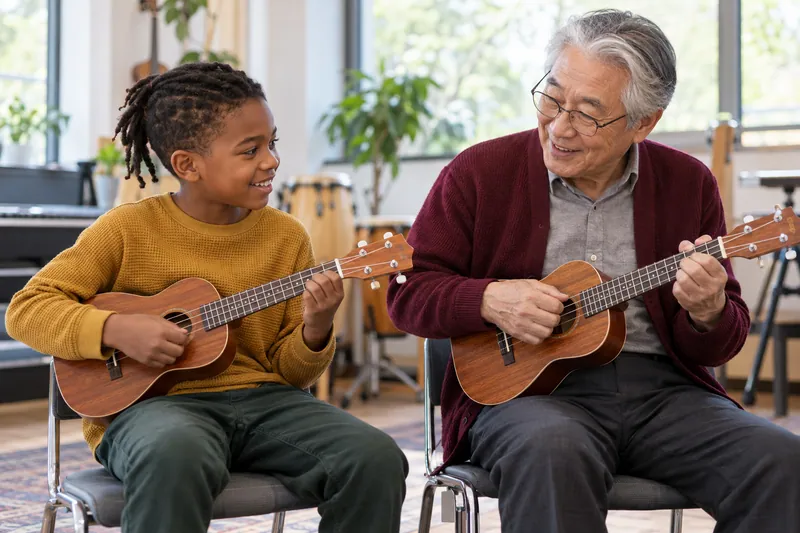
The illustration shows a child and an older adult learning ukulele together. It communicates the activity and shared attention. It does not demonstrate an improvement in vision or imply that musical practice is a myopia treatment.
The same principle applies to other interests: let the child enjoy learning, adapt the material and investigate persistent problems. A favorite activity can be worth keeping even when it requires a thoughtful setup.
Make protection part of the activity, not an afterthought
Different hobbies carry different risks. A ball game, a workshop task and a science activity should not all use the same eye-protection plan. Check the equipment and supervision appropriate to the activity before the child begins.
The National Eye Institute emphasizes protective eyewear for sports with eye-injury risks. Ordinary glasses or sunglasses are not substitutes for properly selected sports protection. Ask the eye-care professional how useful vision and suitable protection can be combined for the chosen activity. [2]
VISUAL GUIDE 2 / 3
Match the protection to the activity
| Activity | Ask about | Avoid assuming |
|---|---|---|
| Ball and racket sports | Suitable sport-specific protection with useful vision | Ordinary glasses are enough |
| Tools, chemicals or small projectiles | Required equipment and supervision | Educational means risk-free |
| Reading, crafts and music | Prescribed correction and usable material | A new safety product will treat myopia |
| Outdoor activities | Sun protection, local conditions and individual needs | Myopia prevention requires unprotected sun exposure |
The matching board makes the distinction visible. It is not a complete equipment standard for every sport or workshop. Follow the activity's current safety requirements and appropriate professional advice.
For hobbies involving tools, chemicals or small projectiles, use the relevant supervision and protection. Do not assume the word “educational” makes an activity safe without it. If a child cannot join using the current equipment, look for an adaptation rather than choosing between participation and eye safety.
Add outdoor interests that fit the child's preferences
An outdoor interest can be gentle or active. Birdwatching from an accessible path, sketching in a shaded courtyard or exploring a familiar park can be enjoyable alongside organized sport. The child does not need to become an athlete to have opportunities outdoors.
Ask what makes the idea appealing. A child who likes stories may enjoy inventing one during a walk. A child interested in building might help with a safe outdoor project. A teen may prefer choosing a route or talking with a friend in a suitable place.
Outdoor time has evidence for helping reduce the chance of myopia starting, while its effect on established progression is less certain. Do not attach a treatment promise to a particular hobby. [4]
The outdoor activity field guide gives more options for matching an activity to access and interests. Use sun protection, check conditions and adapt to individual needs. The goal is a varied routine that includes something the child wants to do again.
Use a swap that preserves what the child enjoys
A useful change keeps the appealing part of the hobby. If a child likes drawing, an occasional outdoor sketch session may offer variety. If they like a game, a shared non-screen version may be enjoyable. If they like making things, choose a project that can use a larger work area or different materials.
VISUAL GUIDE 3 / 3
Keep the interest, change the way of taking part
| The child enjoys | A possible variation | Purpose |
|---|---|---|
| Drawing | A shaded outdoor sketch or a larger work surface | Keep creating while adapting the setting |
| Stories | A shared story during a suitable walk or outdoor sit | Keep the story while changing the task |
| Making or building | A larger, accessible shared project | Keep the making with appropriate support |
| Games with others | A suitable non-screen game alongside digital play | Keep connection and add variety |
The swap board offers possibilities, not compulsory replacements. Reading remains worthwhile, and a child should not lose access to social connection or assistive technology simply because the activity involves a screen. Consider the role the activity plays before changing it.
Let the child test an idea and describe the experience. Did the alternative keep the part they enjoyed? Was it accessible? Did it require more support than expected? If the swap creates a new barrier, adapt it or choose another option.
Variety is the purpose. A different activity may change viewing demand or add an outdoor opportunity, but it does not establish a measured improvement in the child's myopia. Keep those claims separate.
Be cautious with hobbies sold as vision cures
Some activities are marketed as eye training that can eliminate glasses or reverse myopia. That is a different claim from making a task more comfortable. Ask what condition the activity is intended to treat, what outcome was measured and what evidence supports the promise.
UMass Chan Medical School's discussion of eye exercises explains the lack of good evidence for claims that general exercises eliminate the need for glasses or provide lasting correction of common focusing errors. This does not mean every clinician-directed exercise has the same purpose; treatment for a diagnosed binocular-vision problem is a separate discussion. [3]
Do not stop prescribed correction to try a hobby-based cure. A child should be able to participate with useful vision while the clinician manages any specific condition. Ask the prescriber directly when an online promise conflicts with the care plan.
The American Academy of Orthokeratology and Myopia Control (AAOMC) provides patient resources about myopia and management options. Use those alongside professional advice to understand the care discussion, without treating an activity list as an alternative prescription. [5]
CHECK THE EVIDENCE
Sources & references
Research, professional guidance and patient resources. Checked October 22, 2026.
- 1Healthy Vision Tips for KidsNational Eye Institute
- 2Sports and Your EyesNational Eye Institute
- 3Eye exercises to improve sight: is there any science behind them?UMass Chan Medical School · 2024
- 4IMI Risk Factors for MyopiaInternational Myopia Institute · 2021
- 5Patient Resources: Myopia and OrthokeratologyAmerican Academy of Orthokeratology and Myopia Control (AAOMC)
General education. This article does not replace an eye examination, individual advice, or the prescribed care plan.