A SYMPTOM-AND-ACTION GUIDE
Myopia Treatment Side Effects: What Needs a Call?
Find treatment-specific guidance on myopia care concerns, symptoms needing prompt help and the information to have ready when you call the practice.Symptoms happening now? Start here ↓
New pain, marked redness, light sensitivity, or sudden blur during contact-lens wear needs prompt eye-care advice. Remove the lenses and do not reinsert them while seeking care. Other symptoms need treatment-specific assessment. Do not assume a new symptom is harmless adaptation.
On this page
Start here if symptoms are happening now
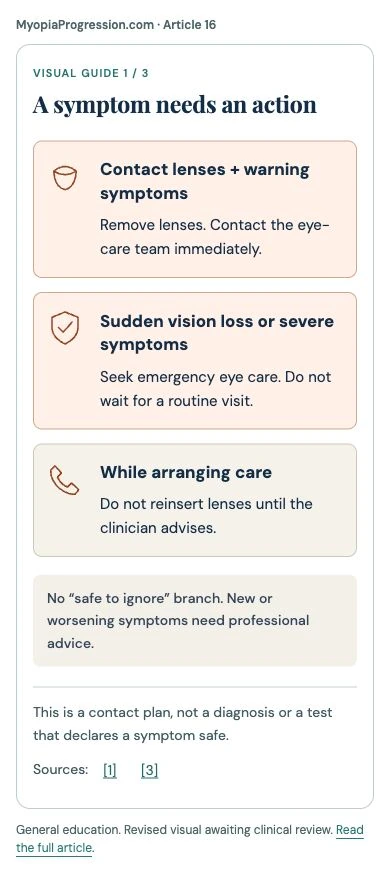
A child with eye pain, redness, light sensitivity, discharge, or a sudden change in vision needs advice from an eye-care professional. If contact lenses are being worn, remove them and contact the eye-care team immediately. Do not put them back in until the clinician says it is appropriate. The CDC lists these symptoms among warning signs of contact-lens-related infection. [1]
VISUAL GUIDE 1 / 3
A symptom needs an action
No “safe to ignore” branch. New or worsening symptoms need professional advice.
Do not use an article to decide that a painful red eye is simply adaptation. Problems that look similar at home can have very different causes. Contact-lens infections can threaten vision. If symptoms are severe, vision is suddenly lost, or urgent help from the usual practice is unavailable, seek emergency eye care. Do not wait for the next routine myopia review. [1][3]
This guide explains what to discuss and what information to have ready. It cannot examine an eye, rule out an infection, or tell you whether a symptom is safe to ignore. A photograph sent to a social-media group is not an adequate substitute for assessment.
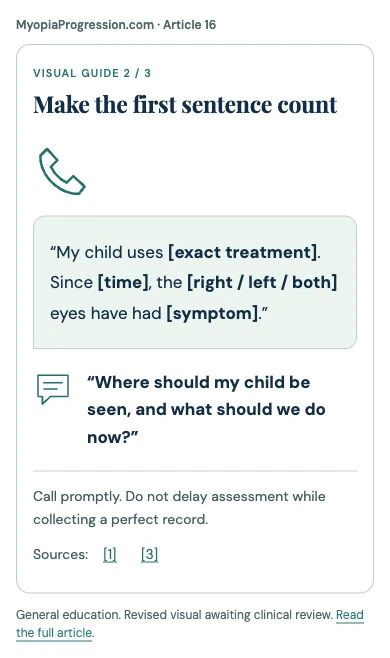
When calling, begin with the symptom and the treatment: “My child wears overnight contact lenses and has a painful red eye,” for example. Ask where the child should be seen and what to do with the lens, case, and products while arranging care. Do not delay the call while gathering a perfect record.
Sort the concern by the treatment being used
Myopia management includes different types of care. Specialty glasses, daytime soft contact lenses, overnight orthokeratology lenses, and atropine drops do not have the same practical risks. The exact product and prescription matter. “Myopia treatment” is too broad a description for someone trying to advise you over the phone.
Write down the product name, which eye is affected, when symptoms began, and whether the symptom is getting worse. Include any recent change in treatment or supplies. If you do not know a name, keep the labeled package available for the call. Do not guess the concentration of a medicine from the color of a bottle cap.
A side effect is not the only possible explanation for a new complaint. A poor fit, damaged lens, an unrelated eye condition, or another issue may need assessment. Likewise, a symptom that began after a change does not prove the new product caused it. The purpose of the call is to arrange a safe assessment, not to settle the cause at home.
A useful opening sentence
VISUAL GUIDE 2 / 3
Make the first sentence count
Since [time], the [right / left / both] eyes have had [symptom].”
Try: “My child is using [exact treatment]. Since [time], the right/left/both eyes have had [symptom]. We have/have not removed the contact lenses. What should we do now, and where should my child be seen?” Keep the description simple. The practice can ask for more details.
Glasses: fit and vision concerns still deserve a check
Glasses avoid contact-lens handling, but that does not make every visual complaint unimportant. If a child reports troublesome blur, headaches, distortion, or difficulty with steps after receiving glasses, contact the dispensing practice. Ask for the prescription, lens position, frame fit, and eye health to be assessed as appropriate. Do not tell a child to push through an unexplained problem indefinitely.
For a specialty myopia-control design, request the exact product information. The FDA's Stellest documentation is an example of why product-specific information matters: its authorized indication and study findings apply to that lens, rather than to every product marketed as myopia-control glasses. [6]
Describe where and when the problem occurs. “The frame slides during reading” is different from “vision suddenly became blurry this morning.” A child may need help finding the words, but avoid supplying the answer for them. Ask what looks different and what activity they were doing.
A broken or poorly fitting frame also raises a practical question: what vision correction should be used until it is repaired? Agree on that with the practice. Do not discard the current glasses or improvise a new wear schedule because an online comment calls a symptom normal.
Contact lenses: pain and redness are a stop-and-call signal
Contact lenses are medical devices. Both daytime wear and overnight Ortho-K need the prescribed care routine and follow-up. The FDA emphasizes that children need the maturity and support to follow lens instructions. A child who can insert a lens still needs to know when to stop wearing it and tell an adult. [3]
The CDC advises removing lenses and calling the eye-care professional right away for symptoms of microbial keratitis, including worsening pain, redness, light sensitivity, sudden blur, or unusual tearing or discharge. [1] Comfort earlier in the day does not rule out a problem now. Do not reinsert a lens to see whether it makes the eye feel better.
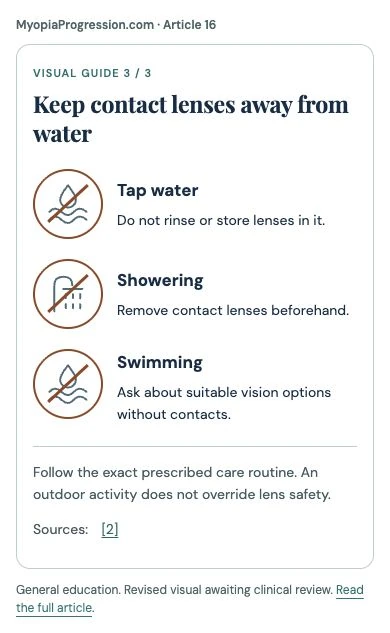
Do not rinse or store lenses in tap water, swim or shower in them, or substitute saliva for lens solution. Follow the specific prescribed cleaning and replacement instructions. Sleep in lenses only when the particular prescribed lens and care plan authorize overnight wear; that does not remove the need for hygiene or urgent assessment of symptoms. [2]
VISUAL GUIDE 3 / 3
Keep contact lenses away from water
If a lens is difficult to remove, follow the practice's instructions and seek help. Do not scrape at the eye or use a tool to retrieve it. If you are uncertain which supplies to bring to an urgent visit, ask while arranging the appointment. Do not delay care to wash or reorganize everything first.

Atropine: discuss light sensitivity, near blur, and unexpected symptoms
Atropine can affect pupil size and focusing at near. AAPOS describes light sensitivity and near-vision blur among possible effects. The prescribed concentration, formulation, and the individual child's experience matter. A child who struggles to read after a change needs that difficulty discussed with the prescriber. [5]
Do not change the concentration, dilute drops, or add another product to manage a symptom on your own. Ask the prescriber what to do about the next scheduled dose while the concern is assessed. Keep the pharmacy label and written instructions available. A concentration written as a percentage must be read exactly, including the decimal point.
Unexpected pain, discharge, a change in vision, or marked discomfort should not automatically be attributed to the expected focusing effects of atropine. The FDA advises stopping eye-drop use and contacting a health professional for warning symptoms such as these. [4] Explain which product was used and when, so the team can give instructions specific to the situation.
Eye drops must remain sterile. Wash hands as instructed and avoid touching the bottle tip to the eye, fingers, or other surfaces. Follow the product's storage and discard instructions. If a tip has been contaminated, the bottle looks wrong, or the label is unclear, ask the pharmacy or prescriber before using it. Do not assume all bottles have the same shelf life. [4]
Build a contact plan before you need one
At a routine appointment, ask for the daytime number, after-hours instructions, and the location of urgent eye care. Save those details where every caregiver can find them. A treatment plan that works in one home also needs a clear handoff to another home, a school nurse, or an adult supervising a trip.
Ask the child to practice saying one plain sentence: “My eye hurts, and I need to tell an adult.” They should not feel responsible for deciding whether a symptom is serious. Praise clear reporting rather than toughness. A child who worries about being blamed for missed wear may hide a problem that needs attention.
For school, distinguish treatment instructions from emergency instructions. Staff should know whom to call and what the family has arranged with the practice. Do not expect a teacher to diagnose a red eye or adjust a prescription. Keep medical details limited to what the responsible adults need to support the child.
Your symptom-call preparation
Discussion prompts only. Check marks stay on this open page; nothing is submitted or stored. This tool does not diagnose, choose a treatment, or set a dose.
Use the follow-up visit to improve the routine
After a concern is assessed, ask what the team believes happened and what should change. Request the instructions in writing if several adults share care. If the same difficulty recurs, describe it honestly. A routine that is too complicated to follow needs discussion, not a promise that the family will somehow manage it next time.
It can help to separate three questions: Is the eye healthy today? Is the treatment being used as intended? Is the myopia plan meeting its goals over time? Those questions may require different checks. Good distance vision does not answer all three, and a progression measurement does not rule out a new surface problem.
The American Academy of Orthokeratology and Myopia Control (AAOMC) offers patient resources that can help families prepare for conversations about myopia care. [7] For an active symptom, use the practice's urgent instructions rather than waiting to finish reading educational material.
A clear safety plan is practical: the child knows to speak up, caregivers know whom to contact, and the team has accurate treatment information. Keep that plan with the care instructions. When a new concern appears, ask for help early instead of trying to decide from a checklist that it must be harmless.
CHECK THE EVIDENCE
Sources & references
Primary research, guidance, and patient resources. Checked October 21, 2026.
- 1Contact lens-related eye infections: microbial keratitisCenters for Disease Control and Prevention
- 2Preventing eye infections when wearing contactsCenters for Disease Control and Prevention
- 3What to know if your child wants contact lensesU.S. Food and Drug Administration
- 4What you should know about eye dropsU.S. Food and Drug Administration
- 5Myopia and treatment of myopia in childrenAAPOS
- 6Stellest: De Novo authorization and exact starting indicationU.S. Food and Drug Administration · September 2025
- 7Patient resourcesAmerican Academy of Orthokeratology and Myopia Control (AAOMC)
General education. This article does not replace an eye examination, individual advice, or the prescribed care plan.