A TREATMENT-REVIEW DECISION PATH
When Is Combining Myopia Treatments Worth Discussing?
Considering a second myopia treatment? Use a decision path to review the current routine, the exact treatment pairing and added responsibilities.Follow the treatment-review decision path ↓
Combining treatments can be worth discussing when progression continues, but first check the measurements, the current routine, fit, and safety. Evidence differs between combinations. An add-on needs a clear goal and a monitoring plan agreed with the prescriber.
On this page
“The prescription changed. Do we need to add something?”
A prescription change can make a parent feel that the current plan has failed. Before adding another treatment, ask what the change means in the full record. Which eye changed? Were the measurements taken in a comparable way? How long was the interval? What was happening with the child's routine during that time?
A useful review starts with those questions. It does not start with the assumption that two treatments must be better than one. Sometimes a fitting problem, missed wear time, unclear instructions, or an incomplete set of measurements needs attention first. Sometimes the prescriber may recommend another approach or an add-on. The reason should be clear enough for the family to explain back.
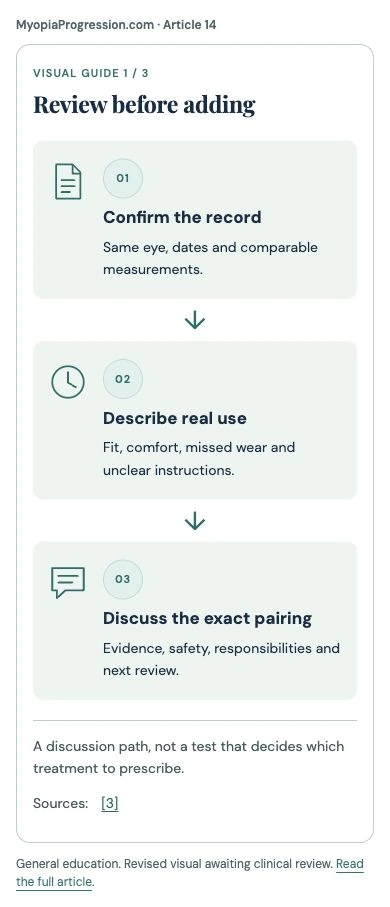
VISUAL GUIDE 1 / 3
Review before adding
Bring earlier prescriptions, eye-length results if available, and the name of the current treatment. Describe what happens on an ordinary day, including the difficult days. “We manage school nights, but the second household has trouble with the routine” gives the clinician something concrete to work with. It is more useful than reporting perfect use because you are worried about being judged.
Think of the appointment as a review of the whole plan. A child may need a change, but the decision should follow a discussion of the evidence, safety, responsibilities, and intended benefit. The International Myopia Institute's review describes evidence for particular combinations; it does not establish that every pairing has the same effect. [3]
First check what the current treatment is actually doing
Confirm the baseline. Ask which date the clinician is using as the start of comparison. A result recorded before fitting is different from a result recorded after a treatment was established. If records came from another practice, ask whether the tests and instruments can be compared directly.
Separate vision from progression. A child can see clearly and still need progression monitoring. With Ortho-K, changes to the corneal shape affect the glasses prescription, so reading the prescription alone does not provide the same information as tracking eye length. Ask how the practice evaluates each treatment's effect. [4][3]
Describe real use. Note when treatment is used, what is missed, and why. The problem might be discomfort, an awkward school schedule, lost supplies, or uncertainty about instructions. A practical change may be needed even when the treatment choice is otherwise suitable.
Look at the pattern. Ask whether one result is enough to justify a change or whether the clinician needs another check. There is no universal number on this page that labels a child a fast progressor or an inadequate responder. Age, the time between measurements, the treatment, and the rest of the examination matter.
These checks are not a reason to postpone necessary care. They help identify the problem that a proposed change is meant to solve. If the child has pain, redness, or a sudden change in vision, deal with the symptom promptly rather than waiting for a routine treatment review.
What “combination treatment” can mean
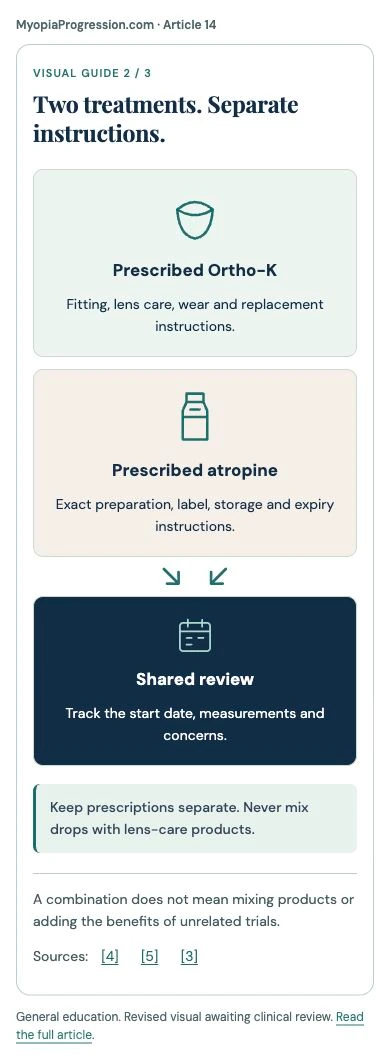
In myopia care, a combination may mean using an optical treatment and a medicine together. One researched example is low-concentration atropine with overnight Ortho-K. That does not mean putting drops on a lens, changing a lens-care solution, or making a mixture at home. Each part retains its own prescription and care instructions.
VISUAL GUIDE 2 / 3
Two treatments. Separate instructions.
Keep prescriptions separate. Never mix drops with lens-care products.
It also does not mean that adding ordinary glasses to drops automatically provides two independent myopia-control effects. Glasses may be necessary to correct distance blur while a medicine is being used. Vision correction and a second progression-control treatment are different roles. Ask the clinician to name the purpose of every part of the plan.
Likewise, outdoor opportunities can support a child's daily habits, but describing them as a “combination” should not make the effect of prescribed treatments seem interchangeable with a lifestyle target. The useful question is specific: “Which intervention are we adding, for what reason, and how will its contribution be assessed?”
Use exact names in the written plan. A note that says only “continue lenses and add drops” can become confusing when there are backup glasses, multiple bottles, or different caregivers. Ask for the lens type, medicine formulation, prescribed schedule, and contact details to be recorded together.
Evidence belongs to the exact pairing
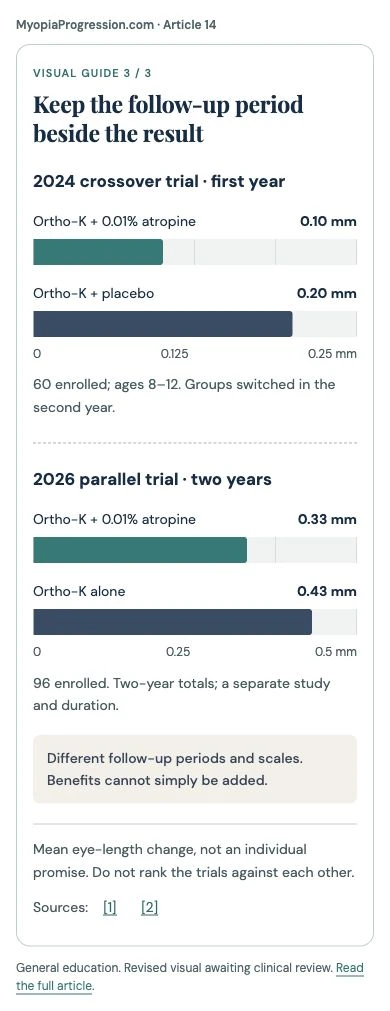
A 2024 randomized crossover trial enrolled sixty children aged eight to twelve in China. It compared Ortho-K with 0.01% atropine against Ortho-K with placebo drops. In the first year, average eye-length growth was 0.10 mm in the combination group and 0.20 mm in the control group. The groups changed treatment for the second year. [1]
That is evidence about an additional effect within a specific trial. It is not evidence that the benefits of separate Ortho-K and atropine trials can simply be added together. The crossover design, small sample, ages, treatment duration, and study setting limit the conclusions that can be drawn for another child.
A later two-year multicenter randomized trial in China studied ninety-six children. Average axial elongation was 0.33 mm with the combination and 0.43 mm with Ortho-K alone. That supports discussing a possible added benefit, while also showing that progression was not eliminated. These results do not guarantee the same difference for an individual patient. [2]
VISUAL GUIDE 3 / 3
Keep the follow-up period beside the result
2024 crossover trial · first year
60 enrolled; ages 8–12. Groups switched in the second year.
2026 parallel trial · two years
96 enrolled. Two-year totals; a separate study and duration.
Different follow-up periods and scales. Benefits cannot simply be added.
Evidence for one pairing does not settle questions about another optical design, a different atropine formulation, a different concentration, or a different population. If a proposed combination is newer or less studied, ask the clinician to explain what is known and what is being inferred. An honest statement of uncertainty is part of informed care.
Ask about harms and inconvenience as well as the main outcome. A study reporting slower eye growth is not, by itself, a complete account of how easily families used the routine or what happened over many more years. Read the duration and safety reporting beside the result.

Decide whether the added responsibilities are workable
An add-on can create a second supply chain. You may need to manage pharmacy refills as well as lens replacements, separate storage instructions, more appointments, and a plan for travel. Before agreeing, walk through a typical evening and a typical morning. Let the child identify the step they are most concerned about.
For contact lenses, maintain the exact hygiene, replacement, and water-avoidance instructions. Overnight wear should occur only with lenses specifically prescribed for that purpose. Adding a medicine does not remove the need for lens safety or scheduled eye-health checks. [4]
For a compounded medicine, ask which pharmacy supplies it, what the label says, and what storage and expiry instructions apply. The FDA explains that compounded drugs are not FDA-approved and may carry quality risks. A second intervention is not a reason to improvise a concentration or use an unverified source. [5]
Ask what to do if one part is temporarily unavailable. Do not assume that the other part should be increased to compensate. Also ask what to do if a symptom occurs: whom to contact, how quickly, and what instructions apply while awaiting assessment. Put those answers beside the routine, not in a separate email that another caregiver may never see.
A workable plan respects the child's growing independence. Explain the purpose in plain language and divide responsibilities fairly. A younger child should not be responsible for judging whether their eye growth is acceptable or whether a medicine needs changing.
Agree on what the next review will decide
Request a review date and the measurements that will be considered. Ask the prescriber to explain what would count as a useful response, what would prompt another assessment, and what side effects would change the plan sooner. A promise to “see how it goes” is harder to use than a shared understanding of the next decision.
Keep the before-and-after comparison anchored to actual dates. If treatment changes halfway between visits, record when the new routine started. Otherwise, an interval can include both the old and new plans, making the result harder to interpret. This is a record-keeping point, not a request to measure a child's eyes at home.
Discuss the full cost of the additional care. Ask whether new fitting, measurements, or follow-up are included in an existing package or billed separately. Check replacement and cancellation arrangements. More expense does not prove more benefit, but unexpected costs can make an otherwise agreed routine difficult to sustain.
Your combination-treatment review
Discussion prompts only. Check marks stay on this open page; nothing is submitted or stored. This tool does not diagnose, choose a treatment, or set a dose.
Leave room for a clear, unhurried decision
You can ask for the proposed plan in writing and return with questions, unless the clinician identifies a reason that care is urgent. Separate a decision about progression management from immediate care for a painful or suddenly blurry eye. The time available for one decision may be very different from the other.
The American Academy of Orthokeratology and Myopia Control (AAOMC) provides patient information. [6] The Ortho-K guide and atropine evidence notebook can help you prepare more focused questions about the proposed pairing.
Before the visit ends, try a short summary: “We are considering adding this because of these results. These are the new responsibilities. This is when we will review it.” Ask the clinician to correct anything missing. The goal is a shared plan the family can understand, rather than a collection of products that no one has explained together.
CHECK THE EVIDENCE
Sources & references
Primary research, guidance, and patient resources. Checked October 21, 2026.
- 1Atropine plus Ortho-K: randomized crossover trialLi et al. · Frontiers in Medicine · 2024
- 2Combined atropine and Ortho-K: two-year multicenter randomized trialYuan et al. · Frontiers in Pediatrics · 2026
- 3Interventions for controlling myopia onset and progressionInternational Myopia Institute · 2025
- 4Types of contact lenses: orthokeratologyU.S. Food and Drug Administration
- 5Understanding the risks of compounded drugsU.S. Food and Drug Administration
- 6Patient resourcesAmerican Academy of Orthokeratology and Myopia Control (AAOMC)
General education. This article does not replace an eye examination, individual advice, or the prescribed care plan.