A SCHOOL CONVERSATION KIT
Myopia at School: Practical Changes Parents Can Request
Ask for practical classroom support for a child with myopia. Make materials readable, agree on adult roles and prepare a useful school request.Prepare a specific school request ↓
Ask for readable classroom material, access to prescribed glasses, appropriate breaks, safe outdoor opportunities and a clear route for reporting vision concerns. Schools support learning and screening; an eye-care professional diagnoses and manages myopia. Start with one observable problem and one workable request.
On this page
Begin with the task the child cannot see
“My child has myopia” tells a school part of the story. “The projected instructions are hard to read from the current seat, even with glasses” gives the teacher something practical to investigate. Start with the activity that is difficult and the support that might help.
Ask your child when the problem happens. A board, tablet, worksheet and outdoor sports lesson each make different demands. Find out whether the difficulty is constant, whether glasses are being worn as directed and whether something has changed. Record the observation without trying to diagnose it yourself.
The school can adjust learning access and tell you what staff notice. An eye-care professional checks the eyes and current correction. These responsibilities can work together. A seating change may help the next lesson while you arrange an examination; it does not prove that the prescription is correct.
A request works best when it is specific enough to try. Agree who will act, what the child should report and when to check back. That is more useful than asking everyone to “be careful with screen time.”
VISUAL GUIDE 1 / 3
From classroom problem to a request someone can try
| Observation | Practical request | Check back on |
|---|---|---|
| Projected text is hard to read | Try a clearer copy or suitable viewing position | Can the child use the actual material? |
| A reflection covers the display | Review the light source and sightline | Does the adjustment improve access? |
| Glasses are missing during lessons | Agree a storage and help routine | Are correction and support available? |
| Blur persists with glasses | Arrange eye-care follow-up alongside support | What does the examination show? |
Make classroom material readable
Ask about the actual format of the lesson. A child may read a paper worksheet comfortably but struggle with a photograph of that worksheet on a small screen. Enlarging the source, providing a clearer copy or allowing a suitable viewing position can make participation easier.
Discuss reflections and sightlines. A shiny display near a window can be difficult to use from one position. Try a practical adjustment with the teacher rather than prescribing a particular brightness level from home. Comfortable lighting advice is about access and symptoms, not evidence that a classroom lamp will stop myopia.
If a child uses magnification, assistive technology or specialist seating, keep the relevant support team involved. Do not remove an accommodation to meet a generic rule about viewing distance. The task should be accessible to the individual child.
The American Academy of Pediatrics describes screen placement, glare and breaks as practical issues when children use computers. Use that guidance as a starting point for a conversation, not a furniture specification every classroom must copy. [3]
Give glasses a place in the school day
A prescribed pair of glasses needs to be available, usable and worn according to the child's instructions. Ask where the case can stay and what the child should do if the frame breaks, slips or becomes uncomfortable. A storage plan is particularly useful around sports, changing rooms and after-school clubs.
Avoid making the child choose between seeing and feeling embarrassed. A quiet reminder can be agreed privately. If glasses are repeatedly left in the bag, ask why before assuming defiance. The frame may hurt, lenses may be scratched or the child may be worried about comments.
Teachers should not change a prescription or decide whether a child can stop using correction. If a problem continues with glasses in place, tell the eye-care team. Bring the glasses and describe the school task that remains difficult.
A class can also support ordinary respect. The goal is for the child to join the lesson, not become the subject of a public demonstration about eye health. Share only the information needed for practical support.

Discuss outdoor opportunities with realistic expectations
Schools can create outdoor opportunities through breaks, play and suitable lessons. Ask what already happens before proposing a new program. A shaded courtyard session may be easier to arrange than a complete timetable change. Weather, staffing, safety and accessible routes all matter.
Research supports outdoor time as a way to reduce the chance of myopia starting in children. Its role in slowing established myopia is less certain. A school outdoor policy therefore supports a wider prevention approach, while individual treatment and monitoring stay with the child's clinician. [4]
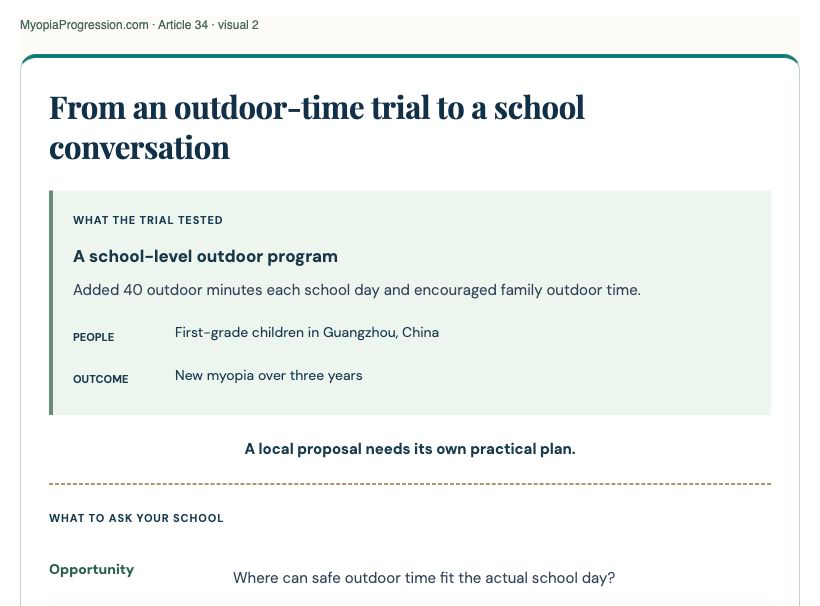
One trial offers a useful example, but it needs its setting. In a 2015 Guangzhou school study, an additional outdoor class was associated with fewer new cases over three years. The visual separates the studied program from questions for a local proposal. The trial is not a promise for another school or a measure of benefit for a child already diagnosed. [1]
From an outdoor-time trial to a school conversation
Added 40 outdoor minutes each school day and encouraged family outdoor time.
- People
- First-grade children in Guangzhou, China
- Outcome
- New myopia over three years
Where can safe outdoor time fit the actual school day?
Who checks inclusion, supervision, shade and local conditions?
Who checks whether the agreed opportunity happens and is usable?
This does not predict your school’s result, prescribe a universal 40-minute threshold or show slower progression after diagnosis.
A request can acknowledge these limits: “Could we discuss safe outdoor opportunities within the school day?” There is no need to tell a teacher that one missed break damaged the child's eyes.
Separate a screening result from an examination
School screening can help identify a child who needs further assessment. It is a valuable route to care, especially when symptoms are not obvious. Ask for the result, what it means and how the school communicates a referral to families. [2]
A passed screening is not a complete answer to every visual complaint. If your child still reports difficulty, explain that concern to the usual care team. Similarly, a referral does not establish that the problem is myopia. Follow the recommendation for an examination rather than trying to interpret the result from a photograph of a form.
Keep the school informed when a follow-up produces a practical change. That might be new correction, a different support need or an appointment that affects attendance. Share the relevant instruction without distributing a full medical record to everyone involved.
If a referral is hard to complete, tell the school nurse or appropriate staff member. They may be able to explain local support routes. The important step is an actual follow-up plan, rather than a form that stays at the bottom of the school bag.
Agree who does what
The child should know how to ask for help. The family should know how to contact the care team. Staff should know what support was agreed and what to do if something changes. Clear responsibilities make the plan easier to maintain through substitute teachers and new terms.
For a simple access request, ask who can coordinate it. Depending on the school, that may be the classroom teacher, nurse, learning-support lead or another staff member. A school can explain its own procedures; this article does not determine legal eligibility or promise a particular accommodation.
VISUAL GUIDE 3 / 3
Who answers which school question?
| Question | Best starting point | What this does not replace |
|---|---|---|
| Can the child access this lesson? | Teacher and learning-support staff | The eye examination |
| Did screening identify a concern? | School screening contact and family | Diagnostic follow-up after referral |
| Is the correction or care plan suitable? | The professional who examines the child | A classroom impression |
| Who acts on the agreed change? | Named coordinating adult | An assumed message carried by the child |
Do not ask staff to monitor myopia progression by comparing how often the child squints. Observations are useful, but clinical measurements answer a different question. The same applies to treatment: school staff need the actual instructions and applicable school process before helping with any prescribed care.
When several adults are involved, use a short written record of the agreed action and contact. Avoid a long list of medical rules that nobody can realistically follow during a busy lesson.
Write a request that invites a response
A first message can be brief. Describe the observation, name the task and suggest a conversation. For example: “Sam says the projected text is difficult to read from the current seat. We are checking the glasses and arranging follow-up. Could we try a clearer copy or another suitable position while we work on this?” This is a fictional example, not a required script.
Ask the teacher what they notice. Perhaps the difficulty appears only with one resource or one part of the room. That information can improve the adjustment and help you describe the problem at an examination.
Agree a practical review point. It could be after the next few relevant lessons or when new correction arrives. The purpose is to check whether access improved, not to score the teacher or test a treatment effect.
Keep routine support separate from urgent symptoms. A child with sudden vision loss, severe pain or an eye injury needs prompt medical attention, not a wait for the next school meeting. Follow the school's emergency process and seek appropriate care.
Keep the conversation connected to the care plan
Ask the eye-care professional which school difficulties are relevant to the examination and what support would help. A written note may be useful when the school needs a clear explanation. Ask questions about the child's actual tasks rather than requesting a general declaration that screens are harmful.
The American Academy of Orthokeratology and Myopia Control (AAOMC) provides parent resources for understanding myopia and care options. Use them to prepare for the clinical discussion. They do not replace the school's process or establish that a particular treatment belongs in a classroom plan. [5]
For home study, the homework guide addresses routines outside school. The axial-length guide explains why clinical measurements cannot be replaced by classroom impressions.
End with a manageable next step: the child can see the material, the teacher knows the agreed support, and the family knows what follow-up is needed. A school plan is successful when it helps the child participate and keeps concerns moving toward the right person.
Your school conversation
Discussion prompts only. Checks stay on this open page; nothing is submitted or saved. This sheet does not diagnose, choose treatment or determine urgency. Do not delay urgent care to complete it.
CHECK THE EVIDENCE
Sources & references
Research, professional guidance and patient resources. Checked October 22, 2026.
- 1Effect of Time Spent Outdoors at School on the Development of Myopia Among Children in ChinaHe et al. · JAMA · 2015
- 2Vision Screening RecommendationsAmerican Association for Pediatric Ophthalmology and Strabismus
- 3How can I help my child avoid eye and back strain from being on the computer?American Academy of Pediatrics
- 4IMI Risk Factors for MyopiaInternational Myopia Institute · 2021
- 5Patient Resources: Myopia and OrthokeratologyAmerican Academy of Orthokeratology and Myopia Control (AAOMC)
General education. This article does not replace an eye examination, individual advice, or the prescribed care plan.